A weight-loss percentage can travel farther than the evidence behind it. On a treatment-shopping page, a trial average may appear close to a company’s enrollment button, making two different propositions feel connected: tirzepatide produced weight loss in a randomized trial, and this particular service will deliver that outcome. SURMOUNT-1 supports the first proposition within defined boundaries. It did not test the second. Reading it well means keeping the study population, treatment groups, time frame and tolerability findings attached to its headline results.
For adults in the United States evaluating GLP-1 services, that distinction is practical rather than academic. Public documentation can establish that a company advertises a medication, describes consultations or offers follow-up messaging. It cannot, by itself, establish that its patients achieved a published trial average. This guide explains the complete SURMOUNT-1 comparison available in the consulted research, then uses documented offerings from several providers to show where clinical evidence ends and service-specific questions begin. Public pages and clinical references were consulted October 19, 2026; that is not necessarily their update date.
At a glance
- Population and design
- SURMOUNT-1 was a double-blind randomized trial of 2,539 adults with obesity or overweight plus a weight-related complication, excluding diabetes.Sources: [3]
- Duration and treatment groups
- The trial lasted 72 weeks and compared studied subcutaneous tirzepatide groups of 5, 10 and 15 mg weekly with placebo. These are study-arm descriptions, not treatment instructions.Sources: [3]
- Mean weight change
- Mean changes were −15.0%, −19.5% and −20.9% for the respective tirzepatide groups, compared with −3.1% for placebo.Sources: [3]
- Adverse-event discontinuation
- Discontinuation because of adverse events occurred in 4.3%, 7.1% and 6.2% of the respective tirzepatide groups and 2.6% of placebo; gastrointestinal events were most common.Sources: [3]
- Funding and applicability
- Eli Lilly funded SURMOUNT-1. The trial did not measure the performance of any provider discussed here or establish outcomes for its compounded products.Sources: [3]
Start with the question the trial actually answered
SURMOUNT-1 compared defined tirzepatide treatment groups with placebo over 72 weeks. Randomization and double blinding are central to understanding the evidence: this was a controlled treatment comparison, not a collection of customer experiences or a survey of people who successfully remained on medication. Its 2,539 participants were adults with obesity, or overweight accompanied by a weight-related complication. People with diabetes were excluded, an essential qualification whenever its results are summarized.
Those boundaries matter when a prospective patient recognizes only part of themselves in the description. A person’s interest in weight management does not make them interchangeable with the study population. Nor does a provider’s willingness to evaluate someone establish that the trial directly represents that person. NIDDK advises discussing benefits, side effects, current conditions, other medicines, family history and costs with a clinician. Trial inclusion and individual prescribing are related questions, but they are not the same decision.
Keep every result attached to its group
The most useful way to read the results is as four parallel groups, not one maximum number. At 72 weeks, mean weight changes were −15.0% with studied subcutaneous tirzepatide 5 mg weekly, −19.5% with 10 mg weekly and −20.9% with 15 mg weekly, versus −3.1% with placebo. These doses identify research groups only. They are not instructions about starting treatment, increasing a dose or choosing a target dose.
A mean describes a group average, not the outcome every participant experienced or the result a new patient should expect. Selecting only the largest mean also removes the other studied groups and the comparator from view. Keep the duration visible as well: a 72-week outcome is not a prediction for the first shipment or first billing cycle. Our guide to average weight change and individual expectations explains why a precise research number can still be an imprecise personal forecast.
| Studied group | Mean weight change | Discontinued because of adverse events |
|---|---|---|
| Subcutaneous tirzepatide, 5 mg weekly | −15.0% | 4.3% |
| Subcutaneous tirzepatide, 10 mg weekly | −19.5% | 7.1% |
| Subcutaneous tirzepatide, 15 mg weekly | −20.9% | 6.2% |
| Placebo | −3.1% | 2.6% |
Read tolerability beside weight change
The most common adverse events in SURMOUNT-1 were gastrointestinal. Discontinuation because of adverse events occurred in 4.3% of the 5 mg group, 7.1% of the 10 mg group and 6.2% of the 15 mg group, compared with 2.6% of placebo. These percentages belong beside the weight results. They show that treatment tolerability was part of the observed experience, not an optional footnote to an efficacy claim.
Discontinuation is also a specific outcome, not a count of everyone who experienced any side effect. It should not be relabeled as the trial’s overall adverse-event rate. Likewise, FDA reports concerning unapproved GLP-1 drugs cannot supply a substitute provider-specific rate: those reports lack a denominator for calculating incidence and do not automatically establish causation. A trial comparison, a spontaneous safety report and a company’s customer-support statement answer different questions.
Funding belongs in the summary, not outside it
Eli Lilly funded SURMOUNT-1. A complete short account should disclose that fact alongside the design, population, duration, results and adverse-event discontinuation. Funding disclosure identifies relevant context; it does not, on its own, invalidate a randomized trial or justify ignoring its findings. Conversely, presenting a study as published research does not make its funding irrelevant. Readers should be able to see both the evidence and its provenance without having to reconstruct missing qualifications.
The same discipline rules out a shortcut often used in treatment shopping: putting SURMOUNT-1 percentages beside STEP 1 percentages and declaring a head-to-head winner. Comparing separate studies is not a randomized direct comparison. This guide therefore makes no numerical cross-trial ranking. More importantly, neither trial can rank the telehealth companies that cite it. As our explanation of trials versus company performance reports emphasizes, evidence about a treatment does not become measured evidence about a service merely through proximity.
An ingredient name does not close the formulation gap
CoreAge Rx describes a telemedicine service offering compounded semaglutide and tirzepatide. Its FAQ says compounded tirzepatide is typically formulated with B-12, with a formulation without B-12 subject to discussion with the provider. It also markets a separate Tirzepatide Microdosing Therapy. These are documented offerings, not SURMOUNT-1 treatment arms. The trial does not establish outcomes for that vitamin blend, a microdosing program or the company’s overall care model.
Enhance.MD likewise documents distinct products: GLP-1 Advanced uses compounded tirzepatide, while GLP-1 Elite combines semaglutide and tirzepatide in an injectable formulation. Found markets compounded tirzepatide and separately advertises compounded semaglutide microdosing. FDA states that compounded preparations are not approved and lack its premarket review for safety, effectiveness and quality. That alone proves neither clinical equivalence nor inequivalence. FDA recommends compounded drugs when an individual’s needs cannot be met by an approved drug, with a prescription and a state-licensed pharmacy.
Provider documents establish services, not trial-level outcomes
Ro describes an initial review of medical history, lifestyle and goals, with a professional deciding eligibility. Its Ro Body membership documents individual messaging, regular check-ins, coaching and laboratory testing if necessary; medication costs are separate. Sesame describes a video consultation, possible laboratory testing and continued video care and messaging. Its terms explicitly say a prescription is not guaranteed. Those details help explain what a patient purchases and how evaluation works, but they do not establish either service’s average weight outcome.
Walgreens describes an initial on-demand video visit for qualified general-program patients, with most subsequent visits conducted through chat and additional video available. Its documentation identifies prescribers as doctors or nurse practitioners. Enhance.MD separates its administrative platform from clinical decision-making and states that payment does not guarantee prescribing or dispensing. These distinctions identify responsibilities. They are useful evidence about delivery, not evidence that one company reproduces SURMOUNT-1 more faithfully than another. See our guide to what public provider documents can prove.
Ask how follow-up and pharmacy responsibilities work
Found says its team follows compounded-tirzepatide patients monthly and provides messaging between visits. Its documentation distinguishes insurance-based synchronous video visits before each refill from mostly asynchronous text care for cash-pay patients. CoreAge Rx advertises ongoing provider access, but its 24/7 support heading is developed with language about customer service. Ro advertises access to its care team around the clock without specifying a response deadline. None of those statements should be converted into a promise of immediate prescriber availability.
Pharmacy arrangements deserve equally concrete questions. CoreAge Rx’s FAQ requires its affiliated pharmacy network, while its terms allow requesting a pharmacy of choice before ordering; that conflict needs clarification. Enhance.MD permits an outside pharmacy but says medication is then billed separately. For delivered injectables, clinical handling advice matters beyond marketing: FDA explicitly recommends not using a GLP-1 injectable that arrives warm or inadequately refrigerated and contacting the provider or dispensing pharmacy. SURMOUNT-1 does not verify any company’s shipping practices.
Build a claim that retains its boundaries
A responsible summary can be compact: SURMOUNT-1 was an Eli Lilly-funded, double-blind randomized trial in 2,539 adults with obesity or overweight plus a complication, without diabetes, comparing three studied subcutaneous tirzepatide groups with placebo over 72 weeks. Report the group-specific averages and adverse-event discontinuation together. Then state what the study did not test: the reviewed providers, their compounded preparations or an individual patient’s likely outcome. Removing those boundaries changes the claim rather than merely shortening it.
For service selection, build a separate list: exact product and formulation, consultation process, prescribing responsibility, pharmacy identity, follow-up access and financial obligations. NIDDK notes that medication selection includes cost and that follow-up concerns both tolerance and response. Use our medical-claims checklist to keep research questions separate from enrollment questions. A service may document useful support while lacking published outcomes; that is a limit on what can be concluded, not proof that the support is ineffective.
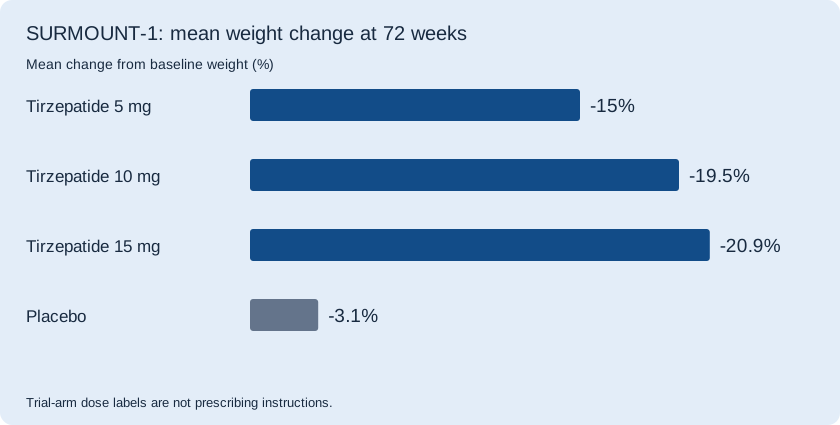
SURMOUNT-1: mean weight change at 72 weeks
Double-blind randomized trial of 2,539 adults with obesity or overweight and a weight-related complication, excluding diabetes. Tirzepatide study groups received weekly subcutaneous injections. Doses identify trial groups, not instructions for use.
Gastrointestinal adverse events were most common. Discontinuation due to adverse events was 4.3%, 7.1% and 6.2% in the respective tirzepatide groups and 2.6% with placebo. Funded by Eli Lilly. These results do not establish provider or compounded-product outcomes. This is not a head-to-head comparison with STEP 1.
Read the original study ↗View the underlying data table
| Study group | Mean weight change (%) | Stopped for adverse events (%) |
|---|---|---|
| Tirzepatide 5 mg | -15 | 4.3 |
| Tirzepatide 10 mg | -19.5 | 7.1 |
| Tirzepatide 15 mg | -20.9 | 6.2 |
| Placebo | -3.1 | 2.6 |
Questions & answers
Does CoreAge Rx’s tirzepatide with B-12 inherit the SURMOUNT-1 results?
No. CoreAge Rx documents that its compounded tirzepatide typically contains B-12. SURMOUNT-1 does not establish outcomes for that formulation or the company. Ask which formulation would actually be prescribed and what evidence supports claims made specifically about it.
Does Enhance.MD’s Elite combination have evidence from this trial?
SURMOUNT-1 does not establish results for Enhance.MD’s injectable combination of semaglutide and tirzepatide. Elite is a distinct documented offering. Its commercial positioning should not be treated as a trial finding or as evidence of superiority over the studied tirzepatide groups.
Does Ro’s ongoing messaging prove better outcomes?
Ro documents individual messaging, check-ins and coaching within its membership, with medication billed separately. Those are service features, not comparative outcome data. They may inform questions about support, but SURMOUNT-1 cannot establish that Ro performs better than another provider.
Can Sesame guarantee a prescription because the trial showed benefit?
No. Sesame’s terms make prescribing dependent on professional discretion and medical necessity and explicitly provide no prescription guarantee. The trial’s population-level findings do not override an individual evaluation or establish that a particular medication is appropriate for a prospective patient.
Is Walgreens pharmacy chat the same as prescriber follow-up?
No. Walgreens documents 24/7 pharmacy-expert chat, while its weight-management service separately describes clinician follow-up visits. The pharmacy chat may involve waiting and is not for emergencies. Its availability does not establish immediate prescriber access or eliminate separate clinician-visit charges.
Do Found’s testing claims make its compounded medication trial-equivalent?
Found states that its compounded semaglutide receives third-party potency, purity and sterility testing. That claim is not a clinical outcome comparison, and SURMOUNT-1 studied tirzepatide rather than that product. Quality-testing statements and evidence of clinical equivalence require separate evaluation; neither should substitute for the other.
Our assessment
SURMOUNT-1 provides substantial randomized evidence for its studied tirzepatide groups over 72 weeks, with meaningful weight-change findings and relevant tolerability limits. Its value is strongest when the population, route, groups, comparator, funding and discontinuation results remain visible. It cannot select a telehealth company or validate a compounded formulation by association. Evaluate providers on separately documented responsibilities and services, and bring the treatment evidence to a clinician rather than turning it into a commercial leaderboard.
Sources & documentation
Public materials consulted October 19, 2026. Provider statements are attributed claims, not independently verified clinical outcomes. Terms can change; obtain a current written quote.
- FDA concerns with unapproved GLP-1 drugs used for weight loss ↗
- NIDDK: prescription medications for overweight and obesity ↗
- Jastreboff et al. (2022): SURMOUNT-1 tirzepatide trial ↗
- Found — medication/compounded tirzepatide ↗
- Ro — weight loss/pricing ↗
- Sesame / Success by Sesame — terms of service ↗
- Found — microdosing ↗
- Enhance.MD — official website ↗
- Enhance.MD — faq ↗
- CoreAge Rx — faq ↗
- CoreAge Rx — product/tirzepatide microdosing therapy ↗
- Ro — weight loss/how it works ↗
- Found — medication/compounded semaglutide ↗
- Walgreens / Walgreens Weight Management — topic/virtual healthcare/weight loss.jsp ↗
- CoreAge Rx — terms ↗
- Enhance.MD — product/advanced tirzepatide ↗
- CoreAge Rx — product/semaglutide ↗
- Walgreens / Walgreens Weight Management — topic/pharmacy.jsp ↗
- Ro — weight loss ↗
- Sesame / Success by Sesame — service/online weight loss program ↗
- Sesame / Success by Sesame — insurance ↗
- CoreAge Rx — es/primeros pasos/acerca de coreage rx ↗
- Enhance.MD — product/elite tirzepatide and semaglutide ↗