A weight-loss percentage can travel much farther than the study that produced it. On a telehealth website, a research result may appear beside a consultation offer, a compounded medication or a monthly subscription. The placement can make the evidence feel like a forecast for that service. STEP 1 supports a more specific conclusion: it measured a particular subcutaneous semaglutide regimen against placebo in a defined population over 68 weeks, with lifestyle intervention in both groups.
This guide reads that result as clinical evidence rather than a shopping claim. The important questions are who participated, what was compared, what the averages mean and how tolerability affected treatment continuation. We also examine where the evidence stops when a provider offers another formulation, route or commercial protocol. The trial and public documentation discussed here were consulted October 19, 2026; that consultation date does not mean every page was updated then.
At a glance
- Trial design and population
- STEP 1 was a double-blind randomized trial of 1,961 adults with obesity or overweight plus a weight-related condition, without diabetes, followed over 68 weeks.Sources: [3]
- Exact mean results
- Mean weight change at 68 weeks was −14.9% with studied subcutaneous semaglutide 2.4 mg weekly and −2.4% with placebo. The dose identifies the study arm, not patient instructions.Sources: [3]
- Lifestyle intervention
- Both the semaglutide group and the placebo group received lifestyle intervention.Sources: [3]
- GI-related discontinuation
- Discontinuation due to gastrointestinal events occurred in 4.5% of the semaglutide group and 0.8% of the placebo group.Sources: [3]
- Funding and applicability
- Novo Nordisk funded STEP 1. Its results are not measured outcomes of a telehealth provider, compounded preparation, oral formulation, microdose protocol or vitamin blend.Sources: [3]
Start with the experiment, not the advertisement
STEP 1, reported by Wilding and colleagues in the New England Journal of Medicine in 2021, was a double-blind randomized trial. It included 1,961 adults with obesity or overweight plus a weight-related condition, without diabetes. Its comparison was studied subcutaneous semaglutide 2.4 mg weekly versus placebo over 68 weeks. Those details define the evidence: the medicine, route, study population, comparator and duration belong together whenever the result is quoted.
The study was not an evaluation of online prescribing, pharmacy delivery or a subscription platform. Nor was it a comparison among telehealth companies. A provider can accurately cite STEP 1 while offering a service whose own outcomes were not measured in that trial. Our guide to why a clinical trial is not a company performance report explains that distinction. The practical test is whether the claim remains about the studied treatment or quietly becomes a claim about the seller.
| Evidence element | What STEP 1 documented | Boundary when interpreting it |
|---|---|---|
| Population | 1,961 adults with obesity or overweight plus a weight-related condition, without diabetes | Not a direct estimate for every patient population |
| Treatment | Subcutaneous semaglutide 2.4 mg weekly | Study-arm description, not dosing advice or evidence for another route |
| Comparator and support | Placebo; lifestyle intervention in both groups | Not medication versus no intervention |
| Duration and means | 68 weeks; −14.9% versus −2.4% | Not a short-term forecast or an individual guarantee |
| GI discontinuation and funding | 4.5% versus 0.8%; funded by Novo Nordisk | Tolerability and sponsorship belong in the interpretation |
Read both averages—and keep the time horizon
At 68 weeks, mean weight change was −14.9% in the semaglutide group and −2.4% in the placebo group. Reporting only the semaglutide figure removes the comparison that makes the randomized study informative. Reporting the figure without 68 weeks removes its time frame. Neither percentage should be presented as what a new patient will lose in the first month, or as a result guaranteed by enrolling with a particular provider.
A mean summarizes a group; it does not assign the same outcome to each participant. The headline therefore cannot tell an individual what their own response will be. It also does not establish how much weight someone will maintain after stopping treatment. NIDDK describes obesity as a chronic disease that may require long-term care, with treatment duration depending on response and side effects. For a closer look at this statistical distinction, see why average weight change is not your predicted result.
Lifestyle intervention was part of both study groups
STEP 1 did not compare semaglutide plus lifestyle intervention against a group receiving nothing. Both groups received lifestyle intervention, including the participants assigned placebo. That matters when interpreting the result outside a research setting: the trial’s headline describes treatment within that shared context. It does not establish the same mean outcome for a medication-only purchase, an unstructured support arrangement or a service whose follow-up consists primarily of payment and refill notices.
NIDDK likewise describes weight-management medicines as accompanying healthy eating and physical activity rather than replacing them. Provider documents can help readers understand what support is actually offered, but those descriptions are a different kind of evidence. Ro lists coaching, regular check-ins and provider messaging in its membership; Enhance.MD lists wellness coaching and educational content in its Core subscription. Those are documented service features, not proof that either program reproduces STEP 1’s intervention or outcomes.
GI-related discontinuation is a separate result
The weight-change findings should travel with the tolerability findings. In STEP 1, 4.5% of participants assigned semaglutide discontinued because of gastrointestinal events, compared with 0.8% assigned placebo. This is a specific endpoint: stopping treatment because of GI events. It is not the percentage who experienced any GI symptom, and it is not a complete rate for all adverse effects or all reasons participants might discontinue.
The distinction prevents two opposite errors. The discontinuation percentage should not be used to imply that everyone else had no symptoms. But it also should not be inflated into a claim that all GI events forced treatment to stop. For a prospective patient, it makes follow-up arrangements worth examining: who handles tolerability questions, through which channel and with what response expectations? NIDDK identifies tolerance and response as clinical follow-up concerns, rather than treating continued prescribing as merely a renewal transaction.
Funding is context, not a substitute for reading the study
Novo Nordisk funded STEP 1. That disclosure belongs beside the trial’s design and results, not buried beneath a promotional summary. Sponsorship identifies a relevant interest in the research. It does not, by itself, tell a reader to accept or reject the reported numbers. A sound reading keeps the funding visible while examining the actual comparison, population, duration, mean outcomes and treatment discontinuation rather than substituting a reaction to the sponsor for those details.
The same discipline applies when another study enters the conversation. SURMOUNT-1 investigated tirzepatide, not semaglutide, in a separate randomized trial. Placing percentages from the two studies side by side does not create a randomized head-to-head drug comparison, much less a ranking of providers that sell them. Readers considering that second evidence base can use our guide to reading SURMOUNT-1 without making a provider ranking. STEP 1 should first be understood on its own terms.
The ingredient name does not erase formulation boundaries
STEP 1 studied subcutaneous semaglutide at the stated study regimen. Its outcome does not automatically transfer to oral products, microdoses, vitamin blends or compounded preparations. This is relevant to actual commercial choices: CoreAge Rx advertises Semaglutide Microdosing Therapy, while Enhance.MD markets an injectable Elite formulation combining semaglutide and tirzepatide. Neither offering becomes a STEP 1-tested treatment because semaglutide appears in its description. A different commercial protocol needs evidence appropriate to the claim being made.
FDA states that compounded preparations are not FDA approved and do not undergo its premarket review for safety, effectiveness and quality. Nonapproval alone does not demonstrate clinical inequivalence; it also does not establish equivalence to the studied product. FDA recommends compounded drugs when an individual’s medical needs cannot be met by an approved drug, with a prescription and a state-licensed pharmacy. Our explanation of approved medicines and compounded preparations separates these regulatory and evidence questions without treating them as interchangeable.
Separate care-delivery documentation from efficacy evidence
Public provider documents can establish what a company says it offers. Found describes monthly follow-up for compounded tirzepatide and guidance on injecting, storing and disposing of compounded semaglutide. Walgreens describes an initial video consultation in its general pathway, followed mostly by chat visits. Sesame describes a video assessment and ongoing provider messaging. These differences help readers prepare practical questions, but none demonstrates that one service delivers STEP 1’s mean weight change or better clinical outcomes than another.
Service language also needs close reading. CoreAge Rx advertises ongoing provider access, but the text beneath its “24/7 Provider Support” heading describes customer support availability. Ro advertises care-team access around the clock without specifying a response deadline in that passage. These are not equivalent promises of immediate clinical help. Before enrolling, ask who responds to medication concerns, whether an additional visit is needed and what remains undocumented. Trial efficacy cannot fill gaps in a provider’s service commitments.
Turn the evidence into questions for a consultation
A useful consultation starts by identifying the exact proposed product and route, then asking how the evidence applies to that proposal. Ask whether the cited result comes from STEP 1 or another study, whether the population resembles the clinical situation under discussion and what follow-up will assess response and tolerability. NIDDK advises discussing health conditions, other medicines, supplements, allergies and pregnancy plans. These are decision inputs for the treating clinician, not details a trial average can resolve.
Practical safety questions remain separate from efficacy. FDA has received reports of measurement or administration errors involving compounded medication, some associated with hospitalization; instructions should be clarified with the prescriber or pharmacist rather than calculated from a review. For an injectable GLP-1 delivery that arrives warm or inadequately refrigerated, FDA explicitly advises not using it and contacting the provider or dispensing pharmacy. A strong weight-loss result does not answer questions about an individual prescription, administration instructions or shipping condition.
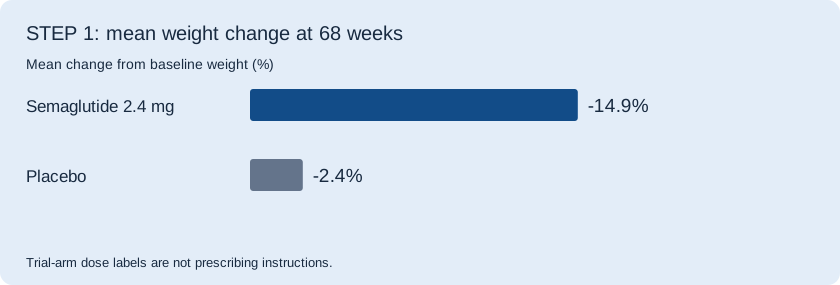
STEP 1: mean weight change at 68 weeks
Double-blind randomized trial of 1,961 adults with obesity or overweight and a weight-related condition, without diabetes. Both groups received lifestyle intervention. The semaglutide study arm used a weekly subcutaneous injection; the dose identifies the trial arm, not instructions for use.
Gastrointestinal events led to discontinuation in 4.5% of the semaglutide group and 0.8% of the placebo group. Funded by Novo Nordisk. These averages are not individual predictions or outcomes measured for a reviewed provider or compounded product.
Read the original study ↗View the underlying data table
| Study group | Mean weight change (%) | Stopped for GI events (%) |
|---|---|---|
| Semaglutide 2.4 mg | -14.9 | 4.5 |
| Placebo | -2.4 | 0.8 |
Questions & answers
Does STEP 1 mean I should expect to lose 14.9% of my weight?
No. The −14.9% figure was the mean change in the studied semaglutide group at 68 weeks, not a prediction for each participant or a new patient. The placebo mean was −2.4%, and both groups received lifestyle intervention. Individual treatment decisions require consideration of benefits, side effects, health conditions, other medicines and costs with a clinician.
Were people with diabetes included in STEP 1?
STEP 1’s population did not have diabetes. It included adults with obesity or overweight plus a weight-related condition. That boundary should remain visible when the result is discussed. This trial alone does not provide a direct outcome estimate for a population with diabetes, even if a provider’s broader program serves people with different health conditions.
Does the 4.5% GI discontinuation figure describe everyone who had stomach symptoms?
No. It describes participants in the semaglutide group who discontinued because of gastrointestinal events; the corresponding placebo figure was 0.8%. It is not the rate of all GI symptoms or all adverse events. Readers should preserve the endpoint’s wording instead of describing it as either the total side-effect rate or the proportion who had any difficulty tolerating treatment.
Can a compounded-semiglutide provider use STEP 1 as proof of its own results?
STEP 1 can inform discussion of the studied semaglutide regimen, but it does not establish outcomes for a provider’s compounded preparation. FDA does not approve compounded preparations or conduct premarket review of their safety, effectiveness and quality. That does not alone prove clinical inequivalence. Provider-specific efficacy claims require evidence beyond citing a trial that did not study that provider’s product.
Does STEP 1 validate oral semaglutide or microdosing programs?
Not by itself. STEP 1 studied subcutaneous semaglutide 2.4 mg weekly; that identifies its study arm, not a recommended regimen for a reader. Results cannot simply be assigned to another route or a microdose protocol. For example, CoreAge Rx’s advertised Semaglutide Microdosing Therapy is a documented commercial offering, not an intervention whose efficacy was established by STEP 1.
Does manufacturer funding make STEP 1 unusable?
Funding is important context, not a standalone reason to discard or accept the findings. Novo Nordisk funded STEP 1, and that disclosure should accompany an account of its randomized, double-blind design, defined population, comparator, duration and tolerability findings. A careful reading neither hides the sponsor nor treats sponsorship as a substitute for examining what the study actually measured.
Our assessment
STEP 1 provides a substantial randomized comparison: over 68 weeks, studied subcutaneous semaglutide produced a mean weight change of −14.9%, versus −2.4% with placebo, with lifestyle intervention in both groups. Its GI-related discontinuation findings and Novo Nordisk funding belong in the same account. The evidence is useful precisely because its boundaries are identifiable. It does not predict an individual outcome, establish results after stopping treatment or validate every product carrying the semaglutide name. When considering a provider, keep two questions separate: what does the clinical study establish, and what does the provider actually document about the proposed product and ongoing care?
Sources & documentation
Public materials consulted October 19, 2026. Provider statements are attributed claims, not independently verified clinical outcomes. Terms can change; obtain a current written quote.
- FDA concerns with unapproved GLP-1 drugs used for weight loss ↗
- NIDDK: prescription medications for overweight and obesity ↗
- Wilding et al. (2021): STEP 1 semaglutide trial ↗
- Jastreboff et al. (2022): SURMOUNT-1 tirzepatide trial ↗
- Found — medication/compounded tirzepatide ↗
- Ro — weight loss/pricing ↗
- Enhance.MD — product/core semaglutide ↗
- CoreAge Rx — product/semaglutide microdosing therapy ↗
- Found — medication/compounded semaglutide ↗
- Walgreens / Walgreens Weight Management — topic/virtual healthcare/weight loss.jsp ↗
- CoreAge Rx — product/semaglutide ↗
- Ro — weight loss ↗
- Sesame / Success by Sesame — service/online weight loss program ↗
- Enhance.MD — product/elite tirzepatide and semaglutide ↗