ATTAIN-1 offers substantial randomized evidence that once-daily oral orforglipron reduces body weight more than placebo over 72 weeks. Its highest study-dose group had an estimated mean weight change of −11.2%, compared with −2.1% for placebo. But the scientific result is more specific than a promise about taking a pill: it concerns assignment to a treatment strategy, in a defined population, with lifestyle support and statistical handling of missing measurements.
This analysis uses the indexed primary report abstract and the available official material, including the full DailyMed Foundayo label—not an examination of every trial protocol or supplement. That distinction matters because the label adds population, missing-data, and safety details while presenting slightly different efficacy estimates. It also establishes that Foundayo received initial US approval in 2026; the research abstract’s historical description of orforglipron as investigational is not its current regulatory status.
At a glance
- Trial design
- ATTAIN-1 randomized 3,127 adults without diabetes to three once-daily oral orforglipron study-dose groups or placebo for 72 weeks, with double blinding and lifestyle intervention.
- Primary published result
- Mean weight change was −7.5%, −8.4%, and −11.2% across the three study-dose groups, versus −2.1% with placebo, using the treatment-regimen estimand.Sources: [1]
- Response was variable
- In the highest study-dose group, 54.6% reached at least 10% weight loss and 18.4% reached at least 20%; these are overlapping thresholds, not separate categories.Sources: [1]
- Tolerability affected continuation
- Adverse events led to treatment discontinuation in 5.3%–10.3% of orforglipron recipients, compared with 2.7% of placebo recipients.Sources: [1]
- Formulation distinction
- The published trial’s milligram doses identify an investigational formulation. They are not current marketed tablet strengths or interchangeable dose instructions.Sources: [2]
What randomization actually tested
ATTAIN-1 was a multinational, phase 3, randomized, double-blind trial funded by Eli Lilly. Participants were assigned in a 3:3:3:4 ratio to oral orforglipron study doses of 6 mg, 12 mg, or 36 mg, or placebo, taken once daily. The larger placebo allocation created a shared comparison group for the three active arms. Both medication and placebo were adjuncts to dietary and physical activity support, so the comparison was not medication versus doing nothing.
Random assignment makes the between-group difference substantially more informative about causation than a before-and-after account. In expectation, it balances measured and unmeasured baseline influences. Double blinding also reduces differences in expectations and behavior attributable to knowing treatment assignment. The resulting causal conclusion concerns assignment to these treatment strategies under trial conditions; it does not isolate a biological effect independent of adherence, tolerability, or the accompanying lifestyle program.
Who participated—and why that shapes applicability
The indexed abstract describes participants as having obesity without diabetes. The official label’s account of the matching trial, NCT05869903, gives broader eligibility: adults with a body mass index of at least 30, or 27 to below 30 with at least one weight-related condition. Type 2 diabetes was excluded. BMI expresses weight relative to height, but does not by itself describe body composition, physical function, or the severity of an individual’s weight-related illness.
The label reports a mean age of 45 years, mean baseline weight of 103.2 kilograms, and mean BMI of 37; 64% were female. Hypertension affected 40%, dyslipidemia 39%, and obstructive sleep apnea 11%. These details anchor the evidence in a population with substantial weight-related health burdens. They do not establish disease-specific treatment effects, and results from the separate diabetes trial in the label should not be silently substituted for ATTAIN-1 results.
STUDY DATA · GLP-1 Evidence Review
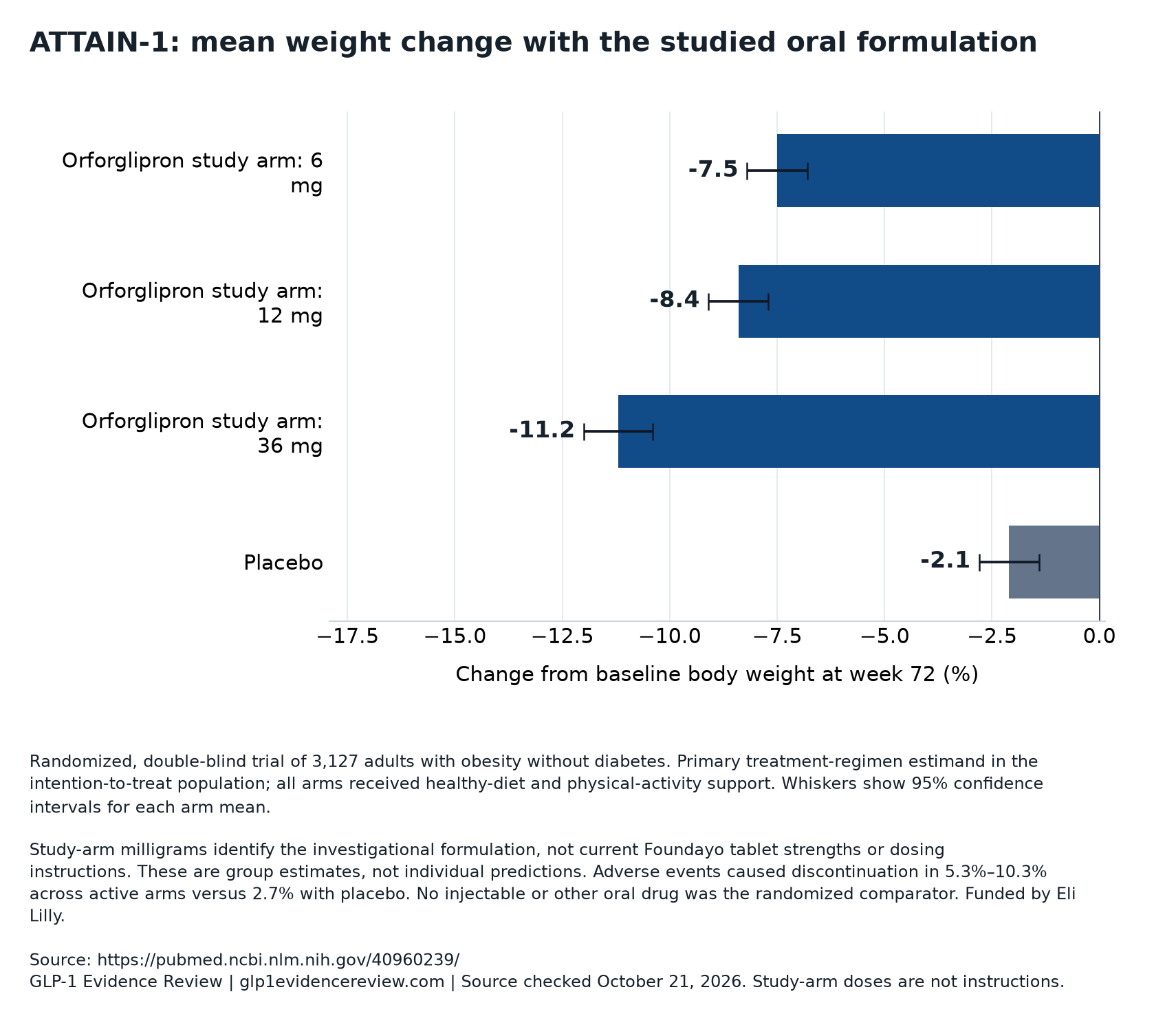
ATTAIN-1: mean weight change with the studied oral formulation
Randomized, double-blind trial of 3,127 adults with obesity without diabetes. Primary treatment-regimen estimand in the intention-to-treat population; all arms received healthy-diet and physical-activity support. Whiskers show 95% confidence intervals for each arm mean.
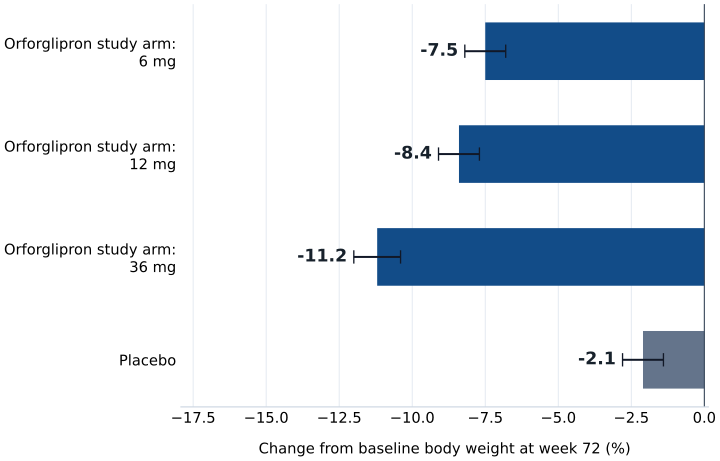
| Study group | Change from baseline body weight at week 72 (%) |
|---|---|
| Orforglipron study arm: 6 mg | -7.5 |
| Orforglipron study arm: 12 mg | -8.4 |
| Orforglipron study arm: 36 mg | -11.2 |
| Placebo | -2.1 |
Study-arm milligrams identify the investigational formulation, not current Foundayo tablet strengths or dosing instructions. These are group estimates, not individual predictions. Adverse events caused discontinuation in 5.3%–10.3% across active arms versus 2.7% with placebo. No injectable or other oral drug was the randomized comparator. Funded by Eli Lilly.
Original visualization of published aggregate data. No individual prediction or provider performance is represented. Original research ↗
Reading the primary endpoint in percentage points
The primary endpoint was percentage change in body weight from baseline to week 72. All three active groups had greater estimated reductions than placebo, with reported P values below 0.001 for each comparison. Subtracting the placebo mean from the published active-group means gives additional mean reductions of 5.4, 6.3, and 9.1 percentage points. These are arithmetic contrasts of the reported means, not separately reported confidence intervals for treatment differences.
For scale, an 11.2% reduction from a hypothetical starting weight of 100 kilograms equals 11.2 kilograms; 2.1% equals 2.1 kilograms. The comparison therefore represents 9.1 kilograms more reduction on that illustrative baseline—not a prediction for a particular participant. Each person’s percentage change depends on their own starting weight, and the trial reports an average across heterogeneous responses. The guide to average weight change explains why a group mean is not a personal forecast.
| Randomized study arm | Mean weight change | 95% confidence interval |
|---|---|---|
| Orforglipron 6 mg | −7.5% | −8.2% to −6.8% |
| Orforglipron 12 mg | −8.4% | −9.1% to −7.7% |
| Orforglipron 36 mg | −11.2% | −12.0% to −10.4% |
| Placebo | −2.1% | −2.8% to −1.4% |
What the confidence intervals do—and do not—resolve
A confidence interval describes statistical uncertainty around an estimated population mean under the analysis assumptions. For the highest study-dose group, the reported interval extends from −12.0% to −10.4%. It is not a range containing 95% of individual weight changes. Individual responses can vary far more widely than the uncertainty surrounding the mean, especially in a trial with thousands of randomized participants.
The ordered means suggest more weight reduction at higher assigned study doses, but the abstract reports comparisons against placebo rather than formal tests of every active dose against every other dose. Overlapping or nonoverlapping arm-level intervals are not a substitute for those tests. Similarly, a small P value addresses incompatibility with a null comparison under a statistical model; it does not quantify the probability of success for an individual or settle the balance between added benefit and tolerability.
The estimand defines which treatment effect is being estimated
The primary published analysis used a treatment-regimen estimand in the intention-to-treat population. An estimand is the precise treatment-effect question an analysis tries to answer. Here, the intention-to-treat population retains all randomized participants, rather than restricting the analysis to people who tolerated treatment and completed every scheduled dose. The treatment-regimen approach seeks to describe assignment to the regimen, including the consequences of treatment discontinuation.
That question differs from asking what might happen if everyone remained on treatment as intended. Estimates answering those two questions can differ without either being mathematically inconsistent. For ATTAIN-1’s primary published result, the highest study-dose mean is −11.2%; a larger efficacy-focused headline should not replace it without identifying the different question and assumptions. This is a useful application of the medical-claims evidence checklist: identify the endpoint, population, and estimand before comparing headline percentages.
Missing measurements remain important in an intention-to-treat analysis
Including everyone in the intended analysis does not mean everyone supplied a week-72 weight. The label reports that this endpoint was missing for 24% of placebo participants and 16%, 14%, and 15% across the active groups. It describes modified multiple imputation: missing values were statistically filled in using information from the same randomized group, with different data sources depending on whether missingness was possibly treatment-related. Retrieved participants—those with follow-up information after discontinuation—helped inform that process.
Imputation makes assumptions explicit rather than making missingness disappear. Confidence in the effect size depends partly on how well observed participants represent those whose measurements were unavailable. The label also reports all-cause trial-drug discontinuation of 22%–24% in active groups and 30% with placebo, a different measure from adverse-event discontinuation. Its efficacy table gives active-group means of −7.4%, −8.3%, and −11.1%, versus −2.1%. The small differences from the abstract should be preserved as separate reported analyses; these accessible materials do not fully explain their reconciliation.
Response thresholds reveal variation hidden by the average
In the published highest study-dose group, 54.6% reached at least 10% weight reduction, 36.0% reached at least 15%, and 18.4% reached at least 20%. The corresponding placebo proportions were 12.9%, 5.9%, and 2.8%. These are nested outcomes: someone losing 20% also satisfies the 15% and 10% thresholds. Adding the percentages would count the same people multiple times.
The absolute differences were 41.7, 30.1, and 15.6 percentage points at those respective thresholds. This pattern shows that substantial responses were more common with treatment while becoming less common as the threshold became more demanding. The abstract also reports improvements in waist circumference, systolic blood pressure, triglycerides, and non-HDL cholesterol. Those measurements are not equivalent to demonstrated prevention of heart attacks, kidney failure, or death. Our ESSENCE liver-evidence analysis addresses the related principle that a conclusion must match the outcome actually measured.
Tolerability and serious risks require different denominators
The ATTAIN-1 abstract reports that adverse events caused treatment discontinuation in 5.3%–10.3% of active-group participants versus 2.7% with placebo. Gastrointestinal effects were the most common adverse events and were mostly mild to moderate, but the discontinuation range includes all adverse events, not gastrointestinal events alone. The abstract does not clearly assign each discontinuation percentage to an individual study arm. Calling the treatment simply safe would erase both this tolerability burden and rarer serious concerns.
The official label supplies broader safety evidence pooled from two weight-management trials, including participants with diabetes. Those pooled figures must not be relabeled as ATTAIN-1-only rates. They include severe gastrointestinal reactions in approximately 3% versus 1%, acute kidney injury in 0.2% versus 0.05%, and gallstones in 1% versus 0.7%. Confirmed acute pancreatitis involved six treated participants versus one placebo participant, with exposure-adjusted rates of 0.14 versus 0.04 patients per 100 years of exposure. Small event counts limit precision about rare risks.
The boxed warning also needs careful wording. Other GLP-1 receptor agonists active in rodents produced thyroid C-cell tumors; orforglipron was not pharmacologically active in rats or mice and was reported as non-carcinogenic in those tests. Human relevance remains undetermined. Foundayo is contraindicated with a personal or family history of medullary thyroid carcinoma or MEN 2. Its label also addresses pancreatitis, severe gastrointestinal reactions, dehydration-related kidney injury, gallbladder disease, and clinically relevant medication interactions.
OASIS 4 provides context, not an oral-drug ranking
OASIS 4 tested once-daily oral semaglutide at a study dose of 25 mg against placebo in 307 participants without diabetes. Its study lasted 71 weeks, but the coprimary weight endpoints were assessed at week 64. Mean weight change was −13.6% versus −2.2%, an estimated difference of −11.4 percentage points with a 95% confidence interval of −13.9 to −9.0. Gastrointestinal adverse events occurred in 74.0% versus 42.2%. Novo Nordisk funded that trial.
Those means cannot establish that oral semaglutide is superior to orforglipron. Participants were not randomized between the two drugs, and trial duration, eligibility, analysis choices, and missingness may differ. SURMOUNT-5 illustrates an actual direct comparison: 751 participants were randomized to weekly subcutaneous tirzepatide or semaglutide for 72 weeks in an open-label trial. Its −20.2% versus −13.7% result concerns injectable regimens, not these oral products. The SURMOUNT-5 evidence review examines that distinct comparison.
| Trial and population | Randomized comparison | Weight endpoint timing |
|---|---|---|
| ATTAIN-1: 3,127 adults without diabetes | Daily oral orforglipron versus placebo | Week 72 |
| OASIS 4: 307 adults without diabetes | Daily oral semaglutide versus placebo | Week 64 in a 71-week study |
| SURMOUNT-5: 751 adults without diabetes | Weekly subcutaneous tirzepatide versus semaglutide | Week 72 |
Approval connects the formulation evidence—not provider outcomes
Foundayo’s label identifies initial US approval in 2026 and explains that the pivotal studies used an investigational orforglipron formulation. The label presents corresponding marketed-equivalent dosages, but the published 6-, 12-, and 36-mg study arms are not current marketed tablet strengths and are not interchangeable milligram instructions. That regulatory bridge does not establish equivalence for arbitrary compounded preparations or other formulations. The formulation-and-route guide explains why ingredient names alone do not carry an entire evidence base.
Editorial interpretation: a credible trial result and a satisfactory service contract answer different questions. ATTAIN-1 did not randomize participants among telehealth companies, examine renewal terms, or establish provider-specific outcomes. Readers checking documentary terms can consult the CoreAge Rx review or Mochi Health review, without inferring that either offers the studied product or reproduces its results. FDA separately emphasizes that compounded drugs do not undergo its premarket review for safety, effectiveness, and quality. Neither a provider’s contract nor a shared ingredient name substitutes for product-specific evidence.
Questions & answers
Does an 11.2% average mean most people lost exactly that amount?
No. The mean summarizes the group, not a typical guaranteed response. The threshold results show variation: 54.6% in the highest study-dose group reached at least 10% loss, while 18.4% reached at least 20%. The confidence interval around the mean describes estimation uncertainty, not the spread of individual outcomes.
Why emphasize the placebo group when participants also received lifestyle support?
Because both groups received lifestyle support, the randomized comparison estimates the additional effect of assignment to the drug regimen under those shared conditions. The active group’s entire baseline-to-follow-up change cannot be attributed exclusively to medication. Placebo adjustment helps separate the treatment contrast from changes occurring in the comparison group.
Can these findings predict weight loss beyond 72 weeks or after treatment ends?
The primary ATTAIN-1 result establishes a week-72 effect. It does not by itself quantify later durability, the consequences of withdrawal, or long-term clinical-event prevention. Foundayo’s approved indication includes long-term weight management, but that regulatory language does not turn this specific endpoint into a measured post-withdrawal outcome.
Were all missing week-72 weights treated as treatment failures?
No. The label describes statistical imputation using information from participants in the same randomized group, including retrieved follow-up data when missingness was possibly treatment-related. This is different from automatically assigning zero weight loss or assuming every missing participant failed. The validity of those estimates still depends on assumptions about unobserved outcomes.
Does OASIS 4 prove which oral medicine works better?
No. OASIS 4 and ATTAIN-1 each support a comparison against their own placebo group. A numerical difference between separate trials is not a randomized comparison between the drugs. A direct oral-product trial with aligned endpoints and explicit handling of discontinuation would answer that comparative question more convincingly.
Our assessment
ATTAIN-1 provides strong randomized evidence that assignment to daily oral orforglipron produces greater mean weight reduction than placebo over 72 weeks in adults without diabetes. Its most informative reading combines the treatment-regimen estimate, response thresholds, missing-data methods, and adverse-event discontinuation—not a single headline percentage. Unresolved questions include longer-term durability, rare-event precision, and direct comparisons with other oral treatments. Eli Lilly’s sponsorship is relevant context, while the randomized design and defined endpoint remain central strengths. The conclusion is product- and trial-specific, not evidence of provider performance.
Sources & documentation
Scientific and official sources consulted October 21, 2026. Study findings apply to the populations, products and time periods described; they are not provider outcome data.
- Orforglipron, an Oral Small-Molecule GLP-1 Receptor Agonist for Obesity Treatment. ↗
- DailyMed - FOUNDAYO- orforglipron tablet, film coated ↗
- Oral Semaglutide at a Dose of 25 mg in Adults with Overweight or Obesity. ↗
- Tirzepatide as Compared with Semaglutide for the Treatment of Obesity. ↗
- FDA concerns with unapproved GLP-1 drugs used for weight loss ↗