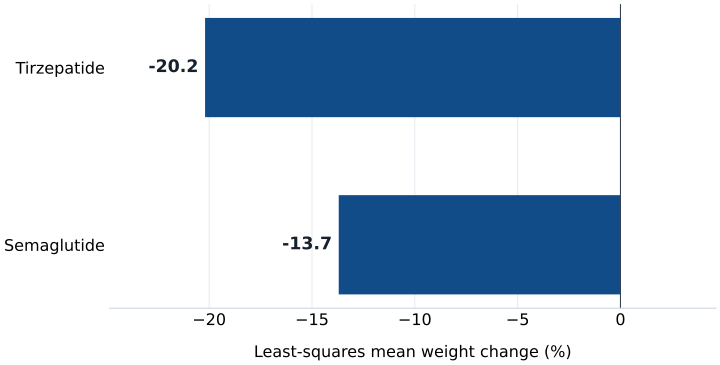
SURMOUNT-5 answers a more useful question than comparing two unrelated weight-loss advertisements: what happened when adults with obesity were randomly assigned to injectable tirzepatide or injectable semaglutide within the same trial? Among 751 participants without type 2 diabetes, the reported model-based average weight changes at 72 weeks were −20.2% and −13.7%, respectively. That is a substantial difference, but its meaning depends on the population, dosing strategies, endpoint, and statistical analysis.
This analysis uses the indexed primary report abstracts for SURMOUNT-5 and the comparison trials, together with FDA material on unapproved GLP-1 drugs. It does not represent a review of every full protocol, supplement, or participant-level dataset. The central finding is clear: tirzepatide produced greater average weight and waist reductions under the tested conditions. The harder questions concern how precisely that advantage is defined, which uncertainties remain, and why it cannot establish universal safety superiority, cardiovascular superiority, or the performance of a particular provider.
At a glance
- Direct randomized comparison
- SURMOUNT-5 assigned 751 adults with obesity but without type 2 diabetes, in a 1:1 ratio, to two active injectable treatment strategies for 72 weeks.Sources: [1]
- Studied regimens
- Participants received maximum tolerated once-weekly subcutaneous tirzepatide at 10 or 15 mg, or semaglutide at 1.7 or 2.4 mg. These doses describe trial arms, not individual treatment instructions.Sources: [1]
- Primary weight result
- Least-squares mean weight change was −20.2% with tirzepatide and −13.7% with semaglutide: a 6.5-percentage-point difference calculated from the reported rounded means.Sources: [1]
- Safety finding
- Gastrointestinal events were the most common adverse events in both groups; most were mild to moderate and occurred primarily during dose escalation. The abstract does not establish an overall safety winner.Sources: [1]
What randomization adds to this comparison
SURMOUNT-5 was a phase 3b, randomized, open-label, controlled trial. Randomization assigned participants to tirzepatide or semaglutide rather than allowing treatment choice to determine the groups. This matters because people choosing different medicines outside a trial may differ in health, prior treatment, access, and expectations. Random assignment reduces the opportunity for those differences to systematically drive the comparison, although it cannot guarantee perfect balance on every characteristic.
Both groups received active treatment, and both were evaluated at week 72. The primary endpoint—the main outcome selected to answer the trial’s central question—was percentage change in body weight from baseline. Unlike a comparison assembled from separate studies, this design places the two strategies inside a common experimental framework. It therefore provides stronger evidence about their relative weight effects than subtracting results from independent placebo-controlled trials.
The eligible population still sets a boundary. These were adults with obesity without type 2 diabetes, not a representative sample of everyone who might receive either medicine. The abstract does not provide enough demographic or recruitment detail to assess every dimension of representativeness. A randomized result can be internally persuasive while leaving uncertainty about how closely it applies to other clinical populations.
Maximum tolerated dosing defines the question
The trial compared treatment strategies, not one fixed dose of each drug. Tirzepatide participants received a maximum tolerated dose of 10 or 15 mg; semaglutide participants received 1.7 or 2.4 mg. Both treatments were administered subcutaneously, meaning under the skin, once weekly. The 72-week result therefore belongs to these injectable strategies rather than to every possible exposure to the two ingredients.
Maximum tolerated dosing makes tolerability part of the comparison. The assigned strategy allowed one of two stated doses within each arm rather than requiring every participant to remain at the largest listed dose. The abstract does not report how many participants reached each dose, their cumulative exposure, or detailed escalation histories. Those omissions prevent a precise explanation of how achieved dose contributed to the final difference.
Milligram amounts also are not interchangeable measures of biological strength across different molecules. The result cannot be translated into a claim that a particular number of milligrams is intrinsically better. Nor does it test lower-dose-only strategies, switching between drugs, oral administration, or individualized combinations. The formulation and route guide explains why an ingredient name alone does not define the treatment evidence.
STUDY DATA · GLP-1 Evidence Review
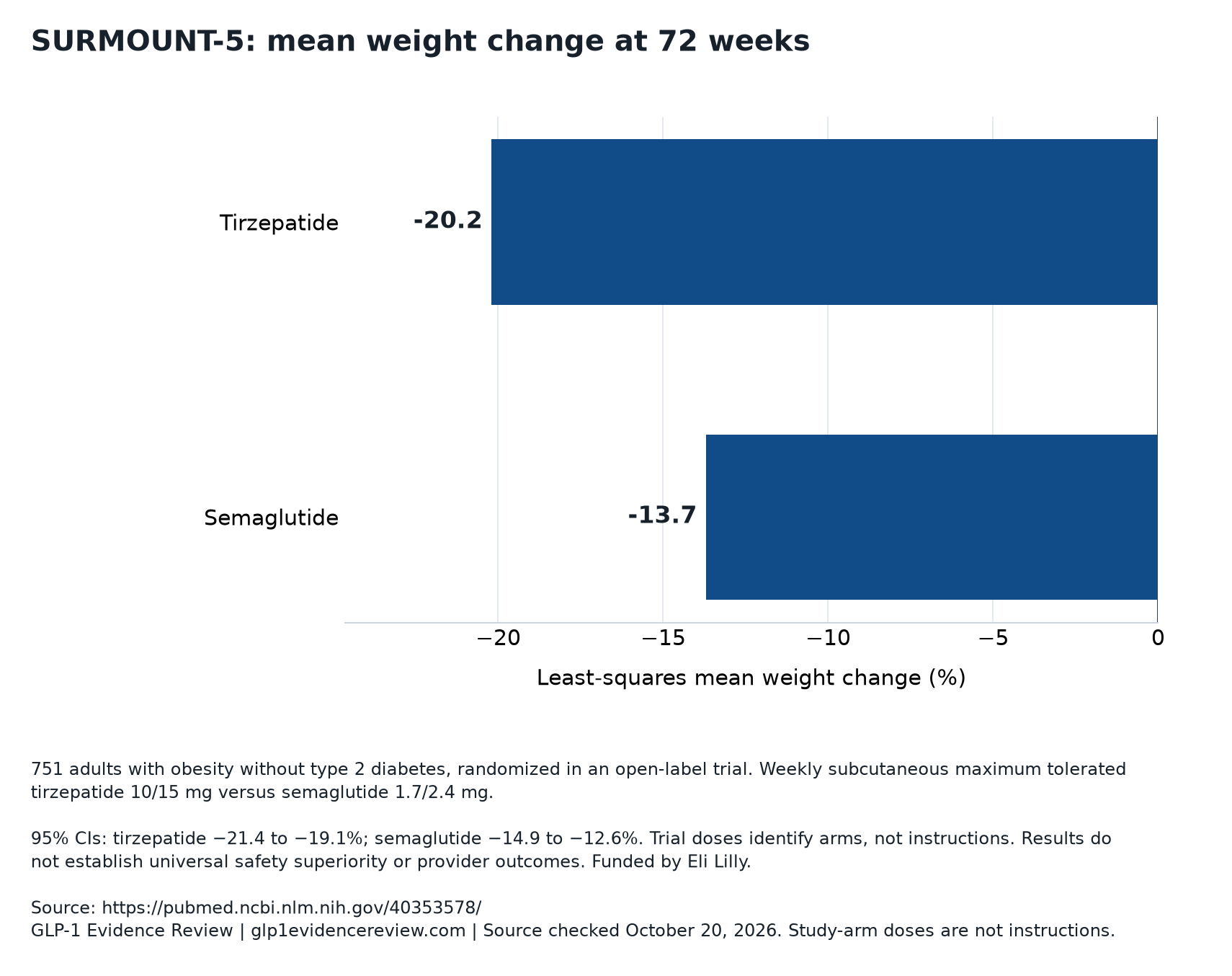
SURMOUNT-5: mean weight change at 72 weeks
751 adults with obesity without type 2 diabetes, randomized in an open-label trial. Weekly subcutaneous maximum tolerated tirzepatide 10/15 mg versus semaglutide 1.7/2.4 mg.
| Study group | Least-squares mean weight change (%) |
|---|---|
| Tirzepatide | -20.2 |
| Semaglutide | -13.7 |
95% CIs: tirzepatide −21.4 to −19.1%; semaglutide −14.9 to −12.6%. Trial doses identify arms, not instructions. Results do not establish universal safety superiority or provider outcomes. Funded by Eli Lilly.
Original visualization of published aggregate data. No individual prediction or provider performance is represented. Original research ↗
Reading the weight and waist estimates correctly
At week 72, the least-squares mean percentage weight change was −20.2% with tirzepatide, with a 95% confidence interval from −21.4% to −19.1%. For semaglutide, it was −13.7%, with a confidence interval from −14.9% to −12.6%. Least-squares means are model-based group estimates, not simply a list of individual outcomes averaged without adjustment. The abstract does not identify every modeling choice.
Subtracting the reported rounded means gives 6.5 percentage points of additional average reduction with tirzepatide. Relative to the 13.7% semaglutide reduction, that difference is approximately 47%. These are two descriptions of the same comparison, not two separate benefits. The relative description can sound larger because its denominator is the weight reduction in the comparator group, not starting body weight.
For scale only, if both estimates were applied to a hypothetical starting weight of 100 kg, they would correspond to reductions of 20.2 and 13.7 kg. That arithmetic is not a prediction for an individual or a reported kilogram endpoint. The guide to mean results develops the distinction between a group estimate and an expected personal outcome.
| Measure | Reported estimates | Interpretation |
|---|---|---|
| Percentage weight change | Tirzepatide −20.2% (95% CI −21.4 to −19.1); semaglutide −13.7% (−14.9 to −12.6) | 6.5 percentage points more average reduction with tirzepatide |
| Waist circumference change | Tirzepatide −18.4 cm (95% CI −19.6 to −17.2); semaglutide −13.0 cm (−14.3 to −11.7) | 5.4 cm greater average reduction with tirzepatide |
| Weight-loss thresholds | At least 10%, 15%, 20%, and 25% reduction favored tirzepatide | The abstract does not give the threshold-specific proportions |
Confidence intervals are not personal outcome ranges
The confidence intervals describe statistical uncertainty around the estimated group means under the analysis assumptions. They do not mean that 95% of participants lost weight within those narrow ranges. Individual responses can be much more dispersed than uncertainty about a group average, and the abstract does not provide a full distribution of individual weight changes.
The report gives P<0.001 for the between-treatment weight comparison. This supports a difference that is difficult to explain by sampling variation alone under the test’s assumptions. It does not measure the probability that tirzepatide is better for every person, identify the mechanism behind the difference, or establish that bias is absent. Statistical strength and clinical scope are separate questions.
Importantly, the abstract supplies confidence intervals for each arm’s mean, not a confidence interval for the 6.5-point difference itself. One should not manufacture that interval by subtracting the endpoints of the two reported intervals. Estimating uncertainty for the contrast requires information about the analysis and its variance structure. The result is clearly directional without pretending that every useful uncertainty measure is available.
The estimand and open-label design leave specific questions
An estimand defines the treatment effect a trial seeks to estimate, including how events such as treatment discontinuation or additional treatment are handled. Two analyses of the same trial can answer different questions: one might emphasize assignment to a strategy regardless of later adherence, while another might emphasize outcomes under continued treatment. That distinction can matter when tolerability affects persistence.
The SURMOUNT-5 abstract does not fully specify its estimand or missing-data procedures. It is therefore inappropriate to label its headline result as either a guaranteed real-world assignment effect or a pure uninterrupted-treatment effect. Resolving that question requires the detailed methods. By contrast, the STEP 1 and SURMOUNT-1 abstracts explicitly describe estimands that assess effects regardless of treatment discontinuation, with STEP 1 also addressing rescue interventions.
Open-label means participants and investigators knew which treatment was assigned. Body weight is more objectively measured than a subjective satisfaction score, but knowledge of treatment could still affect expectations, behavior, persistence, or symptom reporting. These are possible pathways for bias, not demonstrated explanations of the result. Randomization strengthens the comparison; the absence of blinding remains a distinct limitation.
Secondary endpoints broaden—but do not redefine—the finding
Waist circumference fell by a least-squares mean of 18.4 cm with tirzepatide and 13.0 cm with semaglutide. The corresponding 95% confidence intervals were −19.6 to −17.2 cm and −14.3 to −11.7 cm; the comparison had P<0.001. This secondary measurement supports a difference beyond the scale, but it does not directly measure visceral fat, muscle preservation, or physical function.
Participants assigned to tirzepatide were also more likely to reach weight reductions of at least 10%, 15%, 20%, and 25%. Threshold outcomes complement averages: they ask how many people cross a defined milestone rather than how large the average change is. However, the abstract does not give the actual proportions for these comparisons, so it cannot support a precise probability of reaching any one threshold.
The report identifies these as key secondary endpoints, while percentage weight change was primary. The abstract does not describe the full statistical testing hierarchy or multiplicity procedure—the rules used when several outcomes are tested. Most importantly, none of these endpoints establishes comparative effects on heart attack, stroke, survival, long-term disability, or weight maintenance after treatment ends.
Tolerability is not a universal safety ranking
In SURMOUNT-5, gastrointestinal adverse events were most common in both groups. Most were mild to moderate and occurred primarily during dose escalation. This is a substantive safety finding: digestive symptoms were a prominent part of treatment experience, and their timing clustered around increasing doses. Describing most events as mild or moderate does not mean all events were minor or inconsequential.
The abstract does not give enough comparative event counts, discontinuation rates, or serious-event detail to declare one treatment safer overall. A trial designed around weight change also should not automatically be treated as a definitive comparison of uncommon harms. Its sample size and duration constrain what can be learned about rare events, even when the weight endpoint is estimated convincingly.
Related trials show why adverse effects deserve separate attention. In STEP 1, gastrointestinal events led to discontinuation in 4.5% of semaglutide participants versus 0.8% with placebo. In SURMOUNT-1, adverse events caused discontinuation in 7.1% and 6.2% of the 10- and 15-mg tirzepatide groups versus 2.6% with placebo. These are different studies and differently defined summaries, not a valid indirect safety contest.
Earlier weight trials provide context, not a substitute
STEP 1 randomized 1,961 adults without diabetes to injectable semaglutide 2.4 mg or placebo, with lifestyle intervention, for 68 weeks. Mean weight change was −14.9% versus −2.4%, with a reported treatment difference of −12.4 percentage points (95% CI −13.4 to −11.5). Funded by Novo Nordisk, it established a placebo-controlled effect, not a direct comparison with tirzepatide.
SURMOUNT-1 randomized 2,539 adults without diabetes to three tirzepatide doses or placebo for 72 weeks, including 20 weeks of dose escalation. Mean changes were −15.0%, −19.5%, and −20.9% for 5, 10, and 15 mg, compared with −3.1% for placebo. Eli Lilly supported that trial. Its fixed assigned dose groups differ from SURMOUNT-5’s maximum tolerated strategies.
The broad pattern is consistent with the head-to-head finding, but subtracting results across those studies cannot reproduce a randomized comparison. Follow-up length, populations, treatment strategies, and analysis definitions can differ. The separate analyses of STEP 1 and SURMOUNT-1 are useful for understanding each trial on its own terms rather than treating their averages as interchangeable.
| Trial | Design and duration | Question answered |
|---|---|---|
| SURMOUNT-5; 751 participants | Open-label; tirzepatide versus semaglutide; 72 weeks | Relative effects of two maximum tolerated injectable strategies |
| STEP 1; 1,961 participants | Double-blind; semaglutide versus placebo, plus lifestyle intervention; 68 weeks | Effect of semaglutide compared with placebo |
| SURMOUNT-1; 2,539 participants | Double-blind; three tirzepatide dose groups versus placebo; 72 weeks | Effects of assigned tirzepatide doses compared with placebo |
Greater weight loss does not settle cardiovascular benefit
SELECT illustrates why an outcome-specific reading matters. It enrolled 17,604 adults aged at least 45 with established cardiovascular disease, BMI of at least 27, and no history of diabetes. Participants received injectable semaglutide 2.4 mg or placebo. Its primary endpoint combined cardiovascular death, nonfatal heart attack, or nonfatal stroke, analyzed as time to a first event—not percentage weight change.
Over a mean 39.8 months of follow-up, that endpoint occurred in 6.5% of semaglutide participants and 8.0% of placebo participants. The hazard ratio was 0.80 (95% CI 0.72–0.90), representing a lower estimated event hazard over follow-up, not a 20-percentage-point absolute reduction. The rounded observed proportions differed by 1.5 percentage points. A lower composite outcome does not establish that every component improved separately.
SELECT, funded by Novo Nordisk, also reported permanent discontinuation because of adverse events in 16.6% versus 8.2%. Its findings neither negate SURMOUNT-5 nor supply the missing tirzepatide-versus-semaglutide cardiovascular comparison. The SELECT analysis explains that distinct evidence question. Greater average weight loss alone cannot determine which treatment better prevents cardiovascular events in a particular population.
Product evidence cannot rank a provider or contract
SURMOUNT-5 did not randomize participants among telehealth companies, pharmacies, shipping systems, or subscription arrangements. Its clinical result therefore cannot establish which provider produces better outcomes. Eli Lilly’s sponsorship is relevant context for appraisal, but neither sponsorship nor a large treatment difference replaces examination of the methods. The strongest conclusion remains specific to the tested treatment strategies and outcomes.
The same boundary applies to compounded products and oral routes. FDA states that compounded drugs are not FDA approved or reviewed before marketing for safety, effectiveness, or quality, and identifies concerns including dosing errors and semaglutide salt ingredients. Adverse-event reports alone cannot establish rates or causation. The approved-versus-compounded guide separates these product questions from evidence for studied injections.
Editorial interpretation: a clinical advantage is not evidence of a favorable subscription contract, reliable access, or a particular follow-up service. Readers evaluating documentary terms can consult the CoreAge Rx review or Mochi Health review, without assuming either offers the studied product or condition-specific outcomes. Prices, cancellation terms, and care arrangements require their own documentation; the trial supplies none of those comparisons.
Questions & answers
Does the 20.2% result mean everyone receiving tirzepatide lost about one-fifth of their weight?
No. It is a model-based group mean at 72 weeks. The confidence interval describes uncertainty around that mean, not the range containing most individual results. The abstract reports that several weight-loss thresholds favored tirzepatide, but it does not provide the complete response distribution or a reliable personal prediction.
Is the advantage 6.5% or approximately 47%?
The clearest absolute description is 6.5 percentage points more average weight reduction. Approximately 47% describes the additional reduction relative to semaglutide’s 13.7% reduction, using rounded estimates. It does not mean an additional 47% of starting body weight was lost, and it is not a cardiovascular risk reduction.
Does an open-label design make the result unreliable?
Not automatically. Randomization and a directly measured weight endpoint are important strengths. Lack of blinding can nevertheless influence behavior, persistence, expectations, and reporting. The appropriate conclusion is that the comparison is strong evidence for the measured weight outcome, with design limitations—not that open-label evidence is either worthless or immune to bias.
Did SURMOUNT-5 establish which drug is safer?
The accessible abstract does not establish an overall safety winner. It reports mainly mild-to-moderate gastrointestinal events in both groups, often during escalation, but lacks the detailed comparative safety results needed for a broad ranking. Greater weight reduction should not be substituted for a separate assessment of adverse effects and discontinuation.
Can these results be applied to compounded injections or oral products?
Not automatically. The randomized comparison tested specific once-weekly subcutaneous regimens. It did not test oral formulations or establish equivalence for compounded preparations. FDA’s concerns about unapproved GLP-1 drugs reinforce the need to identify the actual product rather than treating all products bearing a similar ingredient name as clinically interchangeable.
Our assessment
SURMOUNT-5 provides persuasive direct evidence that the tested maximum tolerated injectable tirzepatide strategy produced greater average weight and waist reductions than the tested semaglutide strategy over 72 weeks in adults with obesity without type 2 diabetes. Its 6.5-percentage-point weight difference is meaningful without being a universal treatment verdict. The remaining questions are specific: how discontinuation and missing data entered the estimand, how achieved doses and individual responses varied, what detailed comparative safety results showed, and whether differences extend to longer-term clinical outcomes. Neither unrelated outcome trials nor provider marketing can fill those gaps by inference.
Sources & documentation
Scientific and official sources consulted October 20, 2026. Study findings apply to the populations, products and time periods described; they are not provider outcome data.
- Tirzepatide as Compared with Semaglutide for the Treatment of Obesity. ↗
- Once-Weekly Semaglutide in Adults with Overweight or Obesity. ↗
- Tirzepatide Once Weekly for the Treatment of Obesity. ↗
- Semaglutide and Cardiovascular Outcomes in Obesity without Diabetes. ↗
- FDA concerns about unapproved GLP-1 drugs ↗