ESSENCE provides randomized evidence that weekly injected semaglutide improves biopsy-defined liver disease in people with metabolic dysfunction-associated steatohepatitis, or MASH, and moderate or advanced fibrosis. Its clearest finding is not simply that participants lost weight: substantially more met prespecified liver-tissue endpoints than with placebo. Those findings supported an FDA accelerated approval for Wegovy injection in adults with MASH and moderate-to-advanced fibrosis.
The central interpretation question is what those biopsy changes establish. Resolution of steatohepatitis is not the same as disappearance of scar tissue, and improvement in fibrosis is not a measured reduction in liver transplantation or death. This analysis uses the indexed primary ESSENCE report abstract and available official FDA material, rather than a review of the complete trial protocol, supplements, or full article. It examines the reported estimates, their uncertainty, and the boundary between demonstrated tissue improvement and longer-term clinical benefit.
At a glance
- Population and design
- ESSENCE randomized 1,197 participants with biopsy-defined MASH and stage F2 or F3 fibrosis; the planned week-72 analysis involved the first 800.Sources: [1]
- Steatohepatitis resolution
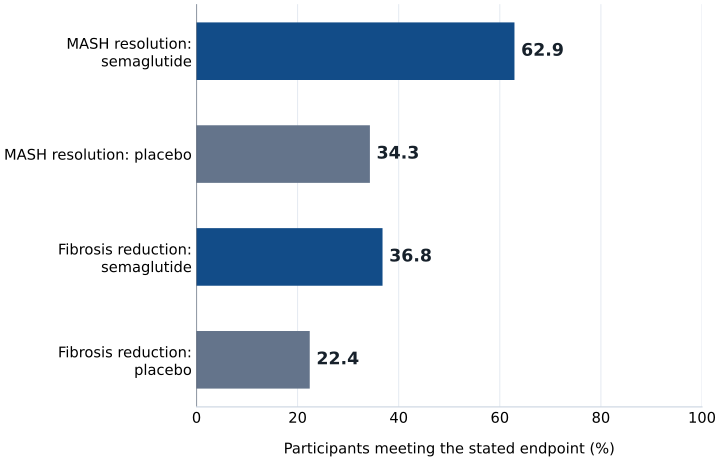
- Resolution without worsening fibrosis occurred in 62.9% with semaglutide versus 34.3% with placebo; the reported estimated difference was 28.7 percentage points (95% CI, 21.1–36.2).Sources: [1]
- Fibrosis improvement
- Fibrosis reduction without worsening steatohepatitis occurred in 36.8% versus 22.4%; the estimated difference was 14.4 percentage points (95% CI, 7.5–21.3).Sources: [1]
- Tolerability
- Gastrointestinal adverse events were more common with semaglutide; the indexed abstract does not give event counts or discontinuation rates.Sources: [1]
- Regulatory meaning
- FDA granted accelerated approval based on a surrogate endpoint, with additional evidence required to confirm clinically meaningful benefit.Sources: [2]
A trial in established liver disease, not elevated liver fat alone
MASH involves liver injury and inflammation associated with fat buildup. Fibrosis means scar tissue; stages F2 and F3 identify moderate and advanced fibrosis short of cirrhosis. ESSENCE therefore studied a specific, biopsy-defined, noncirrhotic population. It was not a trial of everyone with obesity, an abnormal liver blood test, or imaging evidence of fatty liver. That selection matters because the starting disease severity determines what improvement means and which patients the result most directly describes.
The multicenter, double-blind trial randomly assigned 1,197 participants in a 2:1 ratio to once-weekly subcutaneous semaglutide 2.4 mg or placebo for a planned 240 weeks. These doses identify the research arms, not personal treatment instructions. FDA describes both groups as also receiving lifestyle changes, with participants on stable doses of relevant background medications. The comparison thus estimates the added effect of the semaglutide strategy within that setting, not medication versus no care.
Why the first 800 participants matter
The published part 1 result was a planned interim analysis at week 72 involving the first 800 participants: 534 assigned semaglutide and 266 placebo. Those figures should not be confused with the full enrollment of 1,197. Nor should the difference between 1,197 and 800 automatically be described as dropout. The abstract explicitly identifies a planned analysis subset, rather than saying that the remaining participants disappeared from follow-up.
Randomization strengthens a causal interpretation by making treatment assignment independent of participants’ underlying prognosis on average. Blinding also helps limit expectation-driven differences in care and assessment. However, the accessible abstract does not describe missing repeat biopsies, treatment adherence, or the detailed statistical handling of absent outcomes. Those are important questions because a tissue endpoint cannot be directly observed when the follow-up sample is unavailable. The evidence checklist provides a framework for separating reported findings from unreported analytical details.
STUDY DATA · GLP-1 Evidence Review
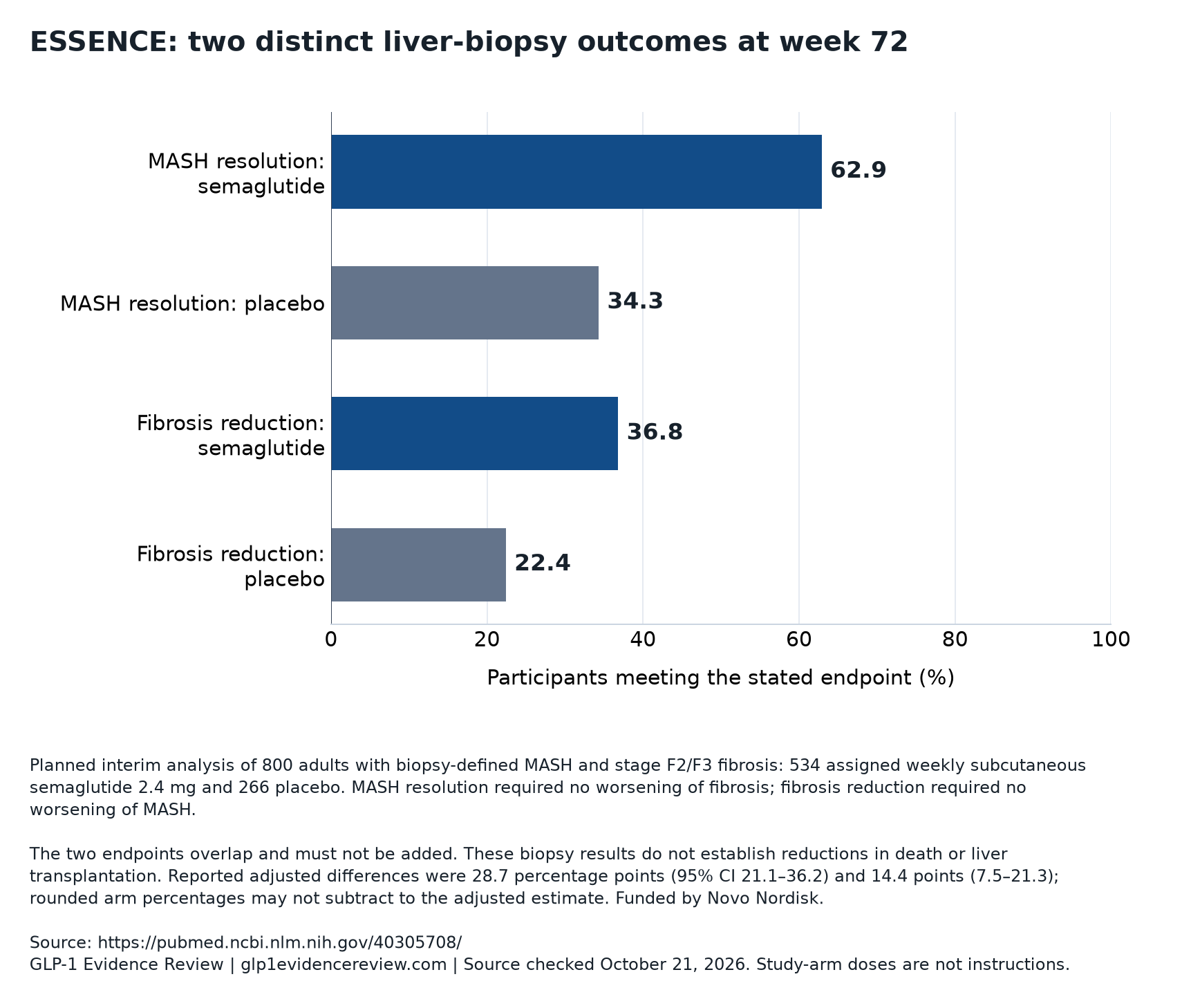
ESSENCE: two distinct liver-biopsy outcomes at week 72
Planned interim analysis of 800 adults with biopsy-defined MASH and stage F2/F3 fibrosis: 534 assigned weekly subcutaneous semaglutide 2.4 mg and 266 placebo. MASH resolution required no worsening of fibrosis; fibrosis reduction required no worsening of MASH.
| Study group | Participants meeting the stated endpoint (%) |
|---|---|
| MASH resolution: semaglutide | 62.9 |
| MASH resolution: placebo | 34.3 |
| Fibrosis reduction: semaglutide | 36.8 |
| Fibrosis reduction: placebo | 22.4 |
The two endpoints overlap and must not be added. These biopsy results do not establish reductions in death or liver transplantation. Reported adjusted differences were 28.7 percentage points (95% CI 21.1–36.2) and 14.4 points (7.5–21.3); rounded arm percentages may not subtract to the adjusted estimate. Funded by Novo Nordisk.
Original visualization of published aggregate data. No individual prediction or provider performance is represented. Original research ↗
Two primary endpoints protect against different trade-offs
ESSENCE used two primary endpoints. The first required resolution of steatohepatitis without worsening liver fibrosis. The second required a reduction in fibrosis without worsening steatohepatitis. Each combines a positive change in one disease feature with a safeguard against deterioration in the other. A participant could therefore satisfy the first endpoint without having less scar tissue, provided fibrosis did not worsen.
This distinction prevents the phrase liver improvement from flattening two different findings into one. Inflammation-related disease activity and established scarring are connected, but they are not interchangeable measurements. The first endpoint does not mean that the liver became entirely normal, while the second does not require complete resolution of steatohepatitis. Keeping the definitions visible is essential when comparing response rates, because the higher percentage does not represent a more comprehensive cure.
| Endpoint | Semaglutide versus placebo | Reported difference, percentage points (95% CI) |
|---|---|---|
| Steatohepatitis resolution without worsening fibrosis | 62.9% versus 34.3% | 28.7 (21.1–36.2) |
| Fibrosis reduction without worsening steatohepatitis | 36.8% versus 22.4% | 14.4 (7.5–21.3) |
| Both steatohepatitis resolution and fibrosis reduction | 32.7% versus 16.1% | 16.5 (10.2–22.8) |
Reading the absolute differences and confidence intervals
For steatohepatitis resolution without worsening fibrosis, the reported estimated advantage was 28.7 percentage points. In plain language, the estimated between-group separation was about 29 additional endpoint responses per 100 participants under the analysis conditions. This is an absolute difference, not a 28.7% relative improvement. Subtracting the displayed percentages produces 28.6 points; the report’s estimated difference is 28.7. Rounded group summaries and the reported analysis estimate need not subtract exactly, so the published estimate should be preserved rather than silently corrected.
The 95% confidence interval, 21.1 to 36.2 percentage points, describes statistical uncertainty around that difference under the analysis assumptions. For fibrosis improvement, the interval was 7.5 to 21.3 points around a 14.4-point estimate. Both intervals exclude zero, but they describe different ranges of plausible effect sizes. Neither is an individual patient’s probability of responding, and neither incorporates every uncertainty about missing biopsies, measurement, or applying the result outside the trial population.
Joint response adds information without creating a third population
A prespecified secondary endpoint asked whether participants achieved both steatohepatitis resolution and fibrosis reduction. That occurred in 32.7% of the semaglutide group and 16.1% of the placebo group, with a reported estimated difference of 16.5 percentage points and a 95% confidence interval of 10.2 to 22.8. This is a stricter description of improvement across both tissue features than either primary endpoint alone.
These categories overlap, so their percentages must not be added. Someone meeting the joint endpoint also contributes to the relevant primary response categories; the rows do not describe separate groups of beneficiaries. The abstract identifies joint response, weight change, and bodily pain as secondary outcomes included in a plan to adjust for multiple testing. That matters because testing many outcomes creates more opportunities for chance findings. The abstract does not provide enough detail to reconstruct the complete testing sequence or allocation of statistical error.
Weight improved, but the trial did not isolate the mechanism
Mean body weight changed by −10.5% with semaglutide and −2.0% with placebo at week 72. The estimated between-group difference was −8.5 percentage points, with a 95% confidence interval from −9.6 to −7.4. These are group averages, not the proportion who lost weight or a prediction of any individual’s result. The guide to mean results explains why an average does not reveal the full spread of responses.
Weight loss and better biopsy findings occurring together do not establish how much of the liver effect was mediated by weight reduction versus other pathways. Treatment was randomized; the amount of weight an individual lost was not independently randomized. FDA describes weight loss and potentially other incompletely understood mechanisms. Meanwhile, mean bodily pain scores did not differ significantly between groups. That result does not prove identical pain outcomes, but it means the reported analysis did not demonstrate a pain benefit alongside the tissue changes.
Gastrointestinal effects are a real part of the result
The ESSENCE abstract reports more gastrointestinal adverse events with semaglutide than placebo. It does not provide their frequency, severity distribution, or the number of participants who stopped treatment because of them. Consequently, this accessible report supports a directional tolerability finding, not a precise calculation of excess gastrointestinal harm. A strong efficacy result does not substitute for those missing safety details.
FDA’s approval announcement lists common adverse effects including nausea, diarrhea, vomiting, constipation, and abdominal pain, alongside other effects. It also identifies restrictions involving personal or family history of medullary thyroid cancer, multiple endocrine neoplasia type 2, and known sensitivity to the drug or its excipients. This announcement is not complete current prescribing information, and its general safety list should not be mistaken for ESSENCE-specific event rates. A meaningful follow-up discussion concerns tolerability as well as whether a prescription is renewed.
Accelerated approval recognizes the result without replacing outcome follow-up
Wegovy injection has an FDA accelerated MASH indication for adults with moderate-to-advanced fibrosis; describing this indication as merely investigational would be outdated. Accelerated approval permits earlier access for serious disease based on a surrogate endpoint, with additional data required to confirm effects on clinically meaningful outcomes. Here, biopsy changes provide evidence about liver tissue rather than direct measurement of how long people live or whether they avoid transplantation.
FDA describes the trial’s planned total duration of 240 weeks as addressing whether the improvements translate into fewer deaths, transplants, and other liver-related events. The 72-week analysis examined here does not establish those outcomes. This is a limit of this particular analysis, not a claim about every later publication. Interpretation: sustained improvement in inflammation and fibrosis is a clinically important reason to investigate downstream benefit, but it is not a numerical estimate of that benefit or proof that every responding participant will avoid progression.
SELECT and FLOW answer different organ-outcome questions
SELECT studied 17,604 people with established cardiovascular disease, overweight or obesity, and no diabetes. With weekly injected semaglutide 2.4 mg, its cardiovascular composite occurred in 6.5% versus 8.0% over mean follow-up of 39.8 months; the hazard ratio was 0.80 (95% CI, 0.72–0.90). FLOW instead studied 3,533 people with type 2 diabetes and chronic kidney disease using weekly injected semaglutide 1.0 mg. Its primary composite hazard ratio was 0.76 (95% CI, 0.66–0.88) over median follow-up of 3.4 years.
Unlike ESSENCE’s response proportions at week 72, those hazard ratios compare event occurrence over time. Their composites also differ: FLOW included kidney outcomes and kidney-related or cardiovascular death. A lower composite hazard does not establish that every component improved. The SELECT analysis explores that distinction. Neither trial fills in ESSENCE’s unmeasured liver-event results, just as the ATTAIN-1 oral-drug analysis cannot establish liver efficacy from an obesity weight-loss endpoint.
| Trial and population | Studied intervention | Primary endpoint framework |
|---|---|---|
| ESSENCE: biopsy-defined MASH, F2/F3 fibrosis | Weekly subcutaneous semaglutide 2.4 mg versus placebo | Two biopsy response endpoints at week 72 |
| SELECT: established cardiovascular disease, overweight/obesity, no diabetes | Weekly subcutaneous semaglutide 2.4 mg versus placebo | Time to cardiovascular death, nonfatal heart attack, or nonfatal stroke |
| FLOW: type 2 diabetes and chronic kidney disease | Weekly subcutaneous semaglutide 1.0 mg versus placebo | Time to a composite kidney event or kidney-related/cardiovascular death |
Product evidence is not a provider performance claim
ESSENCE was funded by Novo Nordisk and registered as NCT04822181. Sponsor identification belongs in the evidence record, but sponsorship alone neither disproves the findings nor resolves questions about analysis choices. The randomized design, endpoint definitions, confidence intervals, and remaining reporting gaps should be assessed together. Crucially, the trial tested a specific injected intervention, not every preparation carrying the ingredient name semaglutide.
FDA states that compounded products do not undergo its premarket review for safety, effectiveness, and quality. ESSENCE therefore does not establish equivalent outcomes for compounded preparations, oral routes, or other formulations; the approved-versus-compounded guide explains the distinction. Interpretation: trial efficacy also cannot establish a service’s contract value or care quality. Readers using the CoreAge Rx review can check documentary terms separately, without treating that review as evidence that the provider offers the studied product, MASH care, or ESSENCE-like outcomes.
Questions & answers
Does MASH resolution mean the liver’s scar tissue disappeared?
No. The first primary endpoint required resolution of steatohepatitis without worsening fibrosis. Stable fibrosis could satisfy that safeguard; fibrosis reduction was not required. The separate fibrosis endpoint and joint-response endpoint describe different levels of improvement. None of these labels should be translated into complete restoration of a normal liver.
Why did more than one-third of placebo participants meet the resolution endpoint?
The reported placebo response was 34.3%, and FDA describes lifestyle changes in both groups. However, the accessible materials do not partition that response among background care, disease variation, biopsy measurement, or other influences. Its main analytical role is to show why the randomized between-group difference is more informative than the semaglutide response rate alone.
Did the study show fewer liver transplants or deaths?
Not in the 72-week analysis examined here. Its primary outcomes were biopsy responses. FDA describes longer follow-up to determine whether those improvements translate into fewer deaths, transplants, and other liver-related events. Cardiovascular or kidney results from separate semaglutide trials cannot be substituted for liver-specific outcome evidence in this population.
Can the abstract show whether missing biopsies changed the answer?
It cannot resolve that question by itself. It reports the planned analysis population and estimated effects, but not the missing-biopsy counts or detailed assumptions used to handle unavailable outcomes. Those details matter because missingness related to tolerability or response could affect interpretation. Their absence from the abstract is an information gap, not proof that the trial handled them incorrectly.
Would an oral GLP-1 drug be expected to produce the same liver response?
That conclusion is not established here. ATTAIN-1 tested daily oral orforglipron in people with obesity without diabetes and used weight change as its primary endpoint. It was not a biopsy-defined MASH efficacy trial. Sharing a receptor target, or producing weight loss, does not demonstrate equivalent liver effects across different molecules, routes, and populations.
Our assessment
ESSENCE’s planned 72-week analysis offers persuasive randomized evidence of improved liver histology in people with biopsy-defined MASH and F2/F3 fibrosis. Both primary endpoints favored semaglutide, with confidence intervals excluding no difference, and a prespecified joint endpoint supported improvement across inflammation and scarring together. The strongest conclusion is therefore a causal treatment effect on the reported biopsy outcomes within the studied setting. The analysis does not quantify prevention of transplantation or death, isolate the biological mechanism, or establish formulation and provider equivalence. Its practical significance is substantial, but its evidentiary strength is greatest when the exact endpoints remain attached to the claims.
Sources & documentation
Scientific and official sources consulted October 21, 2026. Study findings apply to the populations, products and time periods described; they are not provider outcome data.
- Phase 3 Trial of Semaglutide in Metabolic Dysfunction-Associated Steatohepatitis. ↗
- FDA approves treatment for serious liver disease known as MASH ↗
- Semaglutide and Cardiovascular Outcomes in Obesity without Diabetes. ↗
- Effects of Semaglutide on Chronic Kidney Disease in Patients with Type 2 Diabetes. ↗
- Orforglipron, an Oral Small-Molecule GLP-1 Receptor Agonist for Obesity Treatment. ↗
- FDA concerns with unapproved GLP-1 drugs used for weight loss ↗