FLOW asked a consequential question: could semaglutide improve major clinical outcomes in people who already had both type 2 diabetes and chronic kidney disease? Its randomized comparison found an advantage over placebo, including a lower hazard of the primary composite outcome and a slower average decline in estimated kidney function. This was not simply a weight-loss study with kidney measurements added on.
The strongest reading is also a precise one. Participants met specific kidney-function and urine-albumin thresholds, the primary outcome included cardiovascular death, and follow-up ended early after a planned interim analysis. This analysis uses the indexed primary report abstract and available official material, rather than a review of all full-text protocols or supplements. Those materials support a meaningful benefit in the studied population, but not an unrestricted claim about everyone receiving obesity treatment.
At a glance
- Population and comparison
- FLOW randomized 3,533 adults with type 2 diabetes and specified chronic kidney disease criteria to subcutaneous semaglutide 1.0 mg weekly or placebo.Sources: [1]
- Primary outcome
- There were 331 versus 410 first composite events; the hazard ratio was 0.76, with a 95% confidence interval of 0.66–0.88.Sources: [1]
- Follow-up
- Median follow-up was 3.4 years; early trial cessation was recommended at a prespecified interim analysis.Sources: [1]
- Kidney-function trajectory
- The mean annual eGFR decline was slower with semaglutide by 1.16 mL/min/1.73 m² per year.Sources: [1]
- Serious adverse events
- Serious adverse events were reported in 49.6% of semaglutide participants and 53.8% of placebo participants; these totals do not describe every type of treatment-related harm.Sources: [1]
FLOW selected patients using two kidney measurements
Eligibility required type 2 diabetes plus chronic kidney disease defined by a combination of estimated glomerular filtration rate, or eGFR, and urinary albumin-to-creatinine ratio, or UACR. eGFR estimates how much blood the kidneys filter, standardized to a body surface area of 1.73 square meters. UACR measures albumin leakage into urine relative to creatinine; it provides information distinct from filtration.
The two entry pathways mattered. Participants with comparatively higher eGFR needed more albumin in their urine to qualify. Those with lower eGFR could enter at a lower albumin threshold, although both pathways still required elevated albumin. FLOW therefore did not sample all people with diabetes, all people with reduced kidney function, or all people using semaglutide.
Selection shapes interpretation because baseline disease affects both the likelihood of events and the opportunity to prevent them. A result in this higher-risk population cannot supply an absolute benefit estimate for someone with normal kidney measurements. The abstract also does not establish how well results transfer to people with type 1 diabetes or chronic kidney disease without diabetes.
| Entry pathway | eGFR, mL/min/1.73 m² | UACR, mg/g |
|---|---|---|
| Higher eGFR range | 50 to 75 | Greater than 300 and less than 5,000 |
| Lower eGFR range | 25 to less than 50 | Greater than 100 and less than 5,000 |
Randomization tested a particular injectable treatment strategy
Investigators randomly assigned 1,767 participants to semaglutide and 1,766 to placebo. The studied semaglutide arm used a weekly 1.0 mg subcutaneous injection. These details identify the experimental comparison; they are not dosing instructions. Novo Nordisk funded FLOW, which was registered as NCT03819153.
Randomization makes a causal interpretation more credible by reducing systematic differences between the groups at assignment. It does not mean every participant had the same response, remained on treatment equally long, or received identical care afterward. The abstract does not provide enough detail to reconstruct adherence, treatment discontinuation, missing-data handling, or every background kidney therapy.
The practical target of estimation was the difference between assigned groups in the time to a first qualifying event during trial follow-up. A complete formal estimand would also specify how events after treatment changes or discontinuation were handled. That cannot be reconstructed here. Importantly, the randomized comparison does not by itself separate direct kidney effects from effects operating through glucose, weight, blood pressure, or other pathways.
STUDY DATA · GLP-1 Evidence Review
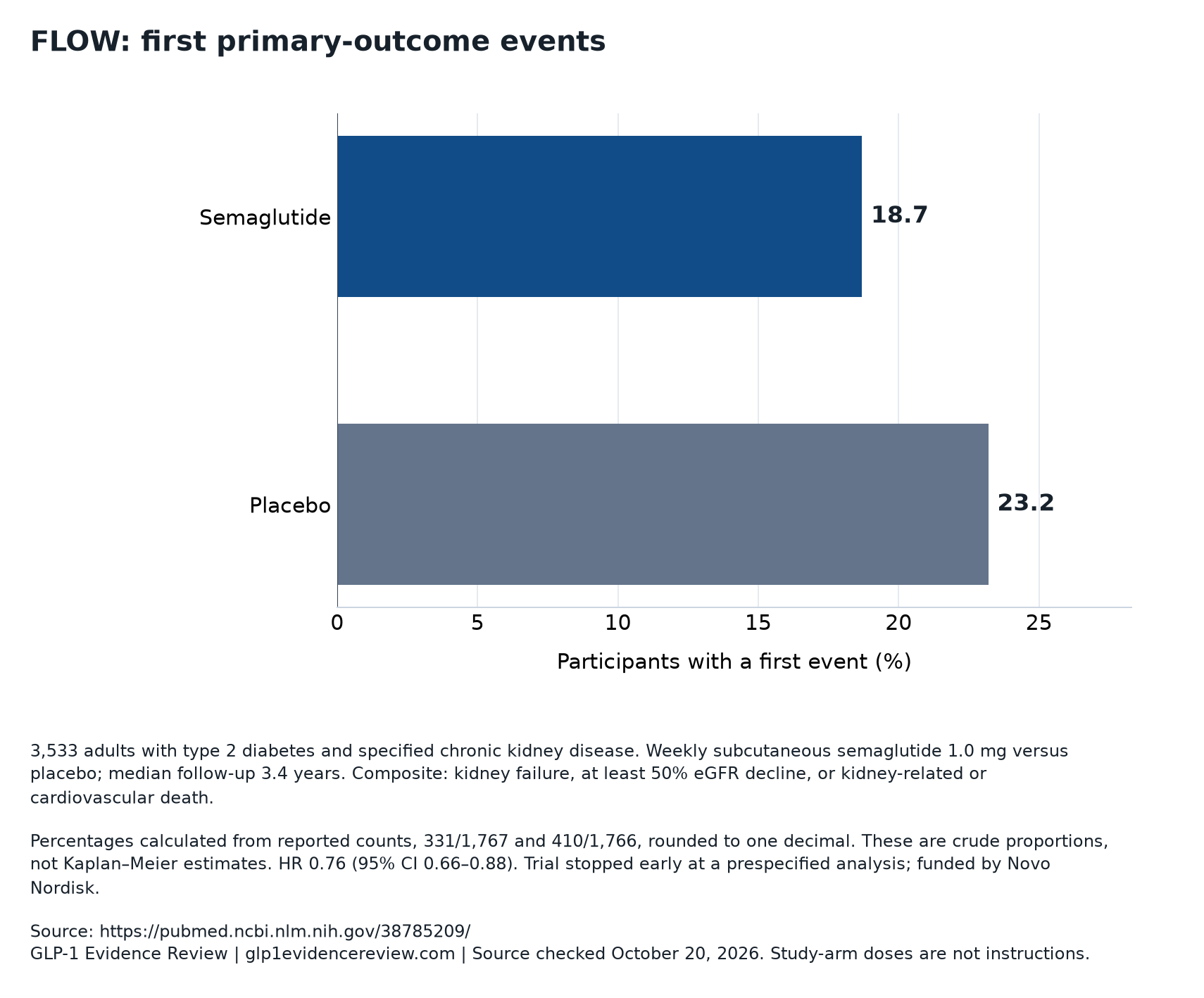
FLOW: first primary-outcome events
3,533 adults with type 2 diabetes and specified chronic kidney disease. Weekly subcutaneous semaglutide 1.0 mg versus placebo; median follow-up 3.4 years. Composite: kidney failure, at least 50% eGFR decline, or kidney-related or cardiovascular death.
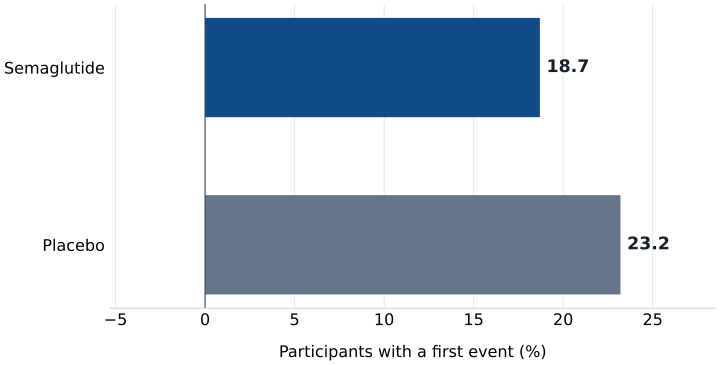
| Study group | Participants with a first event (%) |
|---|---|
| Semaglutide | 18.7 |
| Placebo | 23.2 |
Percentages calculated from reported counts, 331/1,767 and 410/1,766, rounded to one decimal. These are crude proportions, not Kaplan–Meier estimates. HR 0.76 (95% CI 0.66–0.88). Trial stopped early at a prespecified analysis; funded by Novo Nordisk.
Original visualization of published aggregate data. No individual prediction or provider performance is represented. Original research ↗
The primary composite combined kidney events with cardiovascular death
FLOW's primary outcome grouped several events: kidney failure, at least a 50% reduction in eGFR from baseline, and death from kidney-related or cardiovascular causes. Kidney failure included dialysis, transplantation, or eGFR below 15 mL/min/1.73 m². Thus, the endpoint combined treatment milestones, a major laboratory-defined deterioration, and fatal events.
A composite can capture clinically important consequences that are individually less frequent, making a trial more informative within a feasible follow-up period. But its label must not obscure its contents. A cardiovascular death counted even without a preceding kidney-failure event. Conversely, reaching the eGFR threshold counted without necessarily beginning dialysis or receiving a transplant.
The analysis counted first events, not the total number of subsequent complications a participant might experience. A lower composite hazard therefore does not mean that every component declined, or that recurrent hospitalizations or lifetime dialysis burden were reduced by the same amount. Readers comparing composite endpoints across trials can apply the same distinction when reading SELECT's cardiovascular outcomes.
What the 24% headline does—and does not—measure
The primary comparison produced 331 first events with semaglutide and 410 with placebo, with a hazard ratio of 0.76. The report described this as a 24% lower risk. More precisely, the reported estimate concerns the relative hazard of a first event over follow-up, not a 24-percentage-point reduction in the proportion of people experiencing one.
Dividing events by randomized participants gives approximately 18.7% versus 23.2%, a crude difference of about 4.5 percentage points. Those calculations help show the scale of the observations: roughly 19 versus 23 first events per 100 randomized participants over the observed study period. They are not a fixed-time survival estimate because participants' observation times can differ.
The hazard ratio's 95% confidence interval, 0.66–0.88, corresponds to relative hazard reductions ranging from about 12% to 34%. It describes uncertainty around the comparative estimate, not the range of individual benefits. The reported P value was 0.0003. Statistical evidence was strong, but neither that value nor the crude percentage difference supplies a personalized prediction.
| Measure | FLOW result | Interpretation |
|---|---|---|
| First-event counts | 331/1,767 versus 410/1,766 | Observed participants with a first qualifying event in each randomized group |
| Crude event proportions | Approximately 18.7% versus 23.2% | Calculated from counts; about a 4.5-percentage-point difference, without time-to-event adjustment |
| Relative hazard | 0.76; 95% CI 0.66–0.88 | Comparative hazard over follow-up, not an absolute percentage-point reduction |
Kidney-specific findings help interpret the broader result
An important follow-on question is whether the favorable primary result depended entirely on cardiovascular death. The report also presented a composite restricted to the kidney-specific components: its hazard ratio was 0.79, with a 95% confidence interval of 0.66–0.94. That supports a kidney-specific signal rather than a conclusion based solely on the cardiovascular component.
Cardiovascular death itself had a hazard ratio of 0.71, with a 95% confidence interval of 0.56–0.89. These estimates address related but distinct questions. Their confidence intervals overlap, and the abstract does not supply a formal comparison establishing that one type of outcome benefited more than another.
The remaining gap is component-level detail. The abstract does not give separate counts and estimates for dialysis, transplantation, the low-eGFR threshold, large eGFR decline, and kidney-related death. It therefore cannot establish that each improved independently. Nor should the kidney-specific and cardiovascular estimates be treated as independent pieces that can simply be added to reconstruct the primary result.
The endpoint hierarchy strengthens secondary findings without merging them
FLOW prespecified confirmatory secondary outcomes and tested them hierarchically. In a hierarchical procedure, statistical testing follows a planned sequence rather than treating every possible outcome as a separate unrestricted opportunity for success. This helps address the increased chance of a false-positive finding when many outcomes are examined.
All reported confirmatory secondary outcomes favored semaglutide. The annual eGFR slope differed by 1.16 mL/min/1.73 m² in favor of semaglutide, with P<0.001. Major cardiovascular events had a hazard ratio of 0.82, a 95% confidence interval of 0.68–0.98, and P=0.029. Death from any cause had a hazard ratio of 0.80, a 95% confidence interval of 0.67–0.95, and P=0.01.
These are distinct findings, not three restatements of the primary endpoint. The abstract does not reproduce every testing rule or give a confidence interval for the slope difference. A reader should retain those limits while recognizing the value of prespecification. Our medical-claims evidence checklist offers a framework for separating a planned endpoint from a more exploratory observation.
A slower eGFR slope is not the same as avoiding kidney failure
The eGFR slope summarizes the average rate at which estimated filtration changed over time. A less negative slope means kidney function declined more slowly on average. FLOW's between-group difference of 1.16 mL/min/1.73 m² per year describes separation in those average rates, not restoration of that much kidney function in every participant each year.
Slope and kidney failure answer different questions. A trajectory measure can detect differences before someone crosses a severe disease threshold. Kidney failure is an event with immediate clinical importance, but its occurrence also depends on starting function, subsequent changes, and survival. Concordant findings across these measures strengthen interpretation without making them interchangeable.
It would be inappropriate to multiply the slope difference indefinitely and promise a fixed number of dialysis-free years. That projection would assume a stable effect, predictable trajectories, and sufficiently known competing risks. FLOW's abstract does not establish those assumptions. It also does not settle how much of the slope difference reflects particular biological pathways rather than the combined consequences of treatment.
Early stopping changes the horizon of what is known
Median follow-up was 3.4 years after early cessation was recommended at a prespecified interim analysis. A planned interim review is different from looking repeatedly at results without an advance statistical framework. Still, the abstract does not provide the stopping boundary, the number of planned reviews, or the full statistical adjustments.
Stopping once benefit is sufficiently persuasive limits further randomized observation. It can leave fewer late events and less information about long-term durability or uncommon delayed harms than originally anticipated. Early-stopped benefit estimates can also be larger than estimates obtained with longer observation, although that possibility does not demonstrate that FLOW's estimate was biased.
The appropriate conclusion is neither that early stopping invalidates FLOW nor that benefit must continue unchanged for life. The observed evidence spans a median of several years. Questions about continued treatment and later trajectories require other designs and follow-up. A randomized-withdrawal study such as SURMOUNT-4 illustrates a different design question; its results cannot fill FLOW's kidney-specific follow-up gaps.
Serious-event totals are informative but not a complete safety profile
Serious adverse events were reported in 49.6% of semaglutide participants and 53.8% of placebo participants, a 4.2-percentage-point difference. That is reassuring at the level of the reported overall category. It is not evidence that nearly half of participants had events caused by semaglutide: adverse-event reporting records what occurred, while causal attribution is a separate judgment.
The aggregate also cannot show which particular harms were more common, how severe tolerability problems affected daily life, or how often participants stopped treatment because of them. The accessible FLOW abstract does not provide those breakdowns. A lower overall serious-event proportion can coexist with higher rates of a particular adverse effect, so calling the treatment simply safe would erase relevant distinctions.
SELECT illustrates why safety outcomes need their own definitions: adverse events leading to permanent trial-product discontinuation occurred in 16.6% with semaglutide versus 8.2% with placebo. Those are SELECT findings, not FLOW rates, and cannot be imported into this population. They reinforce why clinical follow-up is more than a renewal process, without supplying an individualized monitoring plan.
Transfer the finding carefully—to indications, products, and services
SELECT studied a different population: adults at least 45 years old with established cardiovascular disease, BMI of at least 27, and no diabetes, using weekly injectable semaglutide 2.4 mg. FLOW used 1.0 mg in selected people with diabetes and chronic kidney disease. Shared drug identity does not make their doses, populations, or endpoints interchangeable. Neither trial establishes a uniform kidney benefit for everyone receiving obesity treatment.
The January 2025 FDA Ozempic label included reducing sustained eGFR decline, end-stage kidney disease, and cardiovascular death in adults with type 2 diabetes and chronic kidney disease. That establishes a dated regulatory milestone, not a claim that this historical document is the latest complete prescribing information. Nor does FLOW establish equivalence for oral routes, other formulations, or compounded preparations; the approved-versus-compounded guide explains that separate evidence question.
Editorial interpretation: outcome evidence and purchasing terms deserve separate checks. NIDDK notes that coverage varies and treatment decisions depend on benefits, tolerability, medical history, and cost. A trial result is not an insurance promise or a service guarantee. Readers evaluating documentary terms can consult the CoreAge Rx review or Mochi Health review; neither link implies that a provider offers FLOW's studied product, kidney-specific care, or its outcomes.
Questions & answers
Does FLOW show that semaglutide prevents dialysis?
FLOW supports a lower hazard of a composite that included kidney failure, substantial eGFR decline, and kidney-related or cardiovascular death. Dialysis was one way to meet the kidney-failure component. The abstract does not provide a dialysis-only estimate, so it cannot establish the size or certainty of a separate dialysis-prevention effect.
Can someone without albumin in their urine assume the same benefit?
Not from FLOW alone. Both eligibility pathways required UACR above a specified threshold, with different thresholds depending on eGFR. People without elevated urine albumin were not represented by those entry criteria. Whether their relative effect or absolute benefit would be similar remains a separate evidence question.
Why not turn the crude event difference into a number needed to treat?
A meaningful number needed to treat needs a specified time horizon and an appropriate absolute-risk estimate. Dividing first-event counts by randomized participants does not account for differing observation times or censoring. The abstract reports a hazard ratio and median follow-up, but not the fixed-time survival estimates needed for that calculation here.
Do these results establish that weight loss caused the kidney benefit?
No. Randomization supports an effect of the assigned treatment comparison, but it does not independently randomize weight change or other possible mediators. The abstract cannot determine how much benefit arose through weight, glucose control, blood pressure, direct kidney pathways, or combinations of these factors.
Can a compounded semaglutide product claim FLOW's results?
FLOW does not establish equivalence for compounded preparations. FDA states that compounded drugs are not FDA approved or reviewed before marketing for safety, effectiveness, or quality, and identifies concerns including dosing errors and semaglutide salt ingredients. Those reports also cannot establish adverse-event rates or causation by themselves. Product-specific evidence remains necessary.
Our assessment
FLOW provides persuasive randomized evidence of benefit for a defined population with type 2 diabetes and chronic kidney disease. Its strongest features are clinically consequential outcomes, a kidney-specific supporting composite, favorable prespecified secondary findings, and several years of observation. The central numerical conclusion is a lower hazard of a first composite event—not a universal 24% reduction in every kidney complication. Early stopping, limited component-level detail in the abstract, and incomplete safety breakdowns constrain finer claims. The findings support a specific treatment comparison, not interchangeable promises about obesity care, compounded products, or provider performance.
Sources & documentation
Scientific and official sources consulted October 20, 2026. Study findings apply to the populations, products and time periods described; they are not provider outcome data.
- Effects of Semaglutide on Chronic Kidney Disease in Patients with Type 2 Diabetes. ↗
- Semaglutide and Cardiovascular Outcomes in Obesity without Diabetes. ↗
- FDA Ozempic prescribing information, January 2025 kidney indication ↗
- FDA concerns about unapproved GLP-1 drugs ↗
- NIDDK prescription medications for overweight and obesity ↗