A withdrawal trial asks a different question from a trial that starts treatment. Rather than comparing a medicine with placebo from the outset, SURMOUNT-4 first gave everyone tirzepatide, then randomly assigned eligible participants to continue treatment or switch to placebo. That structure makes it particularly informative about maintaining an established response—but less informative about what every person starting treatment should expect.
The main finding was a large separation in weight trajectories over the following year: continued treatment produced additional average loss, while withdrawal produced substantial average regain. Understanding that result requires keeping two baselines separate and distinguishing the 783 people who entered the initial treatment period from the 670 who reached randomization. Newer SURMOUNT-MAINTAIN research also matters: maintenance-dose reduction has now been studied, although not as a universal solution or a tapering schedule.
At a glance
- Enrollment versus randomization
- SURMOUNT-4 enrolled 783 participants in a 36-week open-label lead-in; 670 were then randomized, with 335 assigned to each group.Sources: [1]
- Initial weight loss
- Participants reaching randomization had lost an average of 20.9% during the lead-in. This is not an average outcome for all 783 entrants.Sources: [1]
- Primary randomized comparison
- From week 36 to week 88, average weight change was −5.5% with continued tirzepatide and +14.0% with placebo; the reported difference was −19.4 percentage points, with a 95% confidence interval of −21.2 to −17.7.Sources: [1]
- Preserving the initial loss
- At week 88, 89.5% continuing tirzepatide versus 16.6% receiving placebo maintained at least 80% of their lead-in weight loss.Sources: [1]
- Newer maintenance evidence
- SURMOUNT-MAINTAIN compared continued maximum tolerated tirzepatide, reduction to 5 mg, and placebo after a 60-week initial treatment period, with rescue therapy permitted later.Sources: [2]
The experiment began before the randomized comparison
SURMOUNT-4 was a phase 3 trial at 70 sites in four countries. Adults qualified with a body mass index, or BMI, of at least 30, or at least 27 with a weight-related complication. Diabetes was excluded. Treatment was studied alongside diet and physical activity, not as an isolated intervention without that context.
During the first 36 weeks, all 783 entrants received once-weekly subcutaneous tirzepatide—an injection under the skin—with maximum tolerated study doses of 10 or 15 mg. This phase was open-label, meaning treatment identity was known. At week 36, 670 participants entered a double-blind comparison: neither participants nor investigators knew who continued tirzepatide and who received placebo for another 52 weeks.
The randomized population averaged 48 years of age, was 71% women, and had a reported mean weight of 107.3 kg. Unlike an initial-treatment trial, this experiment evaluated a continuation decision after substantial treatment exposure. The distinction also explains why findings from other tirzepatide trials should not simply be substituted for its results.
Why 783 and 670 describe different populations
A total of 113 entrants did not reach randomization: about 14% of the lead-in population. That subtraction is useful, but it does not establish why each person left. The indexed abstract does not provide a complete breakdown of lead-in departures, so those 113 should not all be labeled treatment failures or adverse-event discontinuations.
Nevertheless, the randomized group was selected by reaching the end of 36 weeks of treatment and tolerating the study regimen sufficiently to proceed. This creates an important boundary: the comparison is especially relevant to people already established on treatment, not automatically to everyone considering a first prescription. Randomization protects the comparison within that selected population; it does not erase the selection.
The average 20.9% lead-in loss belongs to the participants who reached randomization. Assigning it to all 783 entrants would mix two denominators and overstate what the abstract establishes. Our guide to interpreting average weight results explains the additional distinction between a group average and an individual forecast.
STUDY DATA · GLP-1 Evidence Review
SURMOUNT-4: change after randomization
670 adults randomized after a 36-week tirzepatide lead-in; adults had obesity or overweight with a complication, without diabetes. The chart covers weeks 36–88, using weight at week 36 as the reference.
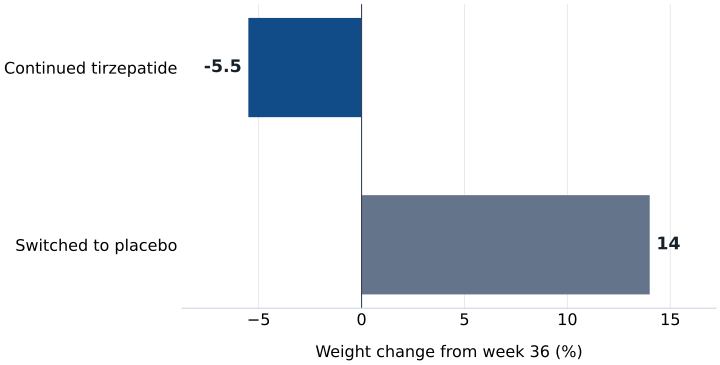
| Study group | Weight change from week 36 (%) |
|---|---|
| Continued tirzepatide | -5.5 |
| Switched to placebo | 14 |
Negative means further loss; positive means regain. The 20.9% lead-in loss uses a different baseline and cannot be added directly to these percentages. This selected population completed the lead-in. Trial sponsor: Eli Lilly.
Original visualization of published aggregate data. No individual prediction or provider performance is represented. Original research ↗
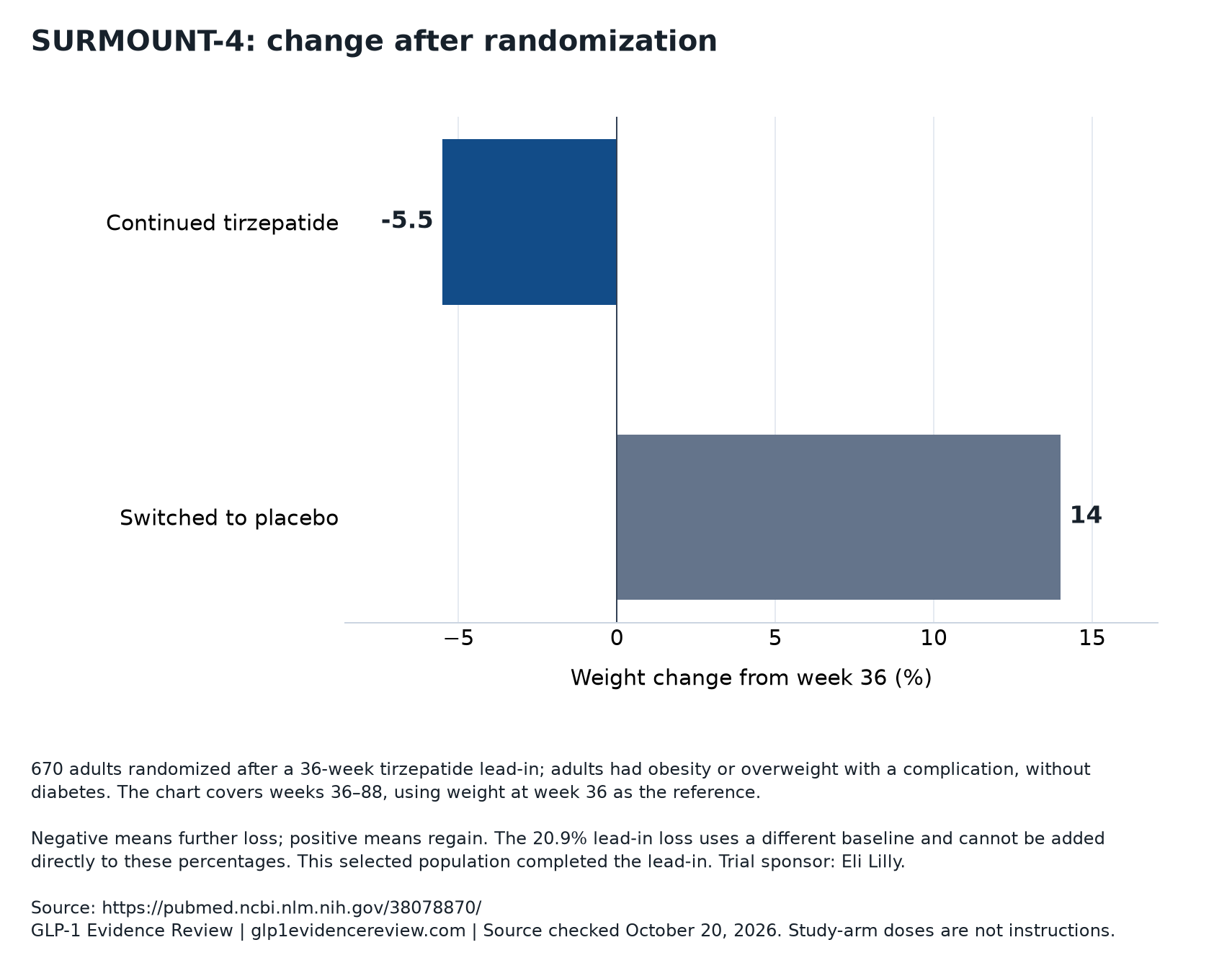
Two baselines change what the percentages mean
Week 0 was the beginning of initial treatment. Week 36 was the beginning of the randomized maintenance comparison. The primary endpoint—mean percentage weight change from week 36 to week 88—used the lower, post-loss weight as its reference. The reported total changes through week 88 instead used the original week-0 weight.
Consider an illustrative starting weight of 100 units, not an actual participant. A 20.9% reduction leaves 79.1 units at randomization. A subsequent 14.0% increase is calculated from 79.1, producing approximately 90.2 units, not 93.1. Similarly, an additional 5.5% reduction from 79.1 leaves approximately 74.7 units.
This arithmetic explains why subtracting 14.0 from 20.9 is incorrect. Percentage changes with different denominators compound rather than add. The illustration closely tracks the reported overall losses of 9.9% with placebo and 25.3% with continuation, but group-level estimates and rounding mean it is not an exact reconstruction of the trial analysis.
| Measurement | Reported result | Correct interpretation |
|---|---|---|
| Week 0 to week 36 | 20.9% mean loss | Initial loss among participants reaching randomization |
| Week 36 to week 88 | −5.5% continued treatment; +14.0% placebo | Changes relative to weight at randomization |
| Week 0 to week 88 | 25.3% loss continued treatment; 9.9% loss placebo | Net changes relative to original starting weight |
| Maintenance threshold at week 88 | 89.5% versus 16.6% | Proportions retaining at least 80% of their initial loss |
The primary result is a weight difference, not a risk reduction
The reported between-group difference in week-36-to-week-88 weight change was −19.4 percentage points, with a 95% confidence interval from −21.2 to −17.7. Because the outcome is percentage weight change, the difference is expressed in percentage points. It is not a 19.4% reduction in the risk of regaining weight, and it is not a hazard ratio.
The rounded group values, −5.5% and +14.0%, subtract to −19.5 points. That small discrepancy from the reported −19.4-point estimate is consistent with rounding; it is not a different result. The confidence interval indicates relatively precise estimation of the average contrast under the analysis assumptions, rather than a range in which individual participants' outcomes must fall.
An estimand is the precise treatment effect a study aims to estimate, including how treatment discontinuation and other events are handled. The SURMOUNT-4 indexed abstract specifies the endpoint but does not describe its complete estimand or missing-data procedures. Those details cannot responsibly be reconstructed from the headline numbers alone.
Maintaining 80% of a loss is a separate endpoint
The primary endpoint measured average weight change. A key secondary endpoint instead classified each participant according to whether they retained at least 80% of the weight lost during the lead-in. At week 88, 300 participants continuing tirzepatide, or 89.5%, met this threshold, compared with 16.6% receiving placebo.
For illustration, someone who initially lost 20 units would retain 80% of that loss by remaining at least 16 units below their original weight. They could regain four units and still qualify. Thus, meeting this endpoint does not require zero regain, and failing it does not necessarily mean returning to the original starting weight.
The absolute separation was 72.9 percentage points. That is a difference in proportions meeting a specified threshold, distinct from the primary difference in average weight change. Neither endpoint establishes a reduction in heart attacks, kidney failure, or mortality. Trials such as SELECT, which measured cardiovascular outcomes, address a different outcome question in a different clinical setting.
Regain is evidence of lost treatment benefit, not a mechanism test
Because participants were randomly assigned to continuation or placebo after a shared treatment period, SURMOUNT-4 offers stronger evidence about the effect of withdrawal than simply observing people who independently chose to stop. Such choices outside trials can be related to side effects, affordability, illness, or response, making comparisons harder to interpret.
The substantial average regain after switching to placebo supports the conclusion that much of the established weight benefit depended on ongoing treatment under these study conditions. It does not establish a withdrawal syndrome, identify a single biological mechanism, or demonstrate that every participant inevitably regained the same amount. The placebo group's average remained below its original starting weight at week 88.
The randomized follow-up lasted one year. It cannot settle whether later weight trajectories would plateau or continue changing, nor whether an alternative support strategy would alter them. Evidence of a large average continuation benefit is therefore compatible with uncertainty about individual outcomes and longer-term trajectories.
SURMOUNT-MAINTAIN tested dose reduction directly
It is no longer accurate to say that maintenance-dose reduction has not been researched. The 2026 SURMOUNT-MAINTAIN report describes a phase 3b trial at 20 US sites, funded by Eli Lilly. After 60 weeks of initial tirzepatide treatment, participants were randomized to continue the maximum tolerated dose of 10 or 15 mg, reduce to 5 mg, or switch to placebo. These identify research arms, not dosing instructions.
Of 441 initial participants, 378 were randomized: 140 to maximum tolerated treatment, 144 to 5 mg, and 94 to placebo. The study reported 345 completers, or 91% of those randomized. At initial enrollment, mean age was 46.6 years, mean BMI was 40.1, and mean weight was 113.8 kg; 65% were women and 67% were White.
Its primary endpoint used the original baseline through week 112, not the start of the randomized phase. Estimated total weight changes were −21.9%, −16.6%, and −9.9%, respectively. Compared with placebo, reported differences were −12.0 percentage points for maximum tolerated treatment and −6.6 for 5 mg. These placebo comparisons should not be mistaken for a reported formal equivalence test between active regimens.
| Randomized arm | Estimated baseline-to-week-112 weight change | Reported difference versus placebo |
|---|---|---|
| Maximum tolerated tirzepatide, 10 or 15 mg | −21.9%; 95% CI −23.5 to −20.3 | −12.0 percentage points; 95% CI approximately −13.8 to −10.1 |
| Tirzepatide reduced to 5 mg | −16.6%; 95% CI −18.0 to −15.1 | −6.6 percentage points; 95% CI −8.3 to −5.0 |
| Placebo | −9.9%; 95% CI −11.1 to −8.8 | Reference group |
Rescue treatment changes the maintenance interpretation
Starting at week 84, 24 weeks after randomization, SURMOUNT-MAINTAIN allowed rescue tirzepatide when regain exceeded 50% of previously lost weight. Reported rescue receipt was 11 of 138 participants in the maximum tolerated group, 35 of 142 in the 5-mg group, and 60 of 90 in the placebo group—approximately 8%, 25%, and 67%.
The primary modified treatment-regimen estimand included randomized participants regardless of discontinuation or prohibited medication use. For people starting rescue, it assumed no further benefit from their assigned study treatment. Consequently, the final estimates are not simply observed weights after everyone remained on their original assignment for the entire year.
Interpretation: the reduced-dose arm retained more average loss than placebo, but rescue was more common than with maximum tolerated treatment. This is evidence for a studied maintenance alternative, not proof that reduction works equally well for everyone. The design did not test a gradual taper to zero, arbitrary dosing intervals, or an individualized sequence selected from repeated responses.
The semaglutide extension answers a related, weaker causal question
The STEP 1 extension followed 327 participants after 68 weeks of semaglutide 2.4 mg or placebo. Unlike SURMOUNT-4, it did not randomize participants again to continuation versus withdrawal. Both study medication and structured lifestyle intervention stopped, and the subsequent one-year analyses were exploratory. Our STEP 1 extension analysis examines those design differences in detail.
Participants previously receiving semaglutide had lost an average of 17.3% and regained 11.6 percentage points relative to original baseline weight, leaving a net 5.6% loss at week 120. The ratio 11.6 divided by 17.3 explains the description of roughly two-thirds regained. This denominator differs from SURMOUNT-4's 14.0% increase relative to post-loss weight.
Most cardiometabolic improvements moved back toward baseline, although some residual improvements remained. The extension cannot isolate stopping medication from stopping structured lifestyle support. It was funded by Novo Nordisk, used a selected subset of treatment completers, and did not systematically collect adverse events during the extension. These differences prevent a valid drug-versus-drug comparison of regain.
Safety and access remain separate evidence questions
SURMOUNT-4 reported predominantly mild-to-moderate gastrointestinal adverse events, more common with tirzepatide than placebo. SURMOUNT-MAINTAIN likewise reported gastrointestinal events as most common, usually mild to moderate and concentrated during dose escalation. These findings are not a blanket declaration of safety: selected tolerators and limited follow-up constrain what maintenance comparisons reveal about starting treatment or uncommon harms.
NIDDK frames treatment duration around benefit and tolerability, with health history, other medicines, adverse effects, and cost considered together. Editorial interpretation: because interruption can affect maintained weight loss, access and follow-up deserve attention before a contract is treated as a long-term care plan. The clinical follow-up guide addresses that distinction; the Ro documentation review can be used to check documentary terms, not to infer trial-level outcomes or condition-specific care.
The evidence here concerns studied subcutaneous formulations. It does not automatically transfer to oral routes, compounded preparations, or provider programs. FDA states that compounded drugs are not reviewed before marketing for safety, effectiveness, or quality and identifies concerns including dosing errors. The approved-versus-compounded guide separates those product questions from the efficacy demonstrated in clinical trials.
Questions & answers
Does SURMOUNT-4 show that everyone regains all lost weight after stopping?
No. It shows substantial average regain over 52 weeks after randomized withdrawal in a selected population. The placebo group's average weight was still 9.9% below original baseline at week 88. An average does not describe every participant, and the trial does not establish the eventual trajectory beyond follow-up.
Why is the 20.9% initial loss not added to the additional 5.5% loss?
The percentages use different reference weights. The initial loss is relative to week 0; the additional loss is relative to the lower weight at week 36. In an illustration starting at 100 units, 79.1 multiplied by 0.945 gives about 74.7 units, consistent with approximately 25.3% total loss rather than 26.4%.
Has a lower tirzepatide maintenance dose actually been tested?
Yes. SURMOUNT-MAINTAIN studied reduction to 5 mg after 60 weeks of initial treatment, alongside continued maximum tolerated treatment and placebo. The reduced-dose arm retained more average loss than placebo, but responses varied and rescue treatment was allowed. It was not a trial of gradual tapering or stopping schedules.
Can the confidence interval predict my likely weight change?
No. The SURMOUNT-4 confidence interval describes uncertainty in the estimated average between-group difference under the study's analysis. It does not contain 95% of individual weight outcomes. Predicting an individual's response would require additional evidence beyond the reported average contrast, including information not available in the indexed abstract.
Do these findings establish that treatment must continue for life?
They support ongoing treatment as an important maintenance strategy, not a universal lifetime requirement. The randomized maintenance periods lasted 52 weeks. NIDDK describes duration as depending on benefit and tolerability. Neither the withdrawal trial nor the newer maintenance trial supplies an individualized prescribing, reduction, or discontinuation plan.
Our assessment
SURMOUNT-4 provides a compelling randomized comparison of continuation and withdrawal after successful treatment exposure: weight trajectories diverged substantially over the next year. Its strongest inference concerns people who reached randomization, not all treatment starters. SURMOUNT-MAINTAIN adds direct evidence that a studied reduced-dose strategy can preserve more average loss than placebo, while also showing more rescue use than maximum tolerated treatment. Together, the studies establish that maintenance is an active treatment question. They do not establish a universally optimal dose, a tapering protocol, lifetime necessity for every individual, or equivalent results across products and providers.
Sources & documentation
Scientific and official sources consulted October 20, 2026. Study findings apply to the populations, products and time periods described; they are not provider outcome data.
- Continued Treatment With Tirzepatide for Maintenance of Weight Reduction in Adults With Obesity: The SURMOUNT-4 Randomized Clinical Trial. ↗
- Tirzepatide for maintenance of bodyweight reduction in people with obesity in the USA (SURMOUNT-MAINTAIN): a multicentre, double-blind, randomised, placebo-controlled trial. ↗
- Weight regain and cardiometabolic effects after withdrawal of semaglutide: The STEP 1 trial extension. ↗
- NIDDK prescription medications for overweight and obesity ↗
- FDA concerns about unapproved GLP-1 drugs ↗