SELECT answered a question that weight-loss trials alone could not: would weekly injectable semaglutide reduce serious cardiovascular events in people with overweight or obesity who already had cardiovascular disease but no history of diabetes? Among 17,604 randomized participants, the primary composite occurred in 6.5% assigned semaglutide and 8.0% assigned placebo. The reported hazard ratio was 0.80. Those figures describe related but different aspects of the result—not interchangeable versions of a single percentage.
The practical meaning depends on who entered the trial, what counted as an event, and how long participants were followed. This analysis uses the indexed primary report abstracts for SELECT, FLOW, and SUMMIT and available official FDA material; it does not represent a review of their complete protocols, supplements, or full articles. The central finding is persuasive for SELECT’s studied population, but it is not evidence that every cardiovascular outcome improved, that people without established disease receive the same benefit, or that every semaglutide formulation is equivalent.
At a glance
- Population
- SELECT enrolled 17,604 adults aged 45 or older with established cardiovascular disease, BMI of at least 27, and no history of diabetes.Sources: [1]
- Randomized comparison
- Once-weekly subcutaneous semaglutide, with a study dose of 2.4 mg, was compared with placebo; both groups received standard cardiovascular care and lifestyle counseling.
- Primary outcome
- Cardiovascular death, nonfatal heart attack, or nonfatal stroke occurred in 569 of 8,803 semaglutide participants and 701 of 8,801 placebo participants.Sources: [1]
- Relative and absolute results
- The hazard ratio was 0.80 (95% confidence interval, 0.72–0.90); rounded event proportions differed by 1.5 percentage points over a mean 39.8-month follow-up.Sources: [1]
- Treatment discontinuation
- Adverse events led to permanent trial-product discontinuation in 16.6% assigned semaglutide versus 8.2% assigned placebo.Sources: [1]
SELECT tested secondary prevention, not cardiovascular protection for everyone
Participants had to be at least 45 years old, have a body-mass index of 27 or greater, and have preexisting cardiovascular disease. BMI relates weight to height; it was an eligibility criterion here, not a complete measure of cardiovascular health. A history of diabetes excluded participation. These conditions define the population behind the result.
Because cardiovascular disease was already present, SELECT was a secondary-prevention trial: it examined prevention of further serious events in people with established disease. Primary prevention asks a different question—whether treatment prevents a first cardiovascular event in people without established disease. SELECT does not directly establish that benefit, even when someone otherwise resembles participants in age or BMI.
Baseline risk matters because it helps determine the possible absolute benefit. The placebo group’s observed event proportion was approximately 8% during trial follow-up despite background care. That is a useful description of this study population, not a universal risk estimate for everyone with overweight or obesity. The abstract does not supply enough detail to calculate an individual’s expected risk or identify which unreported subgroups benefited most.
Randomization isolated an added treatment strategy
SELECT was multicenter, double-blind, randomized, placebo-controlled, and designed to test superiority. Participants were assigned equally: 8,803 to semaglutide and 8,801 to placebo. Random assignment makes the groups comparable on average, including for influences investigators may not have measured. Double-blinding limits bias related to knowing which treatment someone receives, although the abstract does not provide a detailed assessment of blinding.
The intervention was once-weekly subcutaneous injection, with 2.4 mg identifying the semaglutide study arm. This describes the experiment, not a dosing recommendation. According to the FDA announcement, both groups received standard cardiovascular care and lifestyle counseling. The comparison therefore concerns adding semaglutide versus adding placebo within that care context—not replacing established cardiovascular treatment with a weight-management medicine.
The trial was event-driven, meaning accumulation of outcome events was central to its design. That differs from judging success solely by weight change at a fixed visit. Novo Nordisk funded SELECT. Sponsorship is relevant context for appraisal, but the design, endpoint definition, event counts, and uncertainty remain the evidence to examine; funding alone neither proves nor invalidates a result.
STUDY DATA · GLP-1 Evidence Review
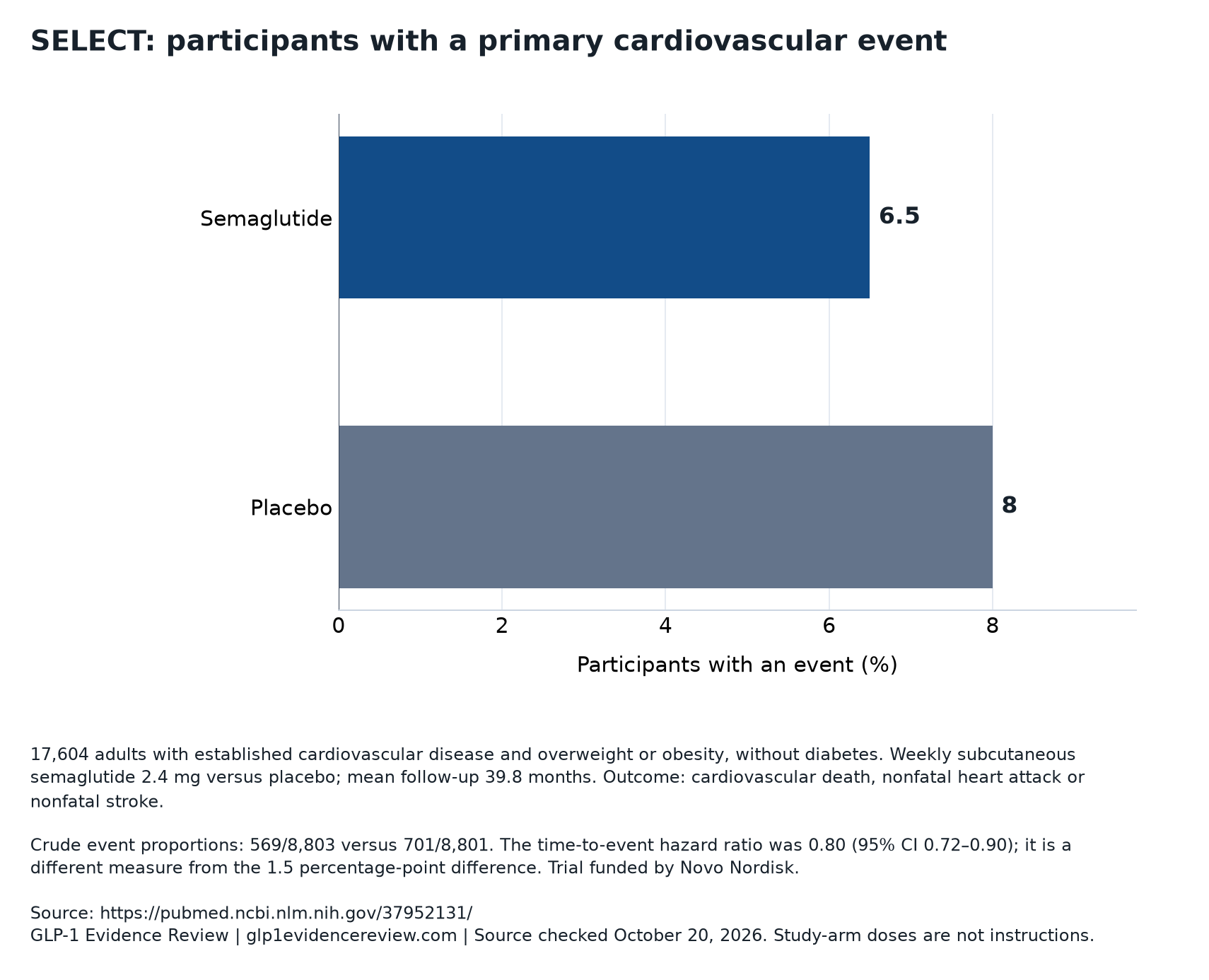
SELECT: participants with a primary cardiovascular event
17,604 adults with established cardiovascular disease and overweight or obesity, without diabetes. Weekly subcutaneous semaglutide 2.4 mg versus placebo; mean follow-up 39.8 months. Outcome: cardiovascular death, nonfatal heart attack or nonfatal stroke.
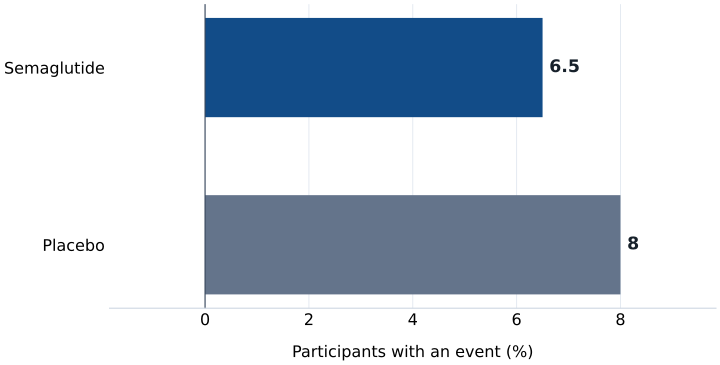
| Study group | Participants with an event (%) |
|---|---|
| Semaglutide | 6.5 |
| Placebo | 8 |
Crude event proportions: 569/8,803 versus 701/8,801. The time-to-event hazard ratio was 0.80 (95% CI 0.72–0.90); it is a different measure from the 1.5 percentage-point difference. Trial funded by Novo Nordisk.
Original visualization of published aggregate data. No individual prediction or provider performance is represented. Original research ↗
The three-part endpoint asks a precise, limited question
SELECT’s primary endpoint combined death from cardiovascular causes, nonfatal myocardial infarction, and nonfatal stroke. Myocardial infarction is a heart attack. A composite endpoint counts any qualifying component toward the main outcome, allowing investigators to study a broader clinical question than any single component alone.
The analysis was time to first event. It considered how long participants remained free of their first qualifying outcome, rather than simply totaling every cardiovascular event experienced. Consequently, 569 versus 701 participants with a primary event is not a count of all heart attacks, strokes, cardiovascular deaths, or recurrent events that occurred.
A favorable composite does not establish that each component improved separately. Components can differ in frequency, treatment response, and statistical precision. The accessible SELECT abstract reports the combined result but not separate estimates for all three components or the complete secondary-endpoint testing hierarchy. The evidence checklist offers a useful reading discipline: match each claim to the exact endpoint that supports it, rather than expanding a composite result into several independent conclusions.
Why 20% and 1.5 percentage points are both correct
The hazard ratio was 0.80. In the trial’s time-to-event comparison, that corresponds to a 20% lower estimated hazard of a first primary event with semaglutide. Hazard describes the rate of events among participants who have not yet had the event at a particular time. It is not simply the final percentage of participants experiencing an event.
The crude proportions answer a more direct counting question: 569 divided by 8,803 is approximately 6.46%, while 701 divided by 8,801 is approximately 7.96%. Subtracting gives about 1.50 percentage points, consistent with the rounded 6.5% and 8.0% figures. Put descriptively, that is roughly 15 fewer participants with a primary event per 1,000 assigned during the observed follow-up—not an annual estimate or an individual prediction.
A relative calculation using the rounded proportions gives about 18.8%, not exactly 20%. That is not a contradiction: the crude calculation ignores event timing and differences in observation time, whereas the reported hazard ratio comes from the time-to-event analysis. The absolute difference should therefore not be called a 1.5% hazard reduction, and the 20% hazard reduction should not be described as a 20-percentage-point reduction.
| Measure | Reported or calculated value | What it describes |
|---|---|---|
| Hazard ratio | 0.80; 95% CI, 0.72–0.90 | The relative time-to-first-event comparison |
| Observed event proportions | 6.5% versus 8.0% | Rounded proportions with a primary event during follow-up |
| Crude absolute difference | About 1.5 percentage points | The difference between observed proportions, not an annualized effect |
Follow-up time and uncertainty shape the interpretation
Mean follow-up was 39.8 months, with a standard deviation of 9.4 months. A mean is an average, not a statement that everyone was observed for exactly that duration. The standard deviation indicates variation around the average. It would be misleading to present SELECT as a fixed 39.8-month risk comparison for every participant.
The hazard ratio’s 95% confidence interval, 0.72 to 0.90, supports a lower composite hazard while expressing uncertainty about its magnitude. On the relative hazard scale, its endpoints correspond to reductions of approximately 28% and 10%. This interval is not a range of benefits guaranteed for individual patients, and it does not address whether the estimate transfers to a different population.
The estimate also does not establish a lifetime effect or a constant annual benefit. Dividing the 1.5-percentage-point crude difference by average follow-up would discard information about when events occurred and how observation varied. The abstract provides neither the full event curves nor detailed modeling diagnostics, so the most defensible interpretation stays with its reported follow-up, event counts, and hazard estimate.
Assignment, exposure, and discontinuation are different questions
Mean exposure to semaglutide or placebo was 34.2 months, compared with mean follow-up of 39.8 months. Exposure describes time receiving trial product; follow-up describes time under observation. Their averages differ by 5.6 months, but that subtraction does not establish why treatment ended for particular participants or reconstruct their individual treatment histories.
This distinction matters for the estimand—the precise treatment effect a study seeks to estimate. An effect of assignment to a treatment strategy is not automatically the same as an effect among people who continuously tolerate and use treatment. The abstract reports randomized-group outcomes but does not fully describe how discontinuation, missing observations, or subsequent treatment were handled. It therefore does not support a detailed reconstruction of the estimand or a separate continuous-use effect.
Adverse events caused permanent product discontinuation in 1,461 semaglutide participants, or 16.6%, versus 718 placebo participants, or 8.2%. The rounded difference is 8.4 percentage points. This is a substantial tolerability finding, but it cannot simply be subtracted from cardiovascular benefit: stopping treatment and experiencing a cardiovascular endpoint differ in meaning and severity. The clinical follow-up guide explains why monitoring is a separate question from obtaining refills.
What the safety and mechanism evidence leaves unresolved
SELECT’s abstract establishes more adverse-event-related discontinuation with semaglutide, but it does not enumerate the symptoms or provide a complete serious-adverse-event profile. It would be inappropriate to import gastrointestinal-event percentages from another trial and label them SELECT findings. Likewise, a reduction in cardiovascular events does not justify describing the treatment simply as safe.
The available abstract also cannot establish how much of the cardiovascular effect resulted from weight loss versus other pathways. Randomization tested the treatment strategy, not an isolated mechanism. Demonstrating that the assigned treatment reduced events is different from showing that a particular amount of weight loss caused the reduction. No mechanism-specific effect size can be calculated from the reported primary results.
Important unresolved questions include how benefits and tolerability vary across clinically relevant groups, how outcomes evolve beyond the observed period, and what happens after treatment ends. These are questions for additional analyses or studies, not gaps to fill with assumptions. SELECT’s strong overall result can coexist with uncertainty about individual response, biological pathways, and longer-term treatment patterns.
FLOW supports a different semaglutide question
FLOW studied 3,533 participants with type 2 diabetes and chronic kidney disease, using weekly subcutaneous semaglutide at a study dose of 1.0 mg versus placebo. Its primary composite included kidney failure, a sustained large decline in kidney function as defined in the report, or death from kidney-related or cardiovascular causes. That is not SELECT’s three-component cardiovascular endpoint.
Over median follow-up of 3.4 years, FLOW recorded 331 versus 410 first primary events, with a hazard ratio of 0.76 and 95% confidence interval of 0.66 to 0.88. Early cessation was recommended at a prespecified interim analysis. Its confirmatory secondary outcomes were tested hierarchically, meaning the testing sequence governed confirmatory claims; major cardiovascular events had a hazard ratio of 0.82, with a 95% interval of 0.68 to 0.98.
Serious adverse events occurred in 49.6% versus 53.8% in FLOW, a different safety measure from SELECT’s discontinuation endpoint. Novo Nordisk funded both trials, but shared sponsorship and ingredient do not merge their populations, doses, or outcomes. The FLOW analysis examines why kidney-focused evidence should be read on its own terms rather than used as a duplicate SELECT result.
SUMMIT shows why the components still matter
SUMMIT evaluated a different medicine, tirzepatide, in 731 people with obesity and heart failure with preserved ejection fraction. Participants received weekly subcutaneous tirzepatide, up to a 15-mg study dose, or placebo. Median follow-up was 104 weeks. Its cardiovascular composite combined cardiovascular death with worsening heart failure, rather than SELECT’s heart attack and stroke components.
The composite occurred in 9.9% versus 15.3%, with a hazard ratio of 0.62 and 95% confidence interval of 0.41 to 0.95. Worsening heart-failure events favored tirzepatide, but cardiovascular deaths numbered eight versus five; the mortality hazard ratio was 1.58 with a wide interval of 0.52 to 4.83. Those sparse data do not establish either a mortality benefit or definitive mortality harm.
SUMMIT also improved a prespecified patient-reported health-status measure, while adverse events, mainly gastrointestinal, led to discontinuation in 6.3% versus 1.4%. Eli Lilly funded the trial. The SUMMIT analysis illustrates why a favorable composite cannot be translated into a claim that every component improved. Neither trial provides a head-to-head cardiovascular comparison of tirzepatide and semaglutide.
| Trial and population | Studied injection | Primary outcome focus |
|---|---|---|
| SELECT: established cardiovascular disease, BMI ≥27, no diabetes | Semaglutide 2.4 mg weekly versus placebo | Cardiovascular death, nonfatal heart attack, or nonfatal stroke |
| FLOW: type 2 diabetes and chronic kidney disease | Semaglutide 1.0 mg weekly versus placebo | Major kidney events or kidney-related/cardiovascular death |
| SUMMIT: obesity and heart failure with preserved ejection fraction | Tirzepatide up to 15 mg weekly versus placebo | Cardiovascular death/worsening heart failure and a separate health-status endpoint |
Regulatory relevance does not establish product or provider equivalence
The FDA’s March 8, 2024 announcement documented a cardiovascular indication for Wegovy injection in adults with cardiovascular disease and overweight or obesity, alongside reduced-calorie diet and increased physical activity. That announcement supports the regulatory significance of SELECT. It is a historical approval document, however, not a substitute for current complete prescribing information.
The result does not automatically transfer to oral semaglutide, other formulations, or compounded preparations. FDA states that compounded drugs are not approved or reviewed before marketing for safety, effectiveness, or quality, and identifies concerns including dosing errors and semaglutide salt ingredients. The approved-versus-compounded guide separates those evidence questions. Adverse-event reports about compounded products cannot by themselves establish event rates or causation.
Editorial interpretation: when assessing a service, separate the medicine’s trial evidence from documentation of the service’s terms. The CoreAge Rx review can be used to check documentary terms, not to infer availability of the studied product, cardiovascular care, or SELECT-like outcomes. A contract or program description cannot establish clinical equivalence, and SELECT did not test telehealth companies against one another.
Questions & answers
Does SELECT mean semaglutide prevents a first heart attack in people without cardiovascular disease?
Not from this trial alone. Participants already had cardiovascular disease, so SELECT directly addresses secondary prevention. A person without established disease may have a different baseline risk and potential absolute benefit. Similarity in weight or age does not erase that difference in eligibility.
Why not describe the result as a 20% lower chance of an event?
That wording blurs the measure. The reported 20% reduction concerns the hazard in a time-to-first-event analysis. Observed event proportions were 6.5% and 8.0%, a crude difference of 1.5 percentage points. Reporting both preserves the relative comparison and the scale of events actually observed.
Did cardiovascular deaths, heart attacks, and strokes each decrease?
The accessible SELECT abstract establishes a reduction in their combined endpoint, not separate statistically supported reductions in every component. Component-specific estimates and their uncertainty are necessary before making those narrower claims. SUMMIT provides a concrete example of why a favorable composite need not imply a favorable mortality estimate.
Do the discontinuation figures cancel out the cardiovascular result?
No. They describe a different outcome and should remain visible alongside efficacy. Permanent product discontinuation because of adverse events occurred in 16.6% versus 8.2%. Cardiovascular events and treatment discontinuations cannot be treated as equivalent units in a simple subtraction, and the abstract does not provide a complete individualized benefit-harm assessment.
Can SELECT results be used to validate a compounded product or a provider program?
No. SELECT studied a particular injectable treatment strategy under trial conditions, not every preparation sharing an ingredient name or every service arranging treatment. FDA states that compounded drugs are not FDA approved. Product identity, formulation, and service documentation remain separate questions from the cardiovascular efficacy demonstrated in SELECT.
Our assessment
SELECT provides strong randomized evidence that weekly injectable semaglutide reduced the first occurrence of its major cardiovascular composite in adults with established cardiovascular disease, overweight or obesity, and no diabetes. The hazard ratio of 0.80 and roughly 1.5-percentage-point crude event difference convey different, complementary information over mean follow-up of 39.8 months. Higher adverse-event-related discontinuation is an important counterweight, not a reason to erase either benefit or tolerability findings. The clearest interpretation stays anchored to the randomized comparison, studied population, specific endpoint, and observed period.
Sources & documentation
Scientific and official sources consulted October 20, 2026. Study findings apply to the populations, products and time periods described; they are not provider outcome data.
- Semaglutide and Cardiovascular Outcomes in Obesity without Diabetes. ↗
- FDA cardiovascular indication for Wegovy, March 8, 2024 ↗
- Effects of Semaglutide on Chronic Kidney Disease in Patients with Type 2 Diabetes. ↗
- Tirzepatide for Heart Failure with Preserved Ejection Fraction and Obesity. ↗
- FDA concerns about unapproved GLP-1 drugs ↗