SUMMIT tested a clinically important question: could tirzepatide improve outcomes in people who had both obesity and heart failure with preserved ejection fraction? Its answer was favorable for a combined endpoint of cardiovascular death or worsening heart failure, and for patient-reported health status. But the combined result is not evidence that cardiovascular deaths alone decreased. Understanding that distinction requires looking beyond the headline hazard ratio to the patients enrolled, the events counted, and the uncertainty around each estimate.
This analysis uses the indexed primary report abstracts for SUMMIT and two related trials, together with available official FDA material—not a review of complete protocols, supplements, or full trial reports. The central finding is substantial but specific: among 731 randomized participants followed for a median of 104 weeks, the primary clinical composite occurred less often with tirzepatide than with placebo. The strongest component evidence concerned worsening heart failure; the small number of cardiovascular deaths left that separate question unresolved.
At a glance
- Population
- SUMMIT randomized 731 people with heart failure, ejection fraction of at least 50%, and BMI of at least 30.Sources: [1]
- Intervention and observation
- The trial compared once-weekly subcutaneous tirzepatide, up to 15 mg, with placebo; median follow-up was 104 weeks.Sources: [1]
- Primary clinical composite
- Cardiovascular death or worsening heart failure occurred in 9.9% versus 15.3%; hazard ratio 0.62, 95% CI 0.41–0.95.Sources: [1]
- Cardiovascular deaths
- There were 8 cardiovascular deaths with tirzepatide and 5 with placebo; hazard ratio 1.58, 95% CI 0.52–4.83. This does not establish an isolated mortality benefit.Sources: [1]
- Treatment discontinuation
- Adverse events, mainly gastrointestinal, led to trial-drug discontinuation in 6.3% with tirzepatide versus 1.4% with placebo.Sources: [1]
The population defines the question
SUMMIT was an international, double-blind, randomized, placebo-controlled trial. Investigators assigned 364 participants to tirzepatide and 367 to placebo. Eligibility required heart failure, an ejection fraction of at least 50%, and a body-mass index of at least 30. BMI relates weight to height; the threshold selected a population with obesity rather than everyone with heart failure.
Ejection fraction measures the proportion of blood pumped out of the left ventricle with each contraction. A preserved value does not mean that heart function or symptoms are normal. Heart failure with preserved ejection fraction, often shortened to HFpEF, identifies a different clinical population from heart failure with reduced ejection fraction. SUMMIT therefore cannot automatically answer treatment questions across all heart-failure categories.
Selection matters for interpretation as much as sample size. These results directly concern people meeting the trial’s disease and obesity criteria, not people seeking weight management without heart failure. The abstract does not provide enough eligibility detail to assess every boundary of applicability, including how representative participants were of all patients encountered in routine care.
What randomization tested—and what remains unspecified
Participants were assigned in a 1:1 ratio to once-weekly subcutaneous tirzepatide, up to 15 mg, or placebo for at least 52 weeks. Those doses identify the research arms; they are not treatment instructions. Double blinding reduces the possibility that knowing the assignment changes symptom reporting, clinical decisions, or event assessment.
Randomization strengthens a causal comparison between the assigned groups because it tends to balance measured and unmeasured baseline characteristics. Nevertheless, the precise estimand—the treatment effect the analysis intends to estimate—also depends on how investigators handle discontinuation, missed observations, and other events after assignment. The abstract identifies a time-to-first-event comparison but does not describe all those handling rules.
Median follow-up was 104 weeks, approximately two years. A median is not a statement that every participant was observed for exactly that duration. The clinical-event analysis and the 52-week questionnaire analysis also answer questions over different observation windows. Eli Lilly funded SUMMIT, registered as NCT04847557; knowing the sponsor adds context but does not replace appraisal of the design and results.
STUDY DATA · GLP-1 Evidence Review
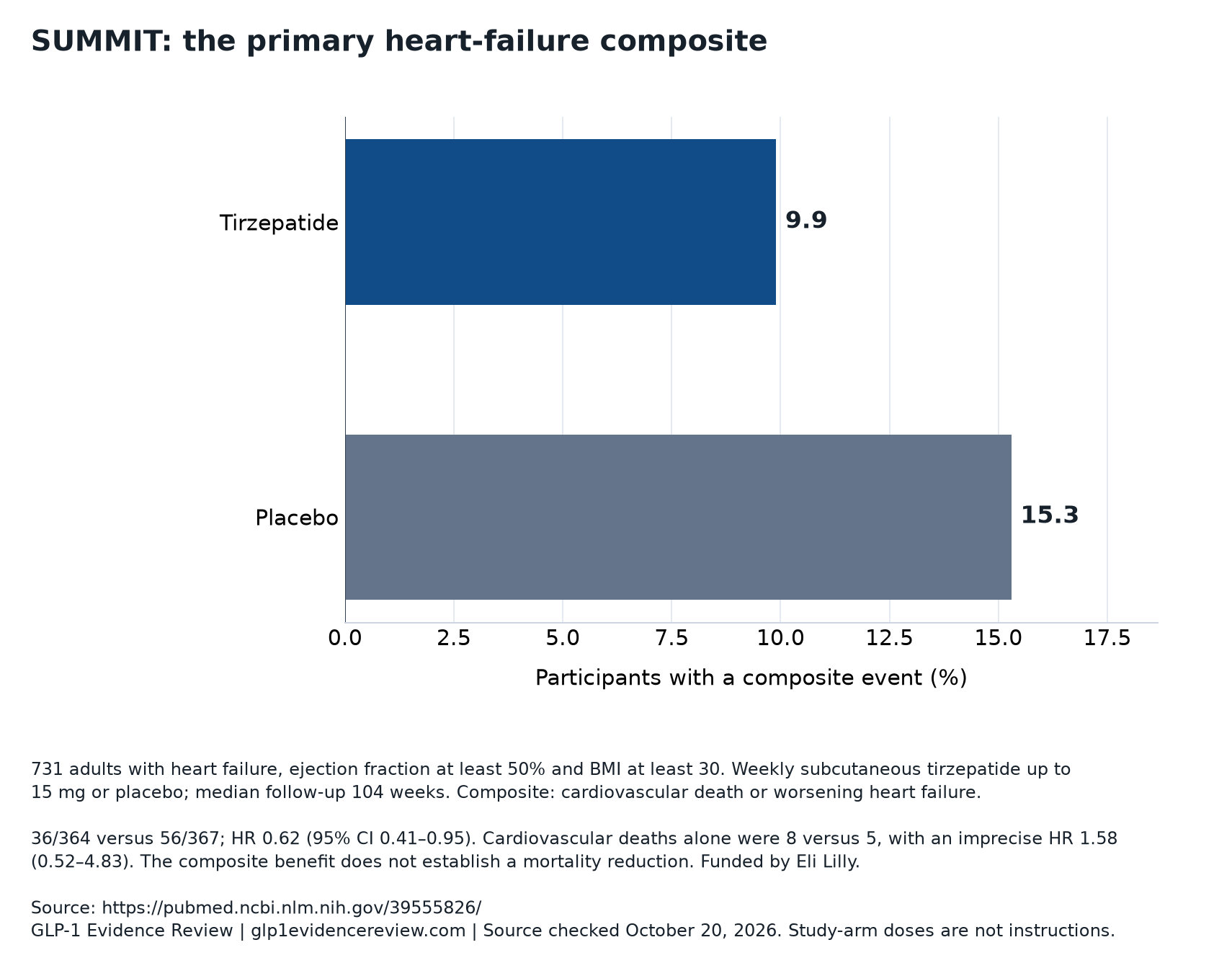
SUMMIT: the primary heart-failure composite
731 adults with heart failure, ejection fraction at least 50% and BMI at least 30. Weekly subcutaneous tirzepatide up to 15 mg or placebo; median follow-up 104 weeks. Composite: cardiovascular death or worsening heart failure.
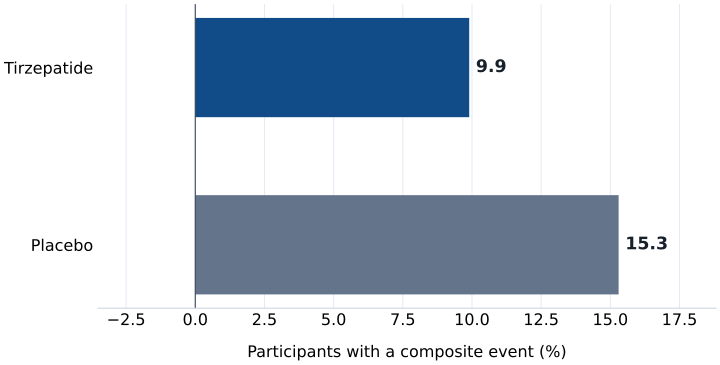
| Study group | Participants with a composite event (%) |
|---|---|
| Tirzepatide | 9.9 |
| Placebo | 15.3 |
36/364 versus 56/367; HR 0.62 (95% CI 0.41–0.95). Cardiovascular deaths alone were 8 versus 5, with an imprecise HR 1.58 (0.52–4.83). The composite benefit does not establish a mortality reduction. Funded by Eli Lilly.
Original visualization of published aggregate data. No individual prediction or provider performance is represented. Original research ↗
Two primary endpoints captured different kinds of benefit
SUMMIT had two primary endpoints. One combined adjudicated cardiovascular death with a worsening heart-failure event, assessed by time to the first qualifying event. Adjudication means events underwent a formal assessment process. The other endpoint measured change from baseline to week 52 in the Kansas City Cardiomyopathy Questionnaire clinical summary score, or KCCQ-CSS.
The distinction is substantive: a clinical-event endpoint records whether and when a serious outcome occurs, while the questionnaire captures patients’ health status. Its scale runs from 0 to 100, with higher values indicating better status. Favorable results on both endpoints support a broader interpretation than either alone, without making them interchangeable measures.
Endpoint hierarchy also matters when judging the component findings. The combined clinical outcome was primary; cardiovascular death and worsening heart failure were reported separately as components. The abstract does not provide the complete multiple-testing plan or detailed definition of a worsening event. Consequently, it supports the reported combined comparison more directly than additional claims built from selected components.
Reading 9.9% versus 15.3% without changing the measure
The primary composite occurred in 36 of 364 tirzepatide participants, or 9.9%, and 56 of 367 placebo participants, or 15.3%. Subtracting the rounded percentages gives an observed absolute difference of 5.4 percentage points. This describes the difference in proportions of participants with an event during the trial’s follow-up, not a guaranteed difference over exactly two years.
The hazard ratio was 0.62, with a 95% confidence interval of 0.41–0.95. A hazard compares the rate at which first events arise over follow-up among participants who have not yet experienced one. The point estimate is conventionally described as a 38% lower hazard. It is not a 38-percentage-point reduction, and it is not identical to the relative reduction calculated from the two reported percentages.
The confidence interval excludes 1, the no-difference value, but extends from a large reduction to a comparatively modest one. Thus the evidence favors a lower composite hazard while leaving meaningful uncertainty about its magnitude. For another example of why event definitions and follow-up matter, see the analysis of SELECT’s cardiovascular endpoint.
| Outcome | Tirzepatide vs placebo | Hazard ratio (95% CI) |
|---|---|---|
| Cardiovascular death or worsening heart failure | 36 (9.9%) vs 56 (15.3%) | 0.62 (0.41–0.95) |
| Worsening heart failure | 29 (8.0%) vs 52 (14.2%) | 0.54 (0.34–0.85) |
| Cardiovascular death | 8 (2.2%) vs 5 (1.4%) | 1.58 (0.52–4.83) |
Why the components do not establish a survival benefit
Worsening heart-failure events occurred in 29 tirzepatide participants and 52 placebo participants: 8.0% versus 14.2%. The hazard ratio was 0.54, with a 95% confidence interval of 0.34–0.85. This component showed a clear favorable signal and was numerically much more common than cardiovascular death. It provides the principal component-level support for interpreting the composite benefit.
Cardiovascular deaths numbered 8 versus 5, or 2.2% versus 1.4%. The corresponding hazard ratio was 1.58, with a wide 95% confidence interval of 0.52–4.83. The point estimate leaned toward more deaths with tirzepatide, but the interval includes both a substantially lower and a substantially higher hazard. With only 13 cardiovascular deaths, neither a separate mortality benefit nor a definitive mortality harm is established.
Component counts cannot simply be added to reconstruct the composite. In the tirzepatide group, 29 plus 8 equals 37, yet 36 participants had the composite; in the placebo group, 52 plus 5 equals 57, versus 56 with the composite. Components can overlap in the same person, whereas the composite’s first-event analysis counts that person once. The abstract does not reveal the individual event sequences.
Health-status gains were measured against an improving placebo group
At 52 weeks, the reported mean KCCQ-CSS improvement was 19.5 points with tirzepatide and 12.7 points with placebo. The reported between-group difference was 6.9 points, with a 95% confidence interval of 3.3–10.6. This supports better average health status with tirzepatide rather than merely documenting improvement from baseline in the treated group.
The placebo group’s improvement is important. A before-and-after comparison in tirzepatide recipients alone would attribute too much change to treatment because trial participation, concurrent care, symptom fluctuation, and other influences can affect both groups. Randomized comparison helps separate the added treatment effect from changes that occur without the active study drug.
Simply subtracting the rounded group changes gives 6.8 points rather than the reported 6.9-point contrast. The abstract does not supply the full statistical calculation; the reported comparison and its interval should be retained rather than replaced by rounded arithmetic. An average difference also does not specify how many individuals improved substantially, stayed unchanged, or worsened—a distinction explored in the guide to interpreting mean results.
Tolerability is a separate result, not a footnote
Adverse events leading to discontinuation of trial medication occurred in 23 tirzepatide participants, or 6.3%, compared with 5 placebo participants, or 1.4%. These events were mainly gastrointestinal. The observed difference was 4.9 percentage points, showing that the favorable efficacy findings came with a greater likelihood of stopping the study drug because of adverse effects.
That discontinuation measure is not the incidence of all adverse events, all gastrointestinal symptoms, or all serious adverse events. The abstract does not provide a complete safety breakdown, so it cannot support a blanket description of treatment as safe. Nor should discontinuations simply be subtracted from prevented clinical events: these outcomes differ in severity, timing, overlap, and patient importance.
A further unresolved question is how tolerability affected exposure and subsequent follow-up. The indexed abstract does not explain all discontinuation-related analysis rules. As an editorial interpretation, sustained clinical support and evaluation of symptoms matter when translating trial evidence into care; a renewal transaction alone is not equivalent to the observation structure of a randomized trial. The clinical follow-up guide explains that distinction.
STEP-HFpEF and SELECT offer context, not a drug ranking
STEP-HFpEF studied 529 people with HFpEF and obesity, comparing weekly semaglutide 2.4 mg with placebo for 52 weeks. Its dual primary endpoints were questionnaire change and weight change—not SUMMIT’s clinical-event composite. The reported KCCQ-CSS difference was 7.8 points, with a 95% confidence interval of 4.8–10.9. The dedicated STEP-HFpEF analysis examines its symptom and functional findings.
STEP-HFpEF also reported a 20.3-meter between-group difference in six-minute walking distance, with a 95% confidence interval of 8.6–32.1 meters. Its hierarchical composite used a win ratio, which is not interchangeable with SUMMIT’s time-to-first-event hazard ratio. Comparing these statistics as though they were the same outcome would obscure their different constructions.
SELECT was larger and addressed another population: 17,604 adults with established cardiovascular disease, BMI at least 27, and no diabetes history. Its semaglutide primary composite included cardiovascular death, nonfatal heart attack, or nonfatal stroke. Neither semaglutide trial was a direct comparison against tirzepatide. Their results therefore cannot establish which drug is superior for SUMMIT’s population or endpoint.
| Trial and population | Main endpoint emphasis | Observation period |
|---|---|---|
| SUMMIT: 731 participants with HFpEF and obesity | Cardiovascular death/worsening heart failure; KCCQ-CSS | Median follow-up 104 weeks; questionnaire at 52 weeks |
| STEP-HFpEF: 529 participants with HFpEF and obesity | KCCQ-CSS and body-weight change | 52 weeks |
| SELECT: 17,604 participants with cardiovascular disease and overweight/obesity, without diabetes | Cardiovascular death, nonfatal heart attack, or nonfatal stroke | Mean follow-up 39.8 months |
The results leave mechanism and longer-term outcomes open
Tirzepatide acts at glucose-dependent insulinotropic polypeptide and glucagon-like peptide-1 receptors. That pharmacology provides biological context, but SUMMIT’s abstract does not establish which pathway produced the observed clinical benefit. A randomized treatment comparison can identify an effect of assignment without proving whether weight change, metabolic effects, or other processes mediated it.
The abstract also does not report enough detail to determine how benefit varied across clinically important subgroups or different background treatments. It would be inappropriate to invent a stronger response in any particular subgroup. Similarly, the median follow-up supports conclusions over the observed trial period, not a claim that benefit necessarily persists unchanged for many more years.
The unresolved mortality result illustrates a practical limit of event information: 731 participants can yield informative evidence about a relatively frequent composite while leaving a rare component imprecise. More observation or additional studies could narrow that uncertainty. Meanwhile, the appropriate conclusion preserves both findings—fewer combined clinical events and uncertain cardiovascular mortality—rather than allowing one to erase the other.
Trial evidence does not certify a formulation or service
SUMMIT studied a defined subcutaneous tirzepatide intervention within a randomized trial. Its outcomes do not automatically transfer to oral routes, other formulations, compounded preparations, or a particular commercial provider. FDA states that compounded drugs are not approved or reviewed before marketing for safety, effectiveness, or quality. The approved-versus-compounded guide separates those evidence questions.
FDA also identifies concerns involving dosing errors and semaglutide salt ingredients in unapproved GLP-1 products. Such reports cannot by themselves establish event rates or causation, and they should not be treated as SUMMIT safety results. Conversely, SUMMIT cannot be used to establish equivalence for a compounded preparation merely because a related ingredient name appears in its description.
Editorial interpretation: readers assessing a service should examine documentary terms separately from clinical efficacy. The CoreAge Rx documentation review offers a place to check those terms; that link does not imply availability of the studied product, heart-failure care, or trial-like outcomes. Pricing and contracts cannot be evaluated from SUMMIT, and the trial report is not current prescribing information.
Questions & answers
Did SUMMIT show that tirzepatide prevents cardiovascular death?
Not as a separate outcome. Cardiovascular deaths were 8 with tirzepatide and 5 with placebo, with a hazard ratio of 1.58 and a wide 95% confidence interval of 0.52–4.83. The favorable primary result concerned cardiovascular death or worsening heart failure together. That combined finding does not establish an isolated survival benefit.
Is a 38% lower hazard the same as 38 fewer events per 100 people?
No. The 38% figure comes from the hazard ratio of 0.62 and describes a relative comparison over follow-up. The reported event proportions were 9.9% and 15.3%, an observed difference of 5.4 percentage points. Neither number should be substituted for the other, and the percentages are not fixed-duration predictions for an individual.
Why can the component totals exceed the composite count?
One participant can experience worsening heart failure and later die from a cardiovascular cause. The component reports may therefore include the same person in both categories, while a time-to-first-event composite counts that person once. SUMMIT’s aggregate counts show why adding the component totals is not a valid way to reconstruct its primary result.
Does SUMMIT prove tirzepatide works better than semaglutide for heart failure?
No. SUMMIT compared tirzepatide with placebo. STEP-HFpEF compared semaglutide with placebo using different primary endpoints, and SELECT studied another population and cardiovascular composite. Differences across these trials are not a randomized head-to-head comparison and cannot establish comparative superiority.
Can the findings be applied to compounded tirzepatide?
The trial does not establish that equivalence. Evidence belongs to the studied intervention and conditions of use. FDA does not review compounded drugs before marketing for safety, effectiveness, or quality, and results for studied products cannot be assumed to validate compounded preparations, alternative routes, or a provider’s service.
Our assessment
SUMMIT provides randomized evidence that tirzepatide lowered the hazard of cardiovascular death or worsening heart failure and improved average patient-reported health status in people with HFpEF and obesity. The component pattern supports a reduction in worsening heart failure, not a demonstrated mortality benefit. Absolute event proportions, hazard ratios, and questionnaire changes describe complementary effects rather than interchangeable claims. More adverse-event-related discontinuations, limited mortality information, and incomplete abstract-level methods remain important boundaries. The most defensible reading is a meaningful, population-specific clinical result—not a universal heart-failure claim, drug ranking, or endorsement of a formulation or provider.
Sources & documentation
Scientific and official sources consulted October 20, 2026. Study findings apply to the populations, products and time periods described; they are not provider outcome data.