Heart failure with preserved ejection fraction, or HFpEF, can impose substantial symptoms and physical limitations even though the heart’s ejection fraction is preserved. In people who also have obesity, STEP-HFpEF asked a practical question: would weekly semaglutide improve how participants felt and functioned, alongside reducing body weight? The randomized trial’s answer was favorable over 52 weeks, but understanding that answer requires separating questionnaire points, walking distance, percentage weight change, and a ranked composite outcome.
This analysis uses the indexed primary report abstracts for STEP-HFpEF, SUMMIT, and SELECT, together with available official FDA material—not a review of all full texts, protocols, or supplements. STEP-HFpEF is the central study; the other trials clarify what different designs can establish. The critical distinction is between evidence of better average health status and evidence about major clinical events. Those questions overlap, but neither the outcome definitions nor the statistical measures are interchangeable.
At a glance
- Trial population and duration
- STEP-HFpEF randomized 529 people with HFpEF and BMI of at least 30 to weekly semaglutide 2.4 mg or placebo for 52 weeks.Sources: [1]
- Symptoms and physical limitations
- KCCQ-CSS improved by 16.6 points versus 8.7 points; the reported estimated between-group difference was 7.8 points, with a 95% confidence interval of 4.8 to 10.9.Sources: [1]
- Weight and walking
- The estimated weight-change difference was −10.7 percentage points; the estimated six-minute walking-distance difference was 20.3 meters.Sources: [1]
- Hierarchical composite
- The win ratio was 1.72, with a 95% confidence interval of 1.37 to 2.15. This is not a mortality hazard ratio or a percentage reduction in deaths.Sources: [1]
- Reported serious adverse events
- Serious adverse events occurred in 35 semaglutide participants (13.3%) and 71 placebo participants (26.7%); this measure does not describe every tolerability issue.Sources: [1]
The population defines the question
STEP-HFpEF enrolled 529 participants with HFpEF and a body-mass index of at least 30. BMI expresses weight relative to height; here, the threshold selected a population with obesity. Participants were randomly assigned to once-weekly semaglutide at a study dose of 2.4 mg or placebo for 52 weeks. The intervention was the injectable semaglutide regimen; the dose identifies a research arm, not a treatment instruction.
Randomization makes the placebo comparison more informative than observing people before and after starting treatment. It helps distribute both measured and unmeasured baseline characteristics across groups. The relevant question is therefore not simply whether semaglutide recipients improved, but whether they improved more than participants assigned to placebo during the same period.
The population boundary matters equally. These findings concern obesity-related HFpEF, not every form of heart failure or everyone taking semaglutide for weight management. The accessible abstract does not provide the full eligibility criteria, baseline clinical profile, or detailed background treatment. It would be inappropriate to fill those gaps with assumptions about diabetes status, disease severity, or the exact ejection-fraction threshold used in this trial.
Two primary endpoints, not one broad promise
The trial had dual primary endpoints: change in the Kansas City Cardiomyopathy Questionnaire clinical summary score, abbreviated KCCQ-CSS, and change in body weight. KCCQ-CSS runs from 0 to 100, with higher scores indicating fewer symptoms and physical limitations. It measures participants’ reported health status, rather than directly measuring cardiac pumping performance or counting hospitalizations.
Specifying both endpoints separated an outcome people experience from an outcome measured on a scale. Improvement in both strengthens the conclusion that the findings were not limited to weight loss. It does not, however, establish that weight loss caused the symptom improvement. Randomization tested assignment to semaglutide against placebo, not weight loss itself as an independently randomized intervention.
An estimand is the precise treatment effect a study aims to estimate, including how it handles events such as treatment discontinuation or missing measurements. The abstract reports estimated between-group effects but does not fully describe those handling rules. Readers can interpret the reported contrasts while recognizing that a complete assessment of the estimand would require methods beyond the abstract.
| Outcome | Reported result | Correct interpretation |
|---|---|---|
| KCCQ-CSS | 16.6 versus 8.7 points; estimated difference 7.8 points (95% CI, 4.8 to 10.9) | Greater average improvement in reported symptoms and physical limitations |
| Body weight | −13.3% versus −2.6%; difference −10.7 percentage points (95% CI, −11.9 to −9.4) | Difference between percentage changes, not a relative risk reduction |
| Six-minute walk distance | +21.5 versus +1.2 meters; difference 20.3 meters (95% CI, 8.6 to 32.1) | Greater average improvement on a timed walking test |
| Hierarchical composite | Win ratio 1.72 (95% CI, 1.37 to 2.15) | More favorable ranked comparisons, not a mortality risk estimate |
| C-reactive protein | −43.5% versus −7.3%; treatment ratio 0.61 (95% CI, 0.51 to 0.72) | A biomarker contrast, not proof of the pathway causing clinical improvement |
STUDY DATA · GLP-1 Evidence Review
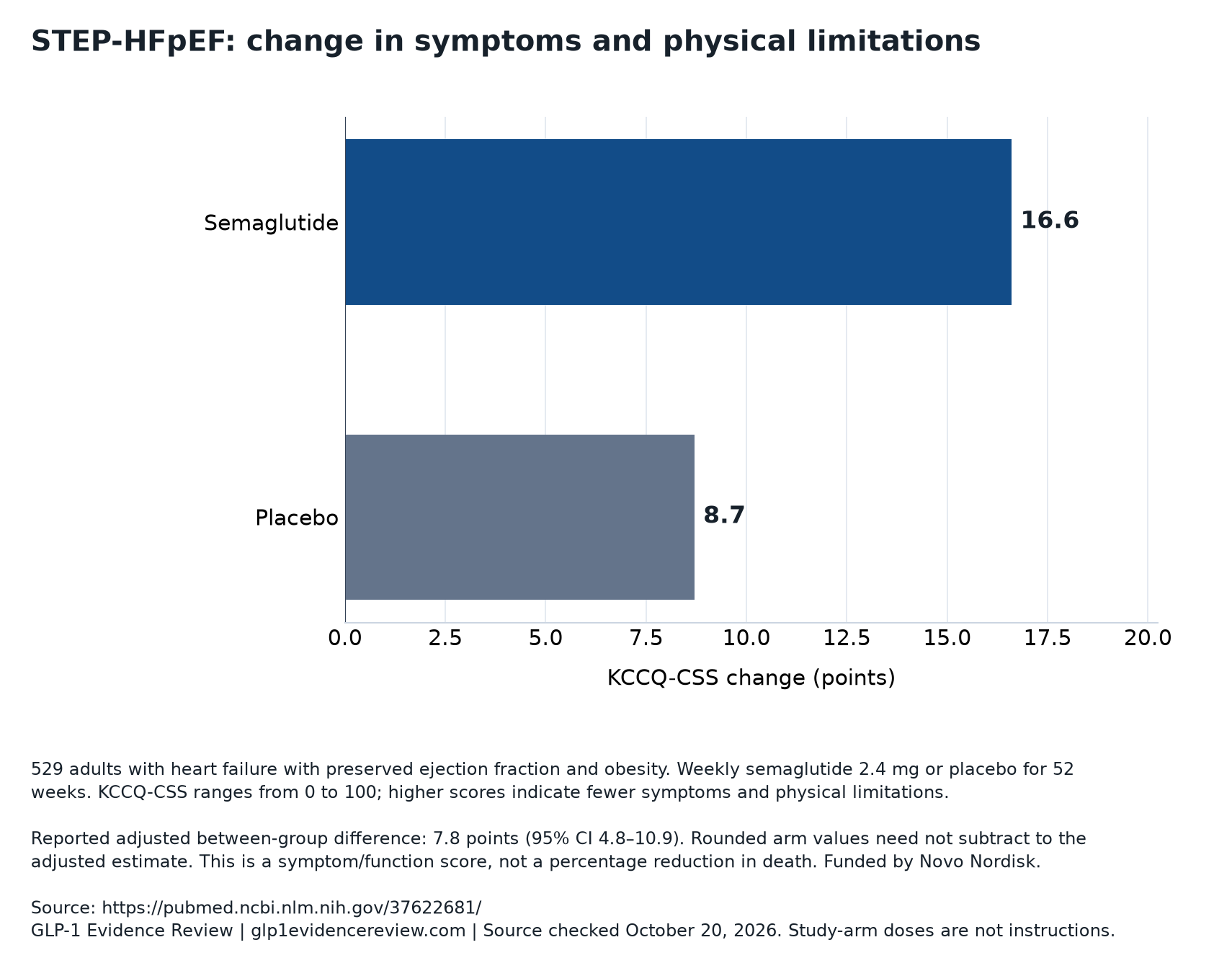
STEP-HFpEF: change in symptoms and physical limitations
529 adults with heart failure with preserved ejection fraction and obesity. Weekly semaglutide 2.4 mg or placebo for 52 weeks. KCCQ-CSS ranges from 0 to 100; higher scores indicate fewer symptoms and physical limitations.
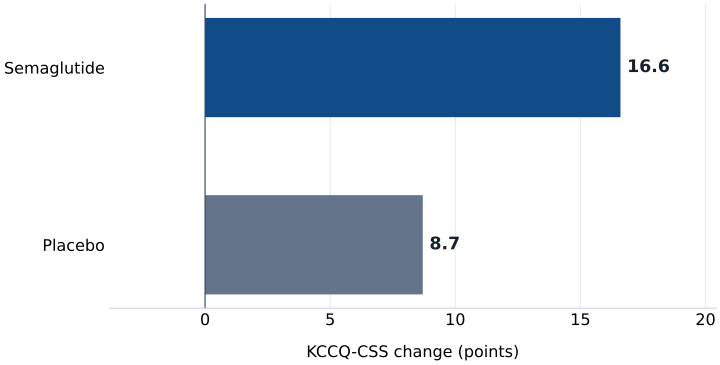
| Study group | KCCQ-CSS change (points) |
|---|---|
| Semaglutide | 16.6 |
| Placebo | 8.7 |
Reported adjusted between-group difference: 7.8 points (95% CI 4.8–10.9). Rounded arm values need not subtract to the adjusted estimate. This is a symptom/function score, not a percentage reduction in death. Funded by Novo Nordisk.
Original visualization of published aggregate data. No individual prediction or provider performance is represented. Original research ↗
Why the symptom benefit is 7.8 points—not 16.6
The semaglutide group’s mean KCCQ-CSS increased by 16.6 points, while the placebo group’s increased by 8.7 points. Both groups improved. Consequently, attributing all 16.6 points to the drug would ignore improvement observed without assignment to active treatment. The reported estimated treatment contrast was 7.8 points.
Subtracting the displayed means gives 7.9 points, slightly different from the reported estimate. Rounded group summaries need not reproduce an estimated, adjusted contrast exactly. The appropriate number to carry forward is the published 7.8-point estimate, rather than replacing it with arithmetic performed on rounded values.
Its 95% confidence interval, 4.8 to 10.9 points, describes uncertainty around the estimated average contrast. It is not the range in which 95% of participants’ improvements fell, and it does not predict an individual response. Averages can conceal substantial variation. The guide to interpreting mean results explains this distinction without turning a group estimate into a personal forecast.
Weight and walking add independent information
Mean percentage weight change was −13.3% with semaglutide and −2.6% with placebo. The estimated contrast was −10.7 percentage points, with a 95% confidence interval from −11.9 to −9.4. Percentage points are essential here: the trial compared two percentage changes. Calling this a 10.7% relative reduction would describe a different calculation.
For scale interpretation only, a 13.3% decrease from a hypothetical starting weight of 100 kilograms equals 13.3 kilograms, while a 2.6% decrease equals 2.6 kilograms. That illustration is not a participant-level prediction or a reported kilogram result. It shows why percentage weight change and an absolute change in kilograms answer related but distinct questions.
The six-minute walk test added a performance-based measure. Distance increased by 21.5 meters with semaglutide and 1.2 meters with placebo, yielding an estimated 20.3-meter difference, with a 95% confidence interval of 8.6 to 32.1. Agreement between questionnaire and walking results supports a broader functional benefit. It does not show that every participant walked farther or establish how improvements translated into specific daily activities.
The win ratio is not a survival statistic
A confirmatory secondary endpoint combined death, heart-failure events, and differences in changes in KCCQ-CSS and six-minute walking distance within a hierarchy. A hierarchical analysis ranks outcomes so that higher-priority events are considered before lower-priority differences. It summarizes which treatment more often produces the more favorable comparison under the specified rules.
The reported win ratio was 1.72, with a 95% confidence interval of 1.37 to 2.15. On that metric, favorable comparisons outnumbered unfavorable comparisons by a ratio of 1.72 to 1. It does not mean 72% fewer deaths, a 72% improvement for each person, or a 72% reduction in heart-failure risk. A win ratio is neither a hazard ratio nor an ordinary event-risk ratio.
The hierarchy can incorporate important events without demonstrating a separate benefit for each component. The abstract does not provide enough component-level detail to identify how much each outcome contributed to the win ratio. For readers comparing promotional claims with endpoints, the medical-evidence checklist offers a useful discipline: identify the actual measure before interpreting the magnitude.
CRP suggests a biological signal, not a proven mechanism
C-reactive protein, or CRP, is a marker associated with inflammation. Mean percentage CRP change was −43.5% with semaglutide and −7.3% with placebo. The reported estimated treatment ratio was 0.61, with a 95% confidence interval of 0.51 to 0.72. This is another statistical scale, distinct from the percentage-point comparison used for weight.
A lower CRP result is compatible with biological changes accompanying treatment, but compatibility is not proof of mediation. The trial results do not establish whether CRP reduction caused improved symptoms, whether weight change drove both, or whether several pathways operated together. Demonstrating a mechanism requires more than showing that a biomarker and clinical outcomes moved favorably.
The unresolved question is not whether the trial detected multiple benefits—it did—but how they connect. The abstract does not isolate contributions from weight loss, inflammatory changes, or other effects. Nor does it establish whether the observed improvements persist beyond 52 weeks. These are substantive scientific gaps rather than reasons to disregard the randomized findings.
Serious events and tolerability are different safety questions
Serious adverse events were reported in 35 semaglutide participants, or 13.3%, and 71 placebo participants, or 26.7%. The difference between the displayed percentages is 13.4 percentage points. That is a favorable serious-event comparison, but the abstract does not supply a confidence interval or a breakdown sufficient to explain the entire difference.
A serious adverse event is not synonymous with every side effect, and an event occurring during treatment is not automatically caused by treatment. The STEP-HFpEF abstract does not provide a comprehensive account of gastrointestinal symptoms, treatment discontinuation, or individual event categories. Its serious-event totals therefore should not be converted into a blanket statement that semaglutide was free of tolerability problems.
Other trials illustrate why these distinctions matter. SELECT reported more adverse-event-related permanent discontinuations with semaglutide, while SUMMIT reported more adverse-event-related discontinuations with tirzepatide. Those findings cannot be imported as STEP-HFpEF rates, because populations, drugs, and observation periods differ. They do demonstrate why clinical follow-up requires attention to tolerability as well as efficacy endpoints.
SUMMIT tested a different heart-failure question
SUMMIT randomized 731 participants with heart failure, ejection fraction of at least 50%, and BMI of at least 30 to weekly subcutaneous tirzepatide, up to 15 mg, or placebo. Median follow-up was 104 weeks. Unlike STEP-HFpEF’s dual focus on symptoms and weight, SUMMIT included a primary time-to-first-event composite of cardiovascular death or worsening heart failure, alongside 52-week KCCQ-CSS change.
The composite occurred in 9.9% versus 15.3%, a 5.4-percentage-point difference in observed proportions. Its hazard ratio was 0.62, with a 95% confidence interval of 0.41 to 0.95. A hazard ratio incorporates event timing; it is not the same calculation as dividing or subtracting those percentages. The SUMMIT analysis examines that distinction in greater detail.
Worsening heart-failure events favored tirzepatide, but cardiovascular deaths were 8 versus 5, with a highly uncertain hazard ratio of 1.58 (95% CI, 0.52 to 4.83). Thus, a favorable composite did not establish reduced cardiovascular mortality. KCCQ-CSS favored tirzepatide by 6.9 points (95% CI, 3.3 to 10.6); adverse-event-related discontinuations, mainly gastrointestinal, occurred in 6.3% versus 1.4%. These are complementary findings, not a head-to-head comparison with semaglutide.
| Trial and population | Primary endpoint focus | Follow-up and interpretation |
|---|---|---|
| STEP-HFpEF: 529 participants with HFpEF and obesity | KCCQ-CSS and body-weight change | 52 weeks; strongest direct findings concern health status, weight, and function |
| SUMMIT: 731 participants with HFpEF and obesity | Cardiovascular death or worsening heart failure; KCCQ-CSS | Median 104 weeks; composite benefit does not establish mortality benefit |
| SELECT: 17,604 participants with established cardiovascular disease, BMI ≥27, and no diabetes history | Cardiovascular death, nonfatal heart attack, or nonfatal stroke | Mean 39.8 months; not a dedicated HFpEF symptom trial |
SELECT cannot fill every STEP-HFpEF evidence gap
SELECT tested weekly subcutaneous semaglutide 2.4 mg in 17,604 adults aged at least 45 with established cardiovascular disease, BMI of at least 27, and no history of diabetes. Its primary endpoint combined cardiovascular death, nonfatal myocardial infarction, and nonfatal stroke. Mean follow-up was 39.8 months, substantially longer than STEP-HFpEF’s 52 weeks.
Primary events occurred in 6.5% with semaglutide and 8.0% with placebo: a 1.5-percentage-point difference in reported proportions. The hazard ratio was 0.80 (95% CI, 0.72 to 0.90). Permanent discontinuations due to adverse events occurred in 16.6% versus 8.2%. These results establish a different benefit-and-tolerability comparison from the symptom-centered HFpEF study.
The SELECT cardiovascular-outcomes analysis provides relevant context, but its findings should not be stitched together with STEP-HFpEF as though both were one trial. Different selection criteria, endpoints, and durations limit that inference. Novo Nordisk funded STEP-HFpEF and SELECT; Eli Lilly funded SUMMIT. Sponsorship is relevant to appraisal, although it does not replace examination of design and reported results.
Transfer the evidence carefully—not the marketing
The randomized findings belong to the studied products, populations, routes, and research conditions. They do not automatically establish equivalent outcomes for oral formulations, compounded preparations, or a particular commercial care program. FDA states that compounded drugs are not approved or reviewed before marketing for safety, effectiveness, or quality, and identifies concerns including dosing errors and semaglutide salt ingredients.
FDA recommends compounded products only when a patient’s needs cannot be met by an FDA-approved drug. The approved-versus-compounded guide separates that regulatory question from trial efficacy. Reports of problems do not themselves establish incidence or causation, just as a branded-product trial does not establish equivalence for a compounded preparation.
Editorial interpretation: a trial’s clinical benefits also do not verify a provider’s contract, renewal process, or follow-up arrangements. Readers examining commercial documentation can use the CoreAge Rx review to check documentary terms, without treating it as evidence that the provider offers the studied product or HFpEF-specific care. Scientific efficacy and service documentation require separate evidence.
Questions & answers
Did STEP-HFpEF prove that semaglutide prevents death?
No. Its primary endpoints were symptom-related health status and body-weight change. Death appeared within a secondary hierarchical composite, but a favorable win ratio does not establish a separate mortality benefit. The abstract does not provide a mortality estimate that supports claiming fewer deaths from semaglutide in this population.
Does a 7.8-point KCCQ-CSS benefit mean everyone felt better?
No. It is an estimated average between-group difference, not a universal individual improvement. Some participants may have experienced larger changes, smaller changes, or no improvement. The confidence interval describes uncertainty around the average treatment contrast, not the distribution of individual experiences.
Can STEP-HFpEF and SUMMIT tell us which drug is better?
Not directly. Each compared its study drug with placebo, rather than with the other drug. Their endpoint priorities, follow-up, and participants were not identical. Comparing the 7.8-point and 6.9-point KCCQ-CSS contrasts as a drug ranking would ignore those differences and the uncertainty around both estimates.
Why does improvement in the placebo group matter?
It shows why before-and-after improvement is not enough to estimate a treatment effect. STEP-HFpEF participants assigned to placebo improved by 8.7 KCCQ-CSS points on average. The randomized between-group comparison accounts for improvement occurring in the comparison group without requiring an unsupported explanation of exactly why it occurred.
Do these findings establish results for compounded semaglutide?
No. Evidence from the studied semaglutide regimen does not establish the quality, equivalence, or outcomes of compounded preparations. FDA identifies separate concerns about unapproved GLP-1 products. Neither sharing an ingredient name nor citing STEP-HFpEF substitutes for evidence about the actual formulation being supplied.
Our assessment
STEP-HFpEF provides randomized evidence that semaglutide improved average symptoms, physical limitations, walking performance, and weight more than placebo over 52 weeks in participants with HFpEF and obesity. The alignment of patient-reported and performance-based outcomes strengthens the functional interpretation. Its hierarchical composite adds supportive evidence but should not be translated into a mortality claim. SUMMIT and SELECT broaden the surrounding cardiovascular evidence while answering different questions. The most defensible reading preserves those boundaries rather than combining favorable numbers into a promise no single trial tested.
Sources & documentation
Scientific and official sources consulted October 20, 2026. Study findings apply to the populations, products and time periods described; they are not provider outcome data.