Can treating obesity delay type 2 diabetes? The three-year SURMOUNT-1 analysis provides strong randomized evidence that tirzepatide can do so in people who already have both obesity and prediabetes. At 176 weeks, diabetes had been diagnosed in 1.3% of participants assigned to tirzepatide, compared with 13.3% assigned to placebo. That is a substantial difference in a clinically important outcome, not simply a change on the scale.
The result nevertheless answers a bounded question: what happened during three years of assigned treatment and a further 17 weeks without study treatment in this particular trial population. It does not establish permanent protection, identify the best dose for diabetes prevention, or demonstrate equivalent outcomes from other formulations or commercial programs. This analysis uses the indexed primary report abstracts and available official NIDDK and FDA material; it does not claim review of the full trial protocols, supplements, or full-text articles.
At a glance
- Population
- The extended analysis included 1,032 participants with obesity and prediabetes from the 2,539-participant SURMOUNT-1 trial.Sources: [1]
- Treatment and observation
- Participants received assigned once-weekly tirzepatide or placebo for 176 weeks, followed by 17 weeks off treatment.
- Diabetes at 176 weeks
- Diabetes diagnoses occurred in 1.3% of pooled tirzepatide participants versus 13.3% with placebo; the reported hazard ratio was 0.07.Sources: [1]
- After the off-treatment period
- At 193 weeks, the reported proportions were 2.4% versus 13.7%, with a hazard ratio of 0.12.Sources: [1]
- Safety findings
- Gastrointestinal adverse events were common, generally mild to moderate, and concentrated during dose escalation; the three-year report identified no new safety signals.Sources: [1]
The prevention population was a defined part of a larger trial
SURMOUNT-1 originally randomized 2,539 adults without diabetes. Eligibility in the original report required a body mass index, or BMI, of at least 30, or at least 27 with a weight-related complication. BMI relates weight to height; it is an enrollment measure, not a complete description of metabolic health. The extended prevention analysis concerned the 1,032 participants who had both obesity and prediabetes.
That distinction matters because prediabetes identifies people already at elevated risk of developing diabetes. The reported placebo experience therefore cannot be treated as the expected risk for every adult considering weight treatment. Nor does this analysis directly answer the same question in people without prediabetes or in those who already have diabetes.
Participants were assigned in a 1:1:1:1 ratio to three tirzepatide arms or placebo. Random assignment makes the comparison more informative than an observational comparison of people who choose medication with those who do not. The original SURMOUNT-1 analysis provides context, but its broader 72-week population should not be substituted for this longer-term subgroup.
Four randomized arms, two different reporting structures
The intervention was once-weekly subcutaneous tirzepatide—an injection under the skin—with assigned doses of 5, 10, or 15 mg. These doses identify trial arms, not instructions for treatment. Placebo supplied the randomized comparator. The original trial included a 20-week dose-escalation period, and the extended report describes gastrointestinal effects as occurring mainly during that early interval.
The three-year report presents weight change separately for each dose, but the headline diabetes result pools the tirzepatide groups. These are different analytical views. Dose-specific weight estimates show how average weight outcomes differed across assigned arms; a pooled diabetes estimate addresses the combined treatment comparison against placebo.
Pooling can provide a more informative estimate when the clinical event is relatively uncommon, but it does not establish that each dose produced the same diabetes reduction. The abstract does not provide separate diabetes estimates for the three doses. It would therefore be incorrect to attach the pooled hazard ratio to each individual dose as though each had independently demonstrated that exact result.
| Question | Reported comparison | Interpretive boundary |
|---|---|---|
| Weight change at week 176 | Each tirzepatide dose versus placebo | Dose-specific mean weight results |
| Diabetes onset through week 176 | Pooled tirzepatide versus placebo | Not a separate prevention estimate for each dose |
| Diabetes onset through week 193 | Pooled tirzepatide versus placebo after 17 weeks off treatment | Limited evidence about persistence after withdrawal |
STUDY DATA · GLP-1 Evidence Review
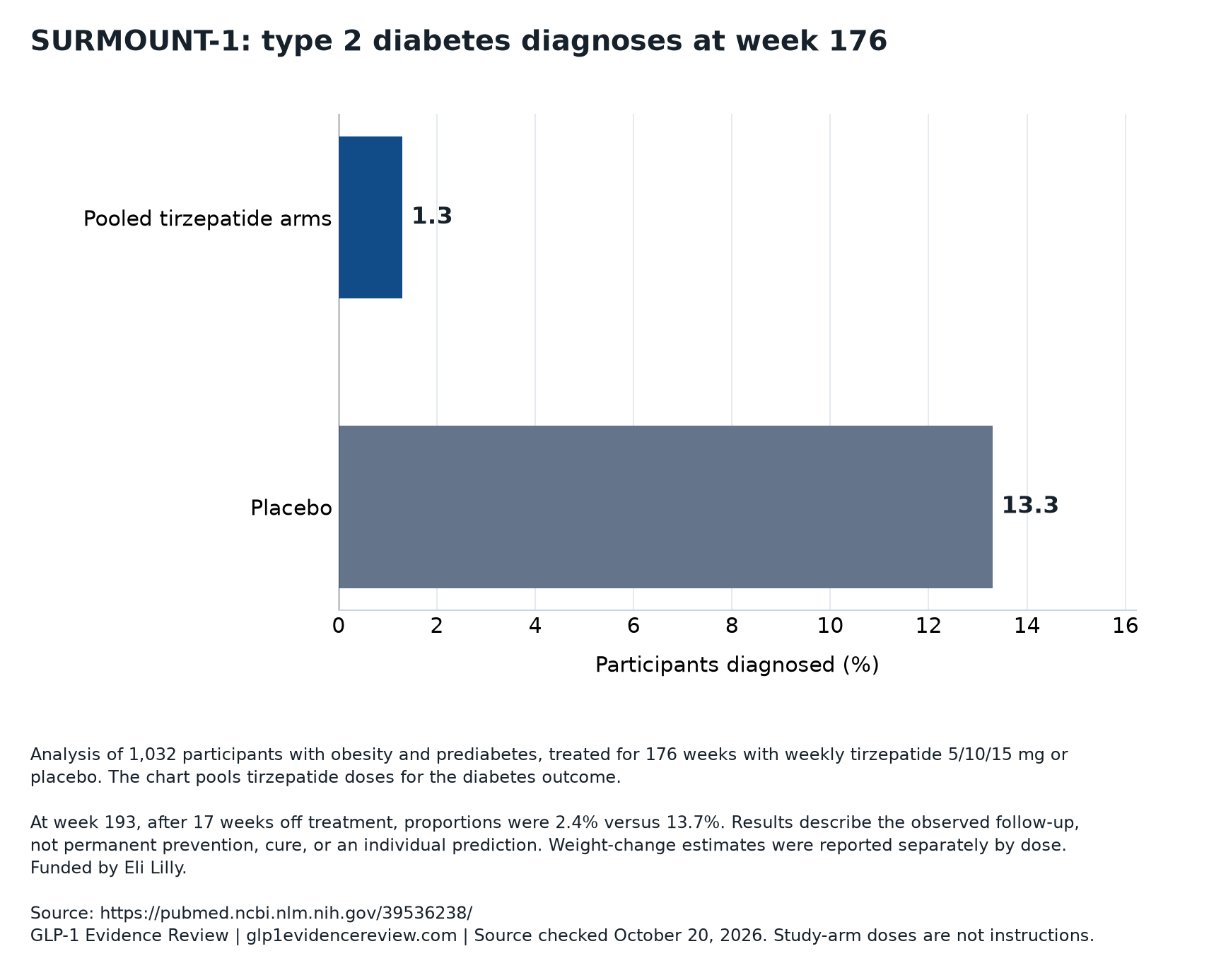
SURMOUNT-1: type 2 diabetes diagnoses at week 176
Analysis of 1,032 participants with obesity and prediabetes, treated for 176 weeks with weekly tirzepatide 5/10/15 mg or placebo. The chart pools tirzepatide doses for the diabetes outcome.
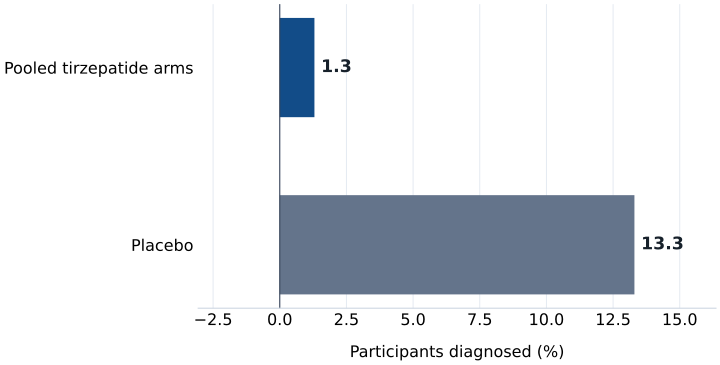
| Study group | Participants diagnosed (%) |
|---|---|
| Pooled tirzepatide arms | 1.3 |
| Placebo | 13.3 |
At week 193, after 17 weeks off treatment, proportions were 2.4% versus 13.7%. Results describe the observed follow-up, not permanent prevention, cure, or an individual prediction. Weight-change estimates were reported separately by dose. Funded by Eli Lilly.
Original visualization of published aggregate data. No individual prediction or provider performance is represented. Original research ↗
Prevention was a key secondary endpoint, not the original primary endpoint
The original 72-week trial had two coprimary endpoints: percentage weight change and the proportion achieving at least 5% weight reduction. The three-year report identifies three key secondary endpoints: percentage weight change at week 176, diabetes onset through week 176, and diabetes onset through week 193. Calling diabetes a secondary endpoint accurately describes its place in the trial rather than dismissing its clinical importance.
The report states that these three endpoints were controlled for type I error. In plain language, the statistical framework addressed the increased chance of a false-positive conclusion when multiple questions are tested. That is more persuasive than highlighting an unplanned favorable result selected from many analyses, although the abstract alone does not reveal the complete testing sequence.
An estimand defines exactly which treatment effect an analysis aims to estimate, including how treatment discontinuation is handled. The original report explicitly describes a treatment-regimen estimand assessing effects regardless of discontinuation. The extended abstract does not specify all corresponding details for its three-year analyses. We should not silently assume that every missing-data or post-discontinuation decision was identical; the evidence checklist explains why those details matter.
Absolute differences and hazard ratios answer different questions
At 176 weeks, the reported diabetes proportions were 1.3% with pooled tirzepatide and 13.3% with placebo. Subtraction gives an absolute difference of 12.0 percentage points. As a scale illustration, those percentages correspond to approximately 13 versus 133 diagnoses per 1,000 people over the reported period—not the trial's actual event counts.
Dividing 1.3 by 13.3 gives a crude ratio of approximately 0.098, or about a 90% lower reported proportion. The published hazard ratio was 0.07, corresponding to a 93% lower estimated hazard. These are not interchangeable statistics: the proportion describes occurrence over the follow-up period, whereas the hazard analysis incorporates when events happened and the time participants remained under observation.
The abstract reports a 95% confidence interval of 0.0 to 0.1 for that hazard ratio, with P<0.001. The printed lower bound is rounded; it does not establish a literally zero hazard. The interval supports a large reduction while leaving uncertainty about its exact magnitude. Neither the hazard ratio nor the absolute difference is a personal forecast for someone whose baseline risk differs from the trial population.
| Measure | Through week 176 | Through week 193 |
|---|---|---|
| Reported diabetes proportions: tirzepatide / placebo | 1.3% / 13.3% | 2.4% / 13.7% |
| Absolute difference, calculated from reported percentages | 12.0 percentage points | 11.3 percentage points |
| Reported hazard ratio and 95% CI | 0.07; 0.0–0.1 | 0.12; 0.1–0.2 |
| Treatment context | 176 weeks of assigned treatment | Includes 17 subsequent weeks off treatment |
Seventeen weeks off treatment is informative, but not a durability test for life
After the off-treatment interval, the reported diabetes proportions were 2.4% in the former tirzepatide groups and 13.7% in the former placebo group. The absolute separation remained substantial at 11.3 percentage points. The reported hazard ratio through 193 weeks was 0.12, with a 95% confidence interval of 0.1 to 0.2 and P<0.001.
Across the two reporting points, the tirzepatide proportion rose by 1.1 percentage points and the placebo proportion by 0.4 percentage points. This descriptive comparison is worth noticing, but it is not a randomized estimate of the effect of stopping treatment. Both sets of participants entered the off-treatment period; there was no continued-treatment arm for that interval, and the abstract does not report an interval-specific hazard ratio.
The defensible conclusion is prevention or delay during the observed period, with some separation persisting for 17 weeks after treatment ended. Permanent protection would require much longer observation. A randomized-withdrawal study such as SURMOUNT-4 addresses a different design question; its structure should not be assumed to apply to this extension.
Weight loss was sustained, but its contribution to the diabetes result is uncertain
At week 176, mean weight changes were −12.3% with 5 mg, −18.7% with 10 mg, and −19.7% with 15 mg, compared with −1.3% with placebo. Each comparison with placebo had P<0.001. Subtracting the placebo change gives differences of 11.0, 17.4, and 18.4 percentage points of baseline weight, respectively.
These averages demonstrate substantial sustained weight reduction, but they do not show that every participant lost a similar amount. The abstract does not provide confidence intervals for these three-year weight estimates or enough information to infer a statistically established difference between the 10-mg and 15-mg arms. A larger numerical mean loss alone is not a complete dose-comparison analysis.
Weight loss and fewer diabetes diagnoses occurred in the same randomized study, but that does not determine how much of the diabetes effect was mediated by weight change versus other treatment effects. Establishing mediation requires additional analysis. The guide to average weight results also explains why a group mean should not become an individual's predicted response.
Safety includes tolerability and discontinuation—not just new signals
In the three-year report, gastrointestinal events were the most common adverse events apart from COVID-19. Most were mild to moderate and occurred primarily during the first 20 weeks, when doses were being escalated. The investigators reported no new safety signals. This means no newly identified pattern emerged in that analysis; it does not mean adverse effects were absent.
The original 72-week report supplies an additional tolerability measure: adverse events caused discontinuation in 4.3%, 7.1%, and 6.2% of participants assigned to 5, 10, and 15 mg, respectively, versus 2.6% with placebo. These figures concern the original broader trial population and period. They should not be relabeled as three-year discontinuation rates for participants with prediabetes.
The extended abstract does not give detailed rates for individual serious or uncommon adverse events. Its summary cannot establish their absence or quantify every longer-term risk. Benefit and tolerability also operate on different scales: a large reduction in diabetes diagnoses does not imply that an adverse effect is unimportant to someone experiencing it.
Selection and incomplete reporting limit transferability
The prevention analysis concerns a baseline-defined group within a randomized trial, not a separate study of everyone with elevated glucose. Its results most directly inform people resembling those enrolled: adults with obesity and prediabetes who could participate in this treatment and follow-up setting. The abstract does not supply enough subgroup detail to determine whether the effect differs by age, race, initial glucose level, or other characteristics.
The original full cohort had a mean weight of 104.8 kg and mean BMI of 38.0, with 94.5% having BMI of at least 30. Those numbers describe the original trial, not necessarily the exact distribution among the 1,032 participants in the extension. Using them as precise subgroup characteristics would blur two different populations.
Other unresolved details include the extended analysis's retention, missing-data assumptions, and exact diagnostic confirmation procedures. These are reporting limits of the accessible abstract, not evidence that the procedures were inadequate. Eli Lilly funded the trial. Sponsorship is relevant context for appraisal, while randomization, prespecified endpoints, and transparent reporting remain central to judging the findings.
Maintenance evidence asks a related but different question
SURMOUNT-MAINTAIN should not be merged with this prevention analysis. It enrolled adults with obesity into 60 weeks of open-label tirzepatide treatment, then randomized 378 participants to continue a maximum tolerated dose of 10 or 15 mg, reduce to 5 mg, or switch to placebo for 52 more weeks. Its primary endpoint was weight change, not progression from prediabetes to diabetes.
At week 112, model-based mean weight changes from the original baseline were −21.9%, −16.6%, and −9.9%, respectively. Rescue tirzepatide was available from week 84 for participants whose regain exceeded 50% of lost weight. The primary estimand explicitly incorporated an assumption about rescue treatment, illustrating why the analysis definition matters alongside the headline result.
This separate trial supports studying continued treatment and dose reduction as maintenance strategies, but it cannot fill the long-term diabetes-prevention gap after SURMOUNT-1 withdrawal. Its randomized population had already completed an extended treatment period, creating a different selection process. Neither study establishes an individualized stopping or dose-reduction plan.
Clinical evidence is not a product-equivalence or contract guarantee
The trial evidence concerns the studied injected tirzepatide regimen. It does not automatically transfer to oral routes, other formulations, or compounded preparations sharing an ingredient name. FDA states that compounded drugs are not FDA approved or reviewed before marketing for safety, effectiveness, or quality. The approved-versus-compounded guide separates that regulatory question from whether a clinical trial found a benefit.
Editorial interpretation: a three-year benefit makes continuity of care a relevant practical question, but it does not prove that a particular subscription, pharmacy, or telehealth service can reproduce trial outcomes. Readers can use the CoreAge Rx review to check documentary terms; that invitation does not establish access to the studied product, diabetes-prevention care, or comparable results.
NIDDK frames medication decisions around health history, other medicines, benefits, adverse effects, and cost, and notes that coverage varies. Trial efficacy therefore is not an insurance promise. The clinically meaningful question is whether a treatment's demonstrated benefits and burdens fit an appropriate care setting—not whether a commercial claim repeats the largest relative reduction.
Questions & answers
Did tirzepatide prevent diabetes or merely postpone its diagnosis?
The study establishes substantially fewer diagnoses during the observed period. That is meaningful prevention or delay, but it cannot determine whether all avoided cases would remain avoided indefinitely. The 17-week off-treatment observation is too short to distinguish durable lifetime prevention from a longer postponement.
Does the 93% reduction mean 93 out of every 100 people benefited?
No. It describes the relative reduction in the estimated hazard, based on a hazard ratio of 0.07. The reported proportions were 1.3% versus 13.3%, an absolute difference of 12.0 percentage points. Neither statistic identifies which individual participants would otherwise have developed diabetes.
Which dose had the strongest diabetes-prevention effect?
The accessible abstract does not answer that question. It reports separate weight-change estimates for 5, 10, and 15 mg, but combines tirzepatide groups for the diabetes comparison. Ranking doses for prevention from their average weight loss would go beyond the reported evidence.
Were the diabetes findings only an exploratory observation?
No. Diabetes onset through 176 and 193 weeks was identified as key secondary endpoints, with control for type I error. These were not the original coprimary weight endpoints, but their stated statistical status makes them more informative than an unspecified exploratory finding.
Does this establish diabetes prevention for compounded tirzepatide?
No. Results from the studied product and regimen do not establish equivalence for compounded preparations. FDA does not review compounded drugs before marketing for safety, effectiveness, or quality. Ingredient naming alone cannot bridge differences in formulation, manufacturing, delivery, and clinical evidence.
Our assessment
SURMOUNT-1 provides strong randomized evidence of substantially reduced progression to type 2 diabetes during three years of tirzepatide treatment in participants with obesity and prediabetes. The absolute difference is clinically substantial, and the statistically controlled secondary endpoints strengthen the finding. The main unresolved issues are durability beyond a short off-treatment interval, dose-specific diabetes effects, and detailed handling of discontinuation and missing observations. This is evidence for prevention or delay in a defined population—not proof of cure, permanent protection, or commercial-program performance.
Sources & documentation
Scientific and official sources consulted October 20, 2026. Study findings apply to the populations, products and time periods described; they are not provider outcome data.
- Tirzepatide for Obesity Treatment and Diabetes Prevention. ↗
- Tirzepatide Once Weekly for the Treatment of Obesity. ↗
- Tirzepatide for maintenance of bodyweight reduction in people with obesity in the USA (SURMOUNT-MAINTAIN): a multicentre, double-blind, randomised, placebo-controlled trial. ↗
- NIDDK prescription medications for overweight and obesity ↗
- FDA concerns about unapproved GLP-1 drugs ↗