The STEP 1 extension is often reduced to a simple message: weight returns after semaglutide stops. Its actual finding is more specific. In a selected group followed for one year after both study medication and structured lifestyle support ended, substantial average regain occurred, but average weight remained below its starting level. That combination matters: regain was considerable without being complete, and the group average did not describe every participant’s course.
Reading this study well requires following three separate questions: who entered the extension, what changed at treatment withdrawal, and how the researchers calculated regain. The analysis below draws on the available full extension article, indexed primary-report abstracts for STEP 1 and the tirzepatide maintenance trials, and official FDA material. It does not assume that all underlying protocols, supplements, or full reports were examined.
At a glance
- Selected follow-up population
- The exploratory extension analysis included 327 treatment completers, compared with 1,961 adults randomized in the original STEP 1 trial.
- Two interventions ended
- At week 68, both study medication and the trial’s structured lifestyle intervention stopped; follow-up continued through week 120.Sources: [2]
- Average regain
- The former semaglutide group regained 11.6 percentage points of baseline body weight after an earlier average loss of 17.3%.Sources: [2]
- Residual weight loss
- At week 120, average loss from baseline was 5.6%; 95 of 197 former semaglutide participants with onsite measurements remained at least 5% below baseline.Sources: [2]
Start with the randomized trial, not the regain headline
STEP 1 enrolled adults without diabetes who had a body mass index, or BMI, of at least 30, or at least 27 with a weight-related condition. BMI relates weight to height. Participants also reported a previous unsuccessful dietary weight-loss effort. Across 129 sites in 16 countries, 1,961 participants were randomly assigned in a 2:1 ratio to semaglutide or placebo.
The intervention was once-weekly subcutaneous semaglutide, meaning an injection under the skin, with a target study dose of 2.4 mg after escalation. Both groups received lifestyle counseling. These doses identify the research arms, not instructions for treatment. The coprimary endpoints at 68 weeks were percentage weight change and achieving at least 5% weight loss.
The original trial estimated average changes of −14.9% with semaglutide and −2.4% with placebo: a treatment difference of −12.4 percentage points, with a 95% confidence interval from −13.4 to −11.5. That randomized treatment comparison is a different result from the extension’s descriptive regain estimates.
The extension followed completers, not everyone randomized
Eligibility for the extension required completing 68 weeks of assigned treatment and consenting to additional observation. Participating sites came from five countries. Interested sites in Canada, Germany, and the UK were included; selected US and Japanese sites were those with the highest recruitment during the main trial. This was not a new random sample of all original participants.
Of 333 people entering the extension, 327 contributed to its analysis set: 228 originally assigned semaglutide and 99 placebo. Their mean age was 49 years, mean BMI was 37.6, 67.0% were women, and 75.8% were White. Baseline characteristics broadly resembled the original population, but resemblance at baseline cannot eliminate selection related to completing treatment.
Indeed, the extension group had lost more weight during semaglutide treatment than the original trial population: 17.3% versus the original 14.9% estimate. Completers can differ from people who stop early because of tolerability, response, or other circumstances. Interpretation: the extension is especially informative about follow-up after completing treatment, rather than all possible treatment starts.
| Population | Number | What it represents |
|---|---|---|
| Original STEP 1 randomized population | 1,961 | Adults assigned semaglutide or placebo at baseline |
| Extension analysis set | 327 | Eligible treatment completers attending at least one specified follow-up visit |
| Onsite week-120 measurements | 290 | 197 former semaglutide and 93 former placebo participants with final onsite data |
STUDY DATA · GLP-1 Evidence Review
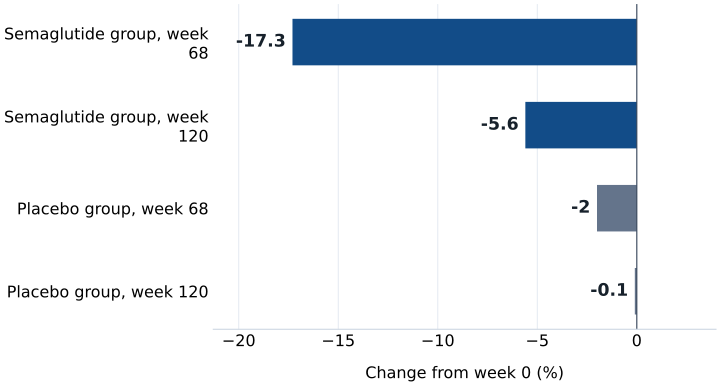
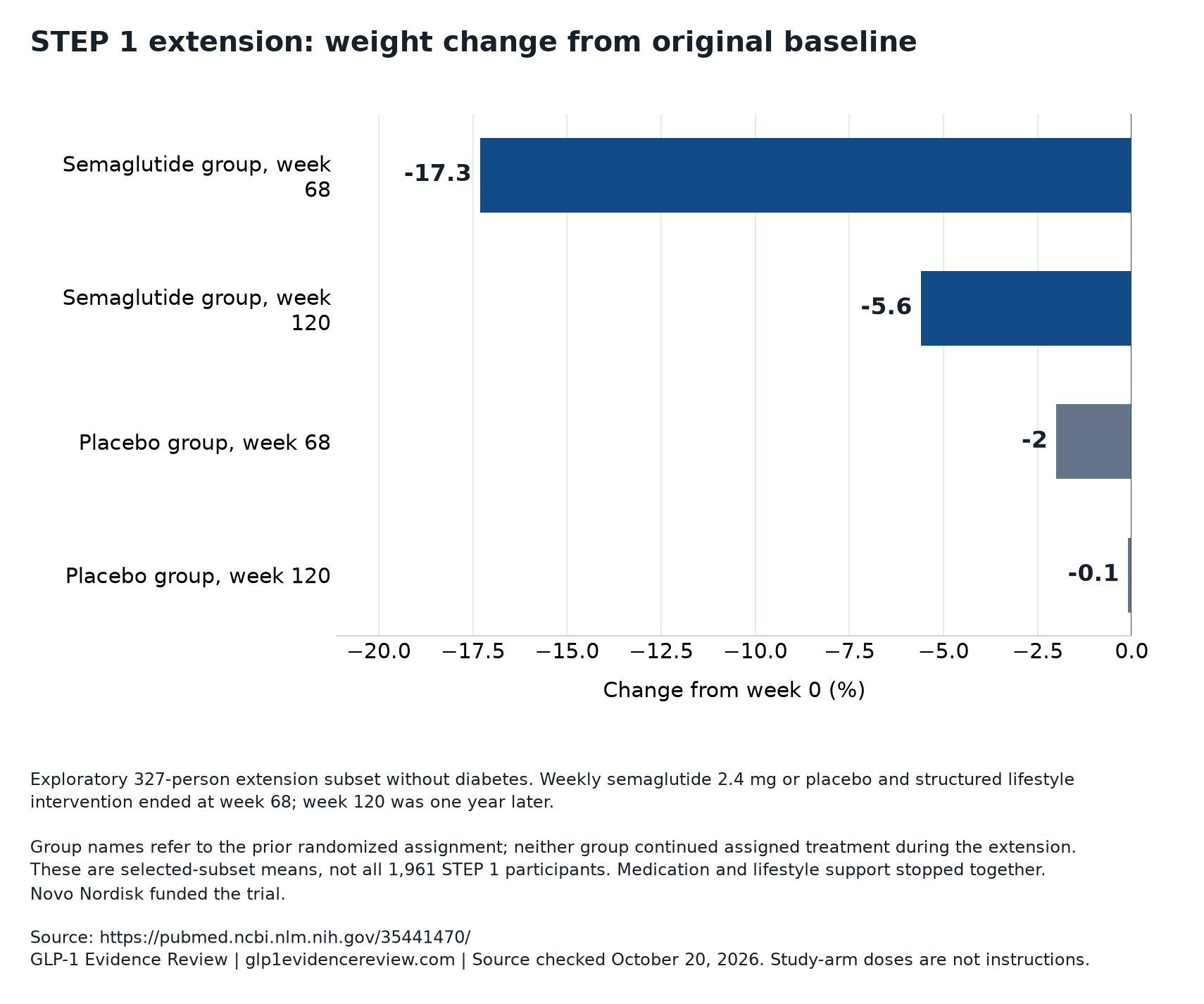
STEP 1 extension: weight change from original baseline
Exploratory 327-person extension subset without diabetes. Weekly semaglutide 2.4 mg or placebo and structured lifestyle intervention ended at week 68; week 120 was one year later.
| Study group | Change from week 0 (%) |
|---|---|
| Semaglutide group, week 68 | -17.3 |
| Semaglutide group, week 120 | -5.6 |
| Placebo group, week 68 | -2 |
| Placebo group, week 120 | -0.1 |
Group names refer to the prior randomized assignment; neither group continued assigned treatment during the extension. These are selected-subset means, not all 1,961 STEP 1 participants. Medication and lifestyle support stopped together. Novo Nordisk funded the trial.
Original visualization of published aggregate data. No individual prediction or provider performance is represented. Original research ↗
Medication and organized support ended together
At week 68, participants stopped study medication and the structured lifestyle intervention. During treatment, counseling had occurred every four weeks and addressed diet and physical activity. The off-treatment extension instead used infrequent study contact, with follow-up visits through week 120—52 weeks after treatment ended.
This simultaneous change limits causal separation. The study did not randomly compare stopping medication while maintaining support against stopping both. It therefore cannot calculate how much regain resulted from medication withdrawal, withdrawal of organized support, or their combination. Ending trial counseling also does not establish that participants abandoned every lifestyle practice.
Participation in outside lifestyle programs was not recorded. Nor were other treatments prohibited during the extension. These features make the study relevant to a less controlled follow-up setting, but prevent a clean experiment isolating medication removal. For a complementary randomized withdrawal design, see the SURMOUNT-4 scientific analysis; its different drug and procedures still require separate interpretation.
Two-thirds regained is a ratio, not a body-weight percentage
In the former semaglutide group, average loss during treatment was 17.3% of starting weight. Average regain afterward was 11.6 percentage points on that same baseline-weight scale. Dividing 11.6 by 17.3 gives approximately 0.67: the origin of the two-thirds description. It does not mean participants gained 67% of their body weight.
Consider an illustrative starting weight of 100 units. A 17.3% loss leaves 82.7 units. Adding back 11.6 baseline-weight units leaves about 94.3 units. The report’s final net loss is 5.6%, rather than exactly the 5.7% implied by this rounded calculation; rounded summaries and changing observed samples need not reconcile perfectly.
The denominator matters. An increase of 11.6 units from 82.7 would be about 14% relative to the lower week-68 weight, but that is a different calculation—not the extension’s reported baseline-referenced regain measure. This distinction also prevents misleading comparisons with trials that calculate follow-up percentage change from the withdrawal visit.
| Reported measure | Former semaglutide group | Meaning |
|---|---|---|
| Week 0–68 average loss | 17.3% | Loss relative to initial body weight |
| Week 68–120 average regain | 11.6 percentage points | Weight regained expressed on the baseline-weight scale |
| Share of earlier loss regained | About two-thirds | 11.6 divided by 17.3; a ratio of group averages |
| Week 0–120 average net loss | 5.6% | Remaining average loss relative to baseline |
Residual loss and variation belong beside the average
At week 120, the former semaglutide group averaged 5.6% below baseline, compared with 0.1% below baseline in the former placebo group. Among participants with final onsite measurements, 48.2% in the former semaglutide group—95 of 197—still had at least 5% weight loss. The corresponding placebo proportion was 22.6%, or 21 of 93.
Those numbers describe meaningful variation. The standard deviation for net percentage weight change in the former semaglutide group was 8.9 percentage points. Standard deviation describes spread among observed participants; it is not a confidence interval for the mean and does not supply an individual prediction range by itself.
Likewise, the ratio of average regain to average earlier loss is not evidence that every person regained the same fraction. The study’s group trajectory cannot establish universal regain, universal maintenance failure, or an individual deadline for weight return. The guide to average weight-change results explains why a population summary and a personal forecast answer different questions.
Exploratory endpoints are not a new confirmatory trial
All extension analyses were exploratory, and there was no sample-size power calculation. The main off-treatment objective examined changes in weight and cardiometabolic measures using observed data. No estimand was specified for that objective. An estimand is the precise treatment-effect question, including how events such as treatment discontinuation or additional therapy are handled.
By contrast, the original trial’s primary estimand assessed assignment to treatment regardless of discontinuation or rescue intervention. A separate extension analysis examined consistency of the earlier 68-week treatment effect and reported a difference of −15.3 percentage points, with a 95% confidence interval of −17.3 to −13.3. That interval concerns the earlier treatment period, not the uncertainty around one-year regain.
The extension reported standard deviations for regain rather than confidence intervals supporting a formal withdrawal comparison. Its multiple exploratory outcomes should therefore not be promoted into equally definitive claims. A clear descriptive signal of regain is valuable evidence, but it is not the same statistical exercise as a prespecified randomized primary endpoint.
High completion did not mean complete measurements
Although 312 of 333 extension entrants completed follow-up, only 290 had final onsite measurements. Another 22 completed the end-of-trial contact remotely. During COVID-19 disruptions, telephone visits were allowed, but self-reported measurements from those contacts were excluded from the analyses. Thus, study completion and availability of analyzable measurements are different denominators.
The off-treatment summaries used observed measurements rather than filling in all missing follow-up values. If people lacking onsite data had systematically different weight changes, available-case averages could differ from the full eligible group’s outcome. The report does not establish the direction or size of any such difference. A high completion percentage cannot resolve that uncertainty.
Additional medication use also complicates the phrase off treatment. By investigators’ classifications, 9.2% of the former semaglutide group and 6.1% of the former placebo group used obesity pharmacotherapy during the extension. Excluding users produced similar weight trajectories, which is reassuring for the overall pattern, but is not proof that every possible influence was removed.
Blood pressure and laboratory changes did not all move identically
Several cardiometabolic improvements weakened after withdrawal. In the former semaglutide group, average systolic blood pressure was 129 mm Hg at baseline, 121 at week 68, and 131 at week 120. Average HbA1c, a measure of longer-term blood glucose, moved from 5.7% to 5.2% and then 5.6%. These are observed visit averages, not proof of identical changes within every participant.
Among participants with prediabetes at baseline, 93.6% in the semaglutide group had normal-range HbA1c at week 68, compared with 41.5% with placebo. At week 120, the corresponding observed proportions were 43.3% and 34.0%. Movement between laboratory-defined categories is not equivalent to demonstrating permanent diabetes prevention.
Some improvements in lipids and C-reactive protein, an inflammation marker, remained after withdrawal. The findings therefore support neither complete preservation nor complete erasure of cardiometabolic benefit. They also do not establish effects on heart attacks, kidney failure, or mortality. The SELECT cardiovascular outcomes analysis concerns a different outcomes question; those results cannot be inferred from this extension’s laboratory measurements.
Other maintenance trials sharpen—but do not replace—the question
SURMOUNT-4 studied tirzepatide, not semaglutide. After a 36-week open-label period using once-weekly subcutaneous maximum tolerated doses of 10 or 15 mg, 670 of 783 entrants were randomized to continuation or placebo for 52 weeks. Its primary endpoint measured weight change from the week-36 randomization visit, unlike the baseline-referenced STEP 1 extension summaries.
From randomization, average weight changed by −5.5% with continued tirzepatide versus +14.0% with placebo, a difference of −19.4 percentage points with a 95% confidence interval of −21.2 to −17.7. Randomizing continuation versus withdrawal strengthens that comparison, although the population had already completed a treatment lead-in. Gastrointestinal adverse events were more common with tirzepatide and were mostly mild to moderate.
The Eli Lilly-funded SURMOUNT-MAINTAIN trial separately randomized 378 participants after 60 weeks of tirzepatide to continued maximum tolerated dose, 5 mg, or placebo. Estimated baseline-to-week-112 losses were 21.9%, 16.6%, and 9.9%, respectively, with rescue treatment incorporated into its estimand. It addresses dose reduction for a different medicine, not a semaglutide tapering protocol or an answer to lifelong treatment.
Safety and care claims need their own evidence
The extension did not systematically collect adverse events, so it cannot establish comprehensive post-withdrawal safety. In the original STEP 1 trial, nausea and diarrhea were common and typically transient, mild-to-moderate events. Gastrointestinal events caused discontinuation in 59 semaglutide participants, or 4.5%, versus five placebo participants, or 0.8%. Novo Nordisk funded STEP 1; the extension also disclosed employee authors and financial relationships.
Interpretation for care planning: these findings make ongoing follow-up a substantive issue, not merely a prescription-renewal transaction. They do not quantify costs or validate any company’s continuity arrangements. The clinical follow-up guide frames those questions; the Ro documentation review can be used to check documentary terms, not to infer access to the studied intervention or comparable outcomes.
Results also do not transfer automatically to compounded preparations, oral routes, or other formulations. FDA states that compounded drugs are not FDA approved or reviewed before marketing for safety, effectiveness, or quality, and identifies dosing-error and semaglutide-salt concerns. The approved-versus-compounded guide separates those evidence questions from what the injected trial product demonstrated.
Questions & answers
Does two-thirds regained mean two-thirds of participants regained weight?
No. It is approximately the ratio of the group’s average regain, 11.6 percentage points, to its earlier average loss, 17.3%. It is neither a participant count nor the average of each participant’s personal regain fraction.
Does STEP 1 prove everyone needs semaglutide indefinitely?
No. It supports the importance of maintenance treatment as a scientific question, but did not randomize different treatment durations or follow participants for life. Substantial average regain after stopping both interventions cannot establish an identical treatment requirement for every person.
Could continued lifestyle support have changed the result?
Possibly, but this extension cannot quantify that effect because medication and structured support ended together. The article discusses STEP 4, which retained lifestyle support, as complementary evidence. Comparing separate studies still cannot isolate the exact contribution of support in these participants.
Was the remaining 5.6% loss a stable plateau?
That remains unresolved. Average regain appeared to slow near the end, but one year off treatment cannot distinguish a lasting plateau from slower movement toward baseline. Longer observation would be needed to determine whether residual weight loss and laboratory improvements persisted.
Why not apply the tirzepatide maintenance results directly to semaglutide?
The medicines, lead-in durations, randomized comparisons, rescue rules, and weight-change denominators differ. The tirzepatide trials strengthen evidence that maintenance strategy matters, but they do not establish equivalent effects, interchangeable doses, or a tested semaglutide dose-reduction approach.
Our assessment
The strongest conclusion is specific: selected STEP 1 treatment completers experienced substantial average weight regain and weakening of several cardiometabolic improvements during the year after semaglutide and structured lifestyle support ended. Residual average loss remained, and individual results varied. The extension is persuasive descriptive evidence that maintaining an initial response is a separate challenge from achieving it—not proof that everybody regains everything or must receive one particular treatment forever.
Sources & documentation
Scientific and official sources consulted October 20, 2026. Study findings apply to the populations, products and time periods described; they are not provider outcome data.
- Once-Weekly Semaglutide in Adults with Overweight or Obesity. ↗
- Weight regain and cardiometabolic effects after withdrawal of semaglutide: The STEP 1 trial extension. ↗
- Continued Treatment With Tirzepatide for Maintenance of Weight Reduction in Adults With Obesity: The SURMOUNT-4 Randomized Clinical Trial. ↗
- Tirzepatide for maintenance of bodyweight reduction in people with obesity in the USA (SURMOUNT-MAINTAIN): a multicentre, double-blind, randomised, placebo-controlled trial. ↗
- FDA concerns about unapproved GLP-1 drugs ↗