SURMOUNT-OSA tested whether tirzepatide could reduce obstructive sleep apnea severity in adults with obesity—not simply whether it could lower weight. Across two trials distinguished by positive airway pressure, or PAP, use at enrollment, the medication produced larger reductions in breathing disturbances than placebo over 52 weeks. The headline finding is meaningful, but its unit matters: the primary outcome counted events per hour of sleep, not events per night and not a percentage.
The analysis below uses the indexed primary report abstract and available official FDA and NIDDK material. It does not represent a review of the complete protocols, supplements, or full trial articles. Those boundaries matter most for questions about missing measurements, PAP handling during sleep testing, detailed safety rates, and the precise statistical treatment of treatment discontinuation. The evidence supports an average treatment effect in the enrolled population; it does not establish that every participant’s apnea resolved.
At a glance
- Population
- The FDA describes 469 adults with moderate-to-severe obstructive sleep apnea and obesity, without type 2 diabetes, across two randomized trials.Sources: [2]
- Two PAP settings
- Trial 1 enrolled participants not receiving PAP at baseline; trial 2 enrolled participants receiving PAP at baseline.Sources: [1]
- Studied intervention
- Participants received weekly injected tirzepatide at a maximum tolerated study dose of 10 or 15 mg, or placebo, for 52 weeks.
- Primary treatment differences
- The placebo-adjusted AHI changes were −20.0 events per hour in trial 1 and −23.8 events per hour in trial 2.Sources: [1]
- Reported tolerability
- The most frequently reported tirzepatide adverse events were gastrointestinal and mostly mild to moderate; the abstract does not provide a complete numerical safety breakdown.Sources: [1]
Two trials separated by PAP use—not a head-to-head PAP comparison
SURMOUNT-OSA consisted of two phase 3, randomized, double-blind, placebo-controlled trials. Randomization assigned participants in a 1:1 ratio to tirzepatide or placebo within each trial. Double blinding means treatment assignment was concealed during the study, helping limit expectations from influencing behavior and outcome reporting. Eli Lilly funded the research.
The dividing line was baseline PAP use. Trial 1 enrolled people who were not receiving PAP; the FDA describes this group as unable or unwilling to use it. Trial 2 enrolled people already receiving PAP. These are clinically different settings, so the two results should remain separate rather than being combined into one headline effect.
Neither trial randomized participants between tirzepatide and PAP. Therefore, the findings do not establish which treatment is superior or whether medication can replace PAP for an individual. Likewise, the larger numerical treatment difference in trial 2 does not prove that baseline PAP use enhances tirzepatide’s effect: PAP status was not randomly assigned across the two trials.
Who entered the trials, and what treatment was tested?
The FDA reports 469 participants overall, all adults with obesity and moderate-to-severe obstructive sleep apnea, without type 2 diabetes. Mean baseline body-mass index was 39.1 in trial 1 and 38.7 in trial 2. Body-mass index relates weight to height; here it describes a population with substantial obesity rather than a general sample of everyone who snores or has sleep apnea.
Participants received a maximum tolerated tirzepatide dose of 10 or 15 mg or placebo for 52 weeks. The FDA identifies the route as weekly injection. These doses identify the study intervention, not a starting regimen or instructions for readers. The abstract reports the tirzepatide strategy as a group, not separate comparative efficacy estimates for the two doses.
The FDA’s December 20, 2024 announcement documented approval of Zepbound for moderate-to-severe obstructive sleep apnea in adults with obesity, alongside reduced-calorie diet and increased physical activity. That announcement supplies historical regulatory context, not complete current prescribing information. Nor should this sleep trial be confused with the differently focused obesity study discussed in our SURMOUNT-1 analysis.
STUDY DATA · GLP-1 Evidence Review
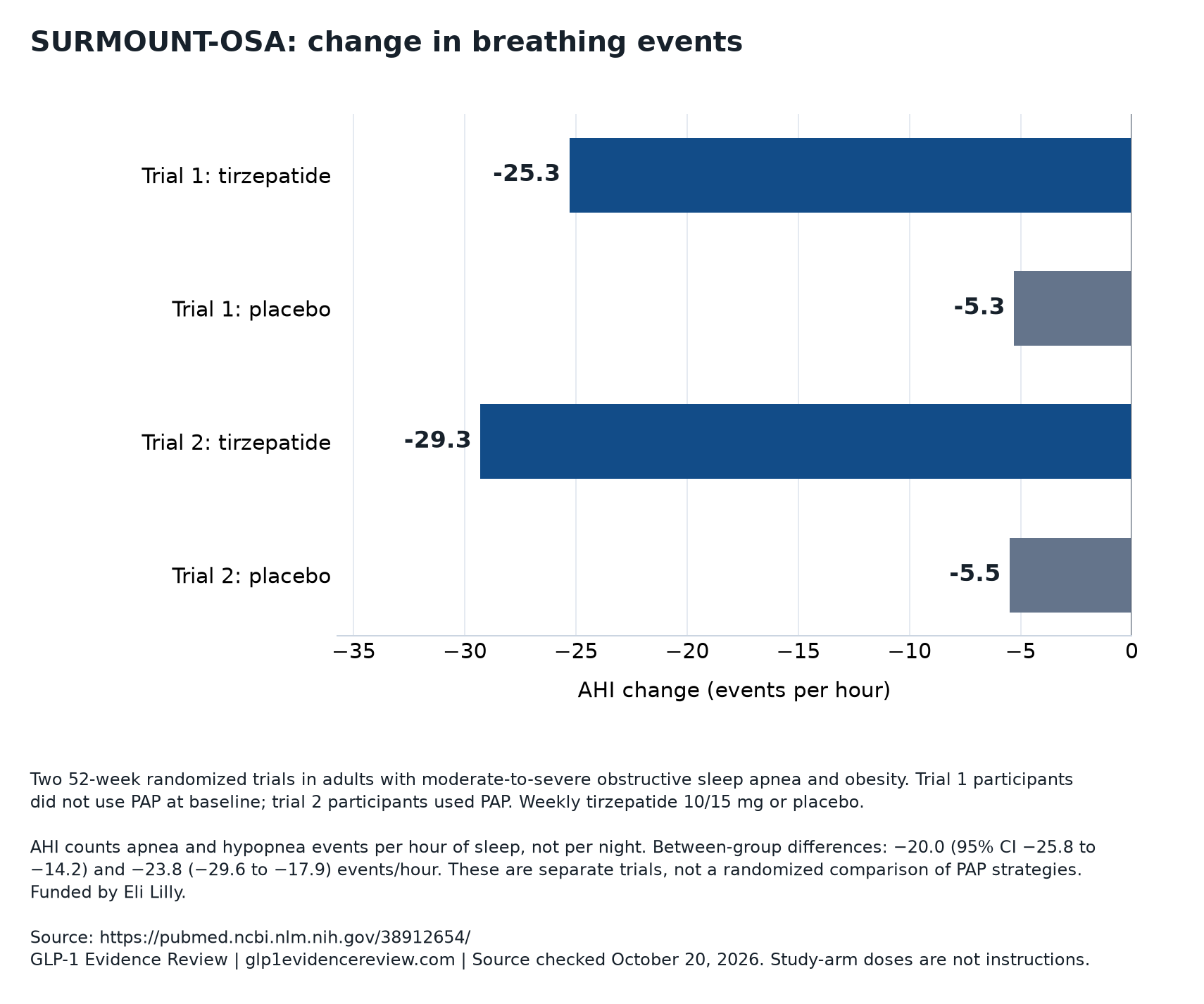
SURMOUNT-OSA: change in breathing events
Two 52-week randomized trials in adults with moderate-to-severe obstructive sleep apnea and obesity. Trial 1 participants did not use PAP at baseline; trial 2 participants used PAP. Weekly tirzepatide 10/15 mg or placebo.
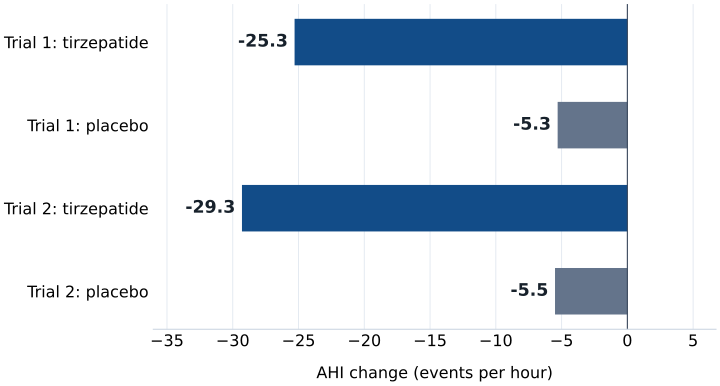
| Study group | AHI change (events per hour) |
|---|---|
| Trial 1: tirzepatide | -25.3 |
| Trial 1: placebo | -5.3 |
| Trial 2: tirzepatide | -29.3 |
| Trial 2: placebo | -5.5 |
AHI counts apnea and hypopnea events per hour of sleep, not per night. Between-group differences: −20.0 (95% CI −25.8 to −14.2) and −23.8 (−29.6 to −17.9) events/hour. These are separate trials, not a randomized comparison of PAP strategies. Funded by Eli Lilly.
Original visualization of published aggregate data. No individual prediction or provider performance is represented. Original research ↗
AHI measures hourly frequency, not the whole night’s burden
The primary endpoint was change from baseline in the apnea-hypopnea index, or AHI. It counts apneas and hypopneas—breathing interruptions and reductions—per hour of sleep. Baseline mean AHI was 51.5 events per hour in trial 1 and 49.5 in trial 2. These figures describe frequent disturbances at enrollment.
A reduction of 20 events per hour is not a reduction of 20 events across an entire night. As a purely illustrative calculation, a constant difference of 20 events per hour over six hours would correspond to 120 fewer counted events. The trials did not report that illustrative nightly number, and actual sleep duration and event frequency vary.
AHI also does not fully describe how long disturbances last, how much oxygen falls, or how a person feels during the day. That is why the study’s additional measures matter. A frequency endpoint offers a clear primary comparison, but a complete clinical interpretation needs more than one count.
The primary results: subtracting the placebo change
In trial 1, mean AHI fell by 25.3 events per hour with tirzepatide and 5.3 with placebo. Subtracting the placebo change gives an estimated treatment difference of −20.0 events per hour. Trial 2 showed reductions of 29.3 and 5.5, respectively, producing an estimated difference of −23.8 events per hour.
The placebo comparison is essential. Reporting only the tirzepatide group’s improvement would count all observed change as a medication effect, even though the placebo groups also improved. Randomized between-group comparisons are designed to separate the assigned treatment’s effect from changes that can occur without that assignment.
The confidence intervals below describe uncertainty around the estimated average treatment differences. Both lie entirely below zero, supporting a reduction relative to placebo. They are not ranges predicting each patient’s response, and their overlap does not establish a meaningful difference between the two trials.
| Measure | Trial 1: no PAP at baseline | Trial 2: PAP at baseline |
|---|---|---|
| Mean baseline AHI | 51.5 | 49.5 |
| Tirzepatide mean change (95% CI) | −25.3 (−29.3 to −21.2) | −29.3 (−33.2 to −25.4) |
| Placebo mean change (95% CI) | −5.3 (−9.4 to −1.1) | −5.5 (−9.9 to −1.2) |
| Estimated treatment difference (95% CI) | −20.0 (−25.8 to −14.2) | −23.8 (−29.6 to −17.9) |
Absolute change, relative change, and the estimand
An absolute AHI difference uses events per hour. A relative change expresses change as a proportion of a starting value. For illustration, dividing trial 1’s tirzepatide-group reduction of 25.3 by the overall trial baseline mean of 51.5 yields about 49%. That rough arithmetic is not the trial’s reported percent-change estimate: the overall baseline mean need not equal the treatment-arm baseline, and statistical methods can differ.
Similarly, the −20.0 events-per-hour placebo-adjusted effect is neither a 20% reduction nor a 20-percentage-point difference. Percentage points compare percentages; events per hour compare event frequencies. The primary result also is not a relative risk reduction for hospitalization, cardiovascular disease, or death.
The estimand is the exact treatment effect a study intends to estimate, including how it handles events such as stopping medication. The abstract identifies the endpoint, comparison, and time point but does not specify the full estimand or missing-data procedures. Thus, it cannot resolve whether the estimate answers an assignment-based question regardless of continued treatment or a more treatment-adherent question. Our evidence checklist explains why that distinction matters.
A large average improvement can leave substantial disease
A useful interpretation exercise is to subtract the tirzepatide-group mean reduction from the overall baseline mean. That gives approximately 26.2 events per hour in trial 1 and 20.2 in trial 2. These are rough illustrations, not reported end-of-study treatment-arm means: the calculation mixes an overall baseline average with an arm-specific change estimate.
Even with that limitation, the exercise explains why improvement and resolution are different claims. A large downward shift from a high starting frequency can leave repeated breathing disturbances. Conversely, some individuals may improve more than the mean and others less. The abstract does not provide the response distribution needed to describe those individual patterns.
The accessible report also does not detail how PAP was handled around follow-up sleep testing. Baseline PAP status alone cannot answer that methodological question. Reassessment of residual disease therefore remains a diagnostic issue rather than an inference from weight loss, symptoms, or the trial average. The distinction is explored in our clinical follow-up guide; these findings are not a recommendation to stop PAP.
Secondary endpoints broaden the finding without proving a mechanism
Prespecified key secondary endpoints included percent changes in AHI and body weight, hypoxic burden, patient-reported sleep impairment and disturbance, high-sensitivity C-reactive protein, and systolic blood pressure. Hypoxic burden addresses oxygen deprivation rather than simply counting breathing events. High-sensitivity C-reactive protein is a blood marker of inflammation.
The abstract reports significant improvements versus placebo for all these key secondary endpoints, with multiplicity control. That means the analysis accounted for making multiple statistical comparisons, reducing the chance of declaring a positive result merely because many outcomes were tested. Nevertheless, the accessible abstract does not supply their numerical effect sizes or confidence intervals, so their magnitude cannot be reconstructed here.
Improvement across objective measures and patient reports makes the primary AHI finding more clinically informative. It does not establish how much benefit was caused specifically by weight loss versus other pathways. Nor does lower blood pressure, inflammation, or hypoxic burden prove fewer future heart attacks or deaths. Those are distinct outcomes requiring their own evidence.
Safety and durability remain separate evidence questions
The primary report identifies gastrointestinal adverse events as the most frequent with tirzepatide and describes most as mild to moderate. That is a real tolerability finding, not a declaration that treatment is harmless. The abstract does not give a complete adverse-event table, numerical discontinuation rates, or enough detail to quantify uncommon harms in these trials.
The 52-week follow-up supports conclusions at approximately one year. It does not establish how apnea severity changes after medication withdrawal, how durable improvement is over several years, or what happens after substantial weight regain. These questions cannot be answered by extending the observed year-one slope forward.
NIDDK notes that weight-management medication duration depends on benefit and tolerability and that regain can occur after stopping. That general guidance is not a measured SURMOUNT-OSA withdrawal result. The SURMOUNT-4 analysis addresses a different randomized-withdrawal question; it should not be treated as direct proof of sleep apnea outcomes after tirzepatide discontinuation.
SUMMIT cannot supply missing cardiovascular outcomes for OSA
SUMMIT studied a different population: 731 people with obesity and heart failure with preserved ejection fraction, defined for enrollment by an ejection fraction of at least 50%. Its median follow-up was 104 weeks. Unlike SURMOUNT-OSA’s primary AHI endpoint, SUMMIT included a time-to-first-event composite of cardiovascular death or worsening heart failure.
That composite occurred in 9.9% of tirzepatide participants and 15.3% of placebo participants, an observed difference of 5.4 percentage points. The hazard ratio was 0.62, with a 95% confidence interval of 0.41 to 0.95. A hazard ratio compares event occurrence over follow-up; it is not interchangeable with the ratio of the two reported percentages.
Importantly, cardiovascular deaths were 2.2% versus 1.4%, with a hazard ratio of 1.58 and a wide confidence interval of 0.52 to 4.83. Thus, the lower composite does not mean every component improved. Mainly gastrointestinal adverse events caused treatment discontinuation in 6.3% versus 1.4%. These are SUMMIT findings, not SURMOUNT-OSA safety rates or proof of cardiovascular protection from treating apnea.
| Evidence feature | SURMOUNT-OSA | SUMMIT |
|---|---|---|
| Population | Obesity and moderate-to-severe OSA; 469 participants across two trials | Obesity and heart failure with preserved ejection fraction; 731 participants |
| Main comparison | Tirzepatide versus placebo within each PAP-defined trial | Tirzepatide versus placebo |
| Primary outcome focus | AHI change at 52 weeks | Cardiovascular death/worsening heart failure composite and health-status score |
| Follow-up context | 52 weeks | Median 104 weeks; health-status change assessed at 52 weeks |
| Cannot establish | Reduced cardiovascular mortality | Sleep apnea resolution or permission to stop PAP |
Translating evidence into product and care questions
Transferability begins with the studied population. These results directly concern adults with obesity and moderate-to-severe obstructive sleep apnea without type 2 diabetes. The accessible evidence does not establish the same effect in children, people without obesity, those with diabetes, or people with milder disease. It also does not establish equivalence for other medicines, oral routes, or compounded formulations.
FDA states that compounded drugs are not approved or reviewed before marketing for safety, effectiveness, or quality. Its concerns include dosing errors and certain semaglutide salt ingredients; those reports do not provide controlled event rates for tirzepatide. The relevant distinction is explained in our approved-versus-compounded guide. Ingredient-name similarity is not enough to carry a clinical result from one product to another.
Editorial interpretation: a year-long trial makes ongoing assessment and access relevant practical questions, but it says nothing about a particular company’s service performance or contract. NIDDK notes that coverage varies. Readers comparing documentation can consult the Ro review or Mochi Health review to examine published terms—not to infer availability of the studied product, condition-specific care, or trial-like outcomes.
Questions & answers
Does a 20-event reduction mean 20 fewer interruptions each night?
No. The trial 1 placebo-adjusted difference was 20 events per hour of sleep. A nightly count depends on sleep duration and event frequency during that night. It also represents an average between-group effect, not a guaranteed reduction for an individual.
Did the trials show that tirzepatide works better than PAP?
No. Tirzepatide was compared with placebo, not randomized against PAP. Baseline PAP use determined which trial participants entered. The design therefore answers medication-versus-placebo questions in two PAP settings, not a direct comparison of medication with PAP.
Can someone stop PAP once weight or symptoms improve?
The trial results do not authorize that change. Average AHI improvement does not establish that an individual’s breathing disturbances have resolved. Decisions about PAP require the treating clinician and appropriate reassessment of sleep apnea, rather than relying on weight change or subjective improvement alone.
Why not report a cure rate from the large mean AHI decline?
A mean change does not show how many people crossed a diagnostic threshold. Different response distributions can produce the same average. The indexed abstract does not provide the individual-level distribution or numerical resolution results needed to calculate such a rate, so deriving one would overstate the accessible evidence.
Do these results apply to compounded tirzepatide?
They do not establish equivalence. The trials tested a particular injected tirzepatide intervention, not every preparation sharing its ingredient name. FDA does not review compounded drugs before marketing for safety, effectiveness, or quality. Product-specific evidence and regulatory status remain separate from the sleep trial’s efficacy findings.
Our assessment
SURMOUNT-OSA provides strong randomized evidence that tirzepatide reduced average AHI more than placebo over 52 weeks in adults with obesity and moderate-to-severe obstructive sleep apnea, in both baseline PAP settings. Improvements in oxygen-related burden and patient-reported sleep measures strengthen the interpretation beyond event counting alone. The principal boundaries are equally specific: the accessible abstract does not fully resolve the estimand, PAP testing procedures, individual response distribution, detailed harms, or post-treatment durability. The most defensible reading is substantial average improvement with a continuing need to determine residual disease—not universal resolution, cardiovascular-outcome proof, or permission to stop PAP.
Sources & documentation
Scientific and official sources consulted October 20, 2026. Study findings apply to the populations, products and time periods described; they are not provider outcome data.
- Tirzepatide for the Treatment of Obstructive Sleep Apnea and Obesity. ↗
- FDA approval of Zepbound for obstructive sleep apnea, December 20, 2024 ↗
- NIDDK prescription medications for overweight and obesity ↗
- Tirzepatide for Heart Failure with Preserved Ejection Fraction and Obesity. ↗
- FDA concerns about unapproved GLP-1 drugs ↗